
Conversation capture and transcription
Capture sales conversations with no-bot recording options, plus 99-language transcription and support for meetings, calls, in-person conversations, email, web conferencing, VoIP, and mobile app recording.

Claap records sales calls and meetings, transcribes them, and turns conversation data into CRM updates, follow-up content, and coaching inputs.
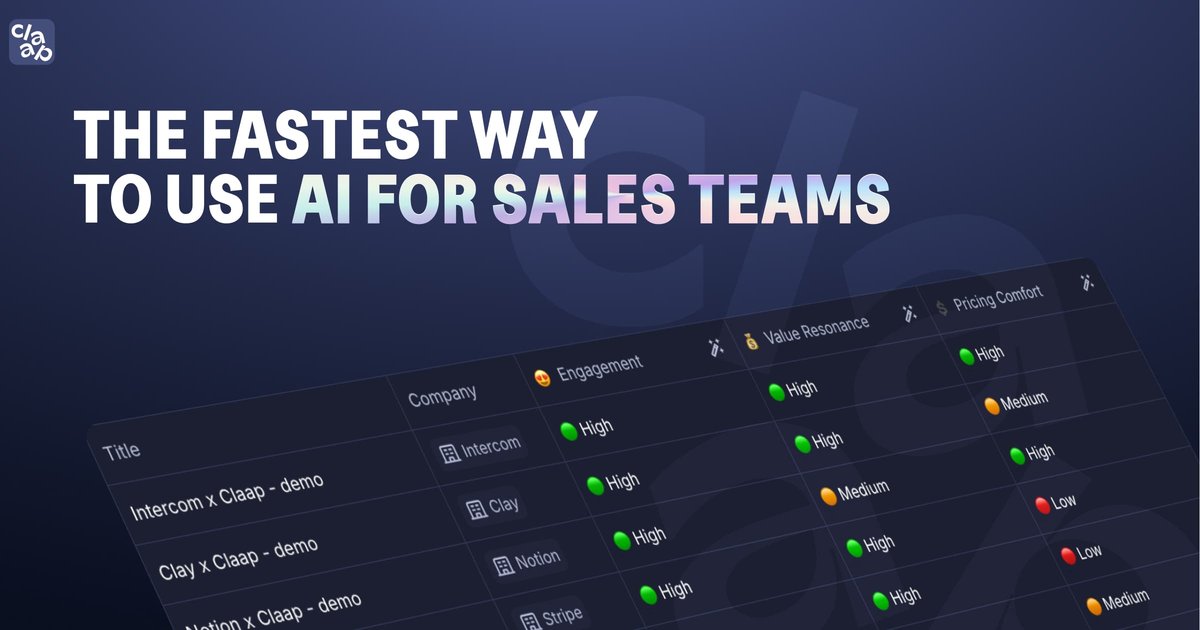
Claap is a sales conversation platform that records calls and meetings, transcribes them, and turns the resulting data into structured CRM updates, follow-up content, and coaching inputs. The product is positioned around helping teams use conversation data directly in workflows, rather than leaving it locked inside transcripts or dashboards.
The site describes a workflow that starts with recording conversations across channels such as online meetings, phone calls, in-person discussions, email, web conferencing, VoIP, and mobile app use. From there, Claap adds summaries, deal signals, and AI agent outputs so sales teams can enrich CRM records, review performance, and connect meeting data to other automation tools.
Capture sales conversations with no-bot recording options, plus 99-language transcription and support for meetings, calls, in-person conversations, email, web conferencing, VoIP, and mobile app recording.
Generate structured notes, meeting recaps, speaker insights, and AI summaries from recorded conversations, with templates and translation support shown on the pricing page.
Push structured conversation data into CRM records, including custom fields, so notes, next steps, objections, and deal context can be kept in sync with tools such as HubSpot, Salesforce, Attio, and Pipedrive.
Use Claap’s built-in agents for deal scoring, coaching, follow-up drafting, risk surfacing, and asking questions across meetings, with MCP support for external AI workflows.
Work with team collaboration tools such as comments, mentions, collaborative notes, private channels, advanced collaboration, and workspace dashboards for sharing conversation context internally.
Connect Claap to external systems through API, MCP, Zapier, Make, n8n, webhooks, and supported integrations listed on the pricing page.
Record sales calls and meetings, then use the resulting summary and structured notes to keep CRM fields, next steps, and objections current after the conversation ends.
Review call scoring, coaching feedback, and speaker insights to identify where reps are handling objections well or missing buying signals.
Use the captured conversation data through MCP or API-driven workflows to feed external AI tools, outbound systems, or internal automations with real meeting context.
Share recordings, comments, and annotated moments with teammates so product, operations, or leadership can review specific sections of a call without rewatching the full conversation.
Mix Basic, Pro, and Business licenses in one workspace to give different levels of access and functionality to contributors, reps, and revenue teams.
Claap records sales conversations and turns them into structured notes, CRM updates, follow-up drafts, and coaching inputs. Its pricing page also indicates a free Basic tier, paid Pro and Business plans, and an Enterprise option with sales contact for setup.
The source shows Claap working across online meetings, calls, in-person conversations, email, and VoIP, with support for Zoom, Teams, Google Meet, calendar sync, and recorder options such as Chrome and Mac desktop apps depending on plan.
Yes. Claap’s pricing page says teams can mix Basic, Pro, and Business licenses within one workspace, and it supports different license types for different users.
The source says Claap connects structured conversation data to CRM systems such as HubSpot, Salesforce, Attio, and Pipedrive, and also supports APIs, MCP, Zapier, Make, n8n, and webhooks on the pricing page.
The pricing page shows a free Basic plan with recording limits, paid Pro and Business plans, and an Enterprise tier with security and support options. Sales can also be contacted to unlock a free trial of paid plans.