
Specialized research focus
Anthropic positions Mythos 5 as its most capable model for cybersecurity and biology research, with benchmark gains in cybersecurity, biology, and healthcare.

Claude Mythos 5 is Anthropic’s trusted-access model for cybersecurity and biology research, with state-of-the-art performance in healthcare.
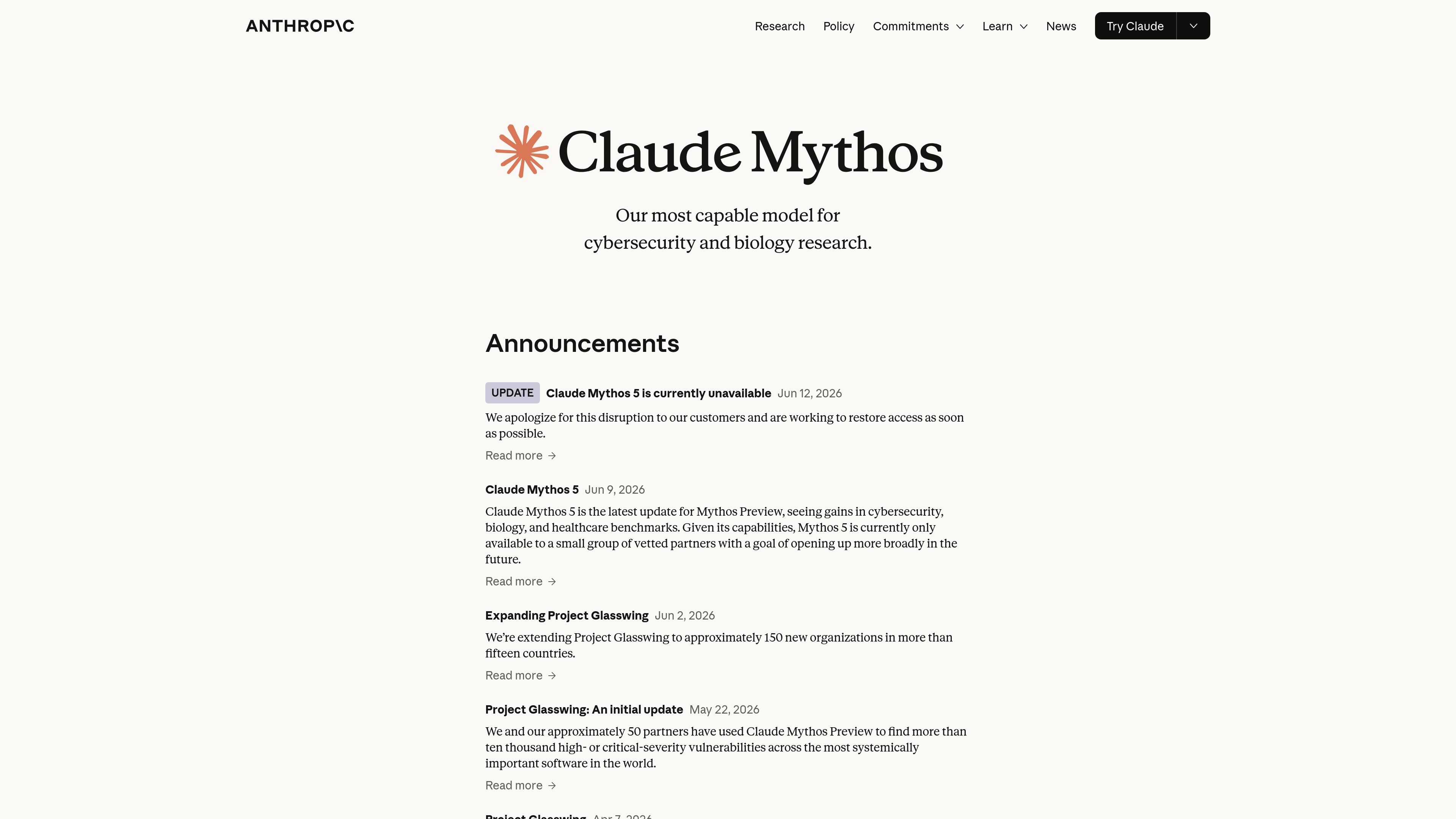
Claude Mythos 5 is Anthropic's model for cybersecurity and biology research. The product page describes it as the company’s most capable model in those domains and says it reaches state-of-the-art performance on cybersecurity, biology research, and healthcare benchmarks.
Unlike Anthropic's general-use Claude models, Mythos 5 is positioned as a trusted-access release for a small group of vetted partners. Anthropic says it is using the model in Project Glasswing and plans to expand access more broadly over time, while maintaining additional safeguards and a 30-day data retention policy for safety monitoring.
Anthropic positions Mythos 5 as its most capable model for cybersecurity and biology research, with benchmark gains in cybersecurity, biology, and healthcare.
The model is described as the same underlying model as Fable 5, but with safeguards lifted in some areas for vetted dual-use work.
Access is limited to a small, growing set of customers through trusted access programs, and the page says deployment began with Project Glasswing partners.
The product page states that Mythos 5 requires a 30-day data retention policy for safety monitoring.
The pricing page shows Claude access across web, iOS, Android, and desktop, with higher-tier plans adding research, connectors, and other workspace capabilities.
Use Mythos 5 for dual-use cybersecurity research where a model needs strong capability but access is being controlled through a trusted program.
Use it for biology and healthcare research tasks that benefit from a model Anthropic describes as state of the art in those domains.
Use it in coordinated partner programs such as Project Glasswing, where Anthropic says it is being deployed first.
Claude Mythos 5 is a model for cybersecurity and biology research. The source says it is currently only available to a small group of vetted partners through trusted access programs, with broader access planned in the future.
The pricing page says Claude Mythos 5 starts at $10 per million input tokens and $50 per million output tokens. The product page also notes that access is currently unavailable for Glasswing partners and that availability may change.
The source describes Mythos 5 as strong in cybersecurity, biology research, and healthcare benchmarks, and says it has safeguards because the same capabilities can be misused in risky domains.
Yes. The pricing page lists chat on web, iOS, Android, and desktop for Claude plans, while the product page frames Mythos 5 as part of Anthropic's trusted-access workflow rather than a broadly self-serve release.
Los datos de tráfico son solo como referencia.
| abr | 25877915 |
|---|---|
| may | 22435724 |
| jun | 40498248 |