
Tracing and trace setup
Capture application traces to see what happened inside each request. The docs describe manual or auto-instrumentation and tracing setup with 30+ providers and frameworks.

Arize AX is an AI engineering platform for tracing, evaluating, and improving AI agents and AI apps with observability, experimentation, and AI-assisted debugging.
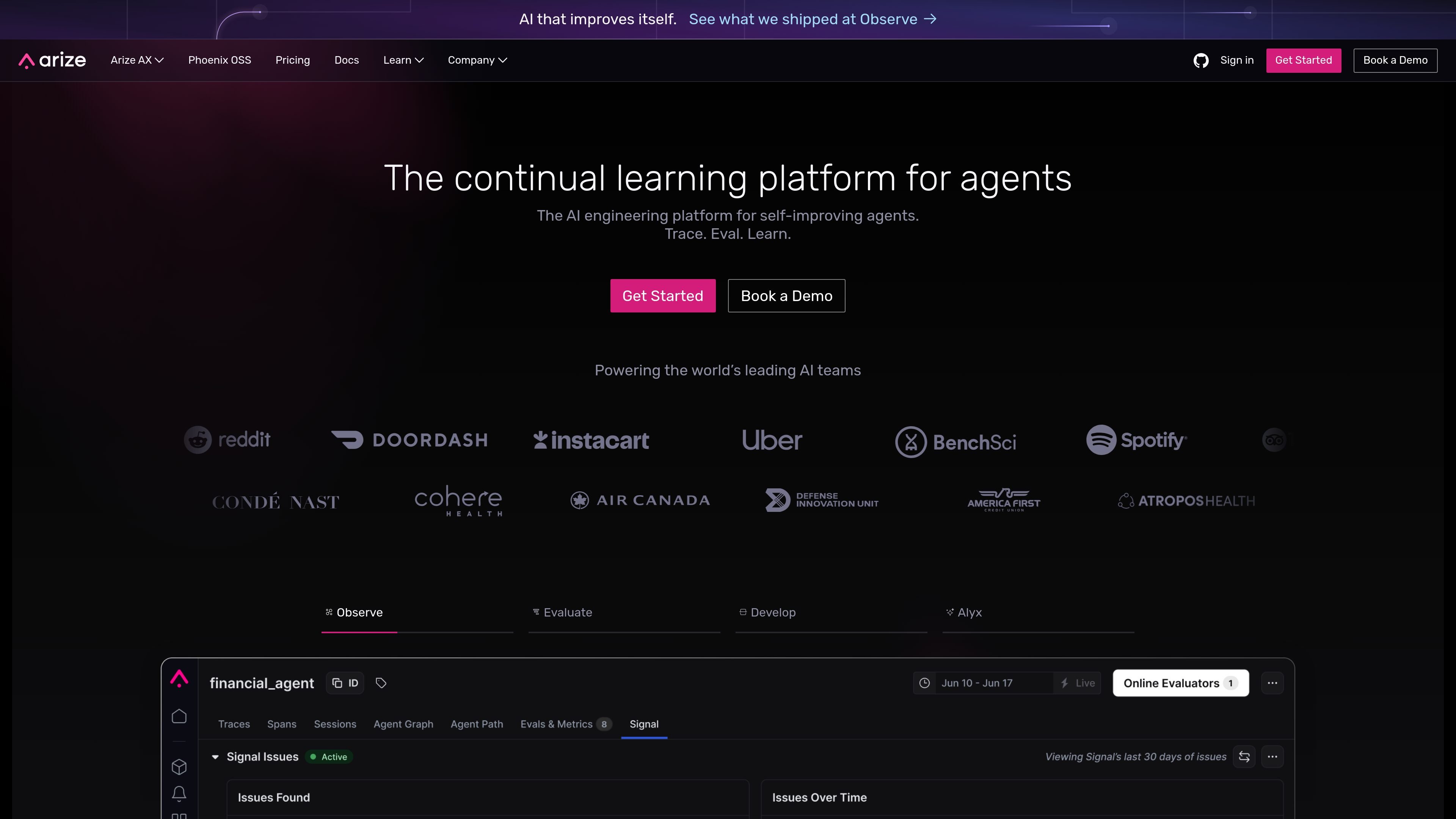
Arize AX is an AI engineering platform for observing, evaluating, and improving AI agents and AI applications. The homepage describes it as a continual learning platform that helps teams trace what their systems did, measure quality with evaluations, and iterate on prompts, models, and workflows before and after production.
The product sits alongside Phoenix, Arize’s open-source observability and evaluation tool. AX builds on open standards such as OpenInference and OpenTelemetry, and the site positions it for AI engineers and product teams that need tracing, experimentation, dashboards, and AI-assisted debugging in one platform.
Capture application traces to see what happened inside each request. The docs describe manual or auto-instrumentation and tracing setup with 30+ providers and frameworks.
Find problematic traces using queries, filters, and AI Search, then inspect span, trace, and session data for debugging and investigation.
Create evaluators, run offline and online evaluations, and use human review, labeling queues, and dashboards to monitor quality over time.
Curate datasets, store experiment runs, compare prompts and models, and gate deployment with CI/CD based on experiment performance.
Use Alyx to debug traces, run evals, compare experiments, suggest prompt edits, and generate dashboards from natural-language requests.
Support OpenInference and OpenTelemetry-based instrumentation across a broad integration surface, including LLM providers, agent frameworks, coding agents, and orchestration tools.
Instrument an AI application, capture traces, and inspect spans to understand what happened inside each request when debugging failures or slow paths.
Run evaluators against traces, spans, or sessions to measure quality continuously and track whether changes are improving or degrading performance.
Compare prompts, models, or experiment runs on curated datasets before releasing changes to production and use CI/CD gates where needed.
Use human annotation, feedback tracking, and aligned evaluators to calibrate automated scores against real judgments and identify failure patterns.
Adopt open-standard tracing across frameworks and providers so teams can connect their existing stack without switching to a proprietary format.
You connect an agent or application to Arize and send your first trace. The platform uses traces to show what happened inside each request, and the docs note that you can start setting up traces and then use Alyx for help.
Yes. The docs say Arize integrates with 40+ models, frameworks, and AI tools, including OpenAI, Anthropic, Google, Amazon Bedrock, LangGraph, LangChain, LlamaIndex, CrewAI, OpenAI Agents SDK, and DSPy.
Arize supports flexible deployment options and the pricing page lists SaaS and self-hosted options for enterprise. The FAQ and pricing page also point to deployment across Google Cloud, AWS, Azure, and self-hosted environments.
Yes. The site says Arize is built for modern AI applications including chatbots, RAG systems, copilots, and agents, with workflows for tracing, evaluation, monitoring, and iteration.
Phoenix is the open-source product for tracing, evaluation, experimentation, and prompt iteration, and the site says it can run locally or self-hosted. Arize AX is the managed enterprise platform on the same open standards, with managed infrastructure and additional workflows.