
Parse into structured output
Convert documents into structured data with layout-aware parsing that preserves text, tables, figures, and hierarchy for downstream automation.

LandingAI provides agentic APIs for document extraction and processing, turning complex files into structured, auditable data for compliance review, loan processing, plan review, search, and analytics.
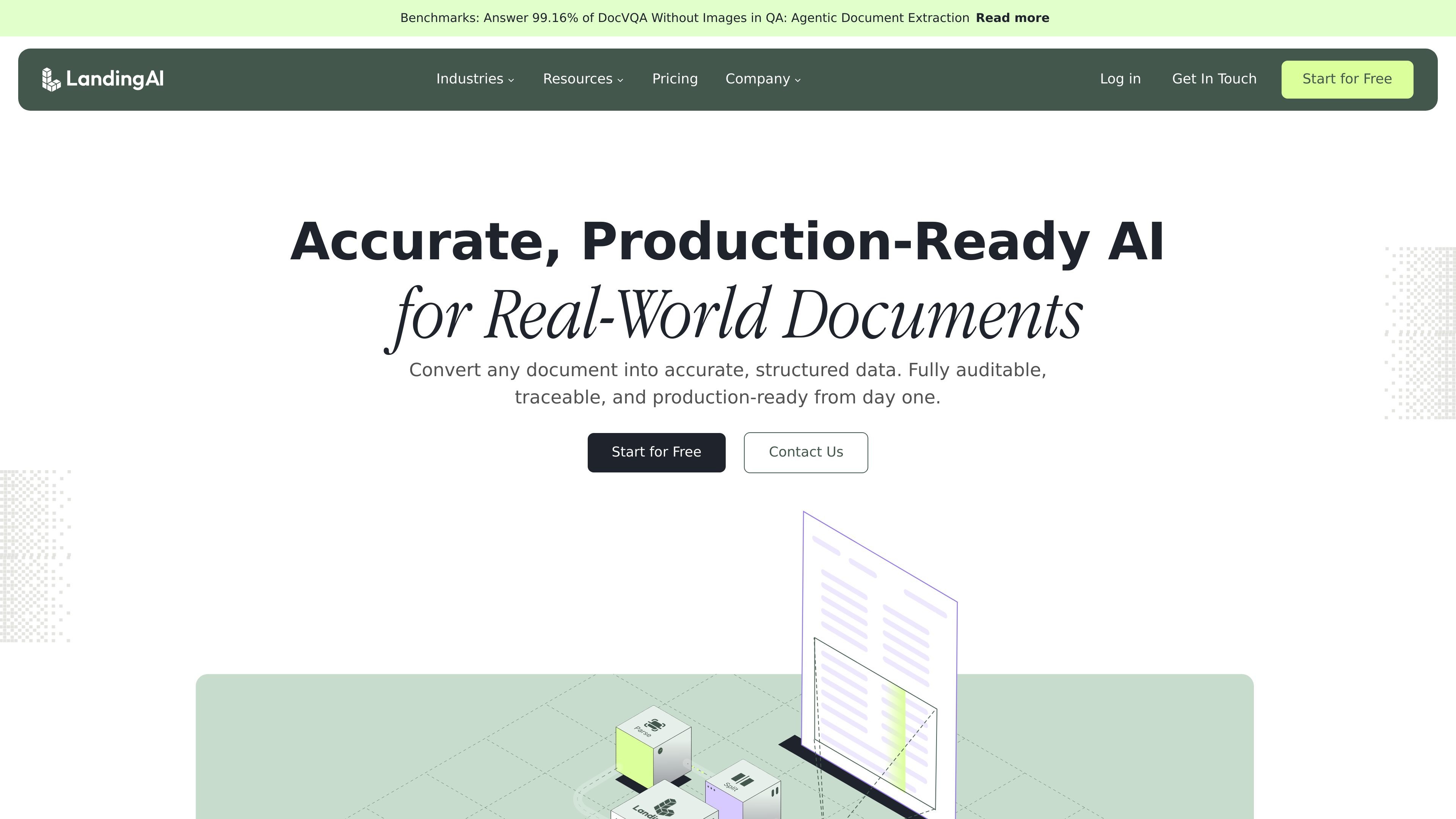
LandingAI provides Agentic APIs for intelligent document processing, centered on Agentic Document Extraction. The platform is built to turn variable documents into structured data that developers can use in automation pipelines, search, analytics, and AI workflows.
Its core emphasis is accuracy with provenance: outputs include traceable citations, page references, and confidence scores so teams can review extracted data, route exceptions, and use the results in regulated or high-volume document operations.
Convert documents into structured data with layout-aware parsing that preserves text, tables, figures, and hierarchy for downstream automation.
Split long or mixed PDF files into classified sub-documents using document classification and instance detection.
Extract fields from user-defined schemas, including nested objects, arrays, and large multi-table documents.
Attach page numbers, coordinates, and bounding-box citations so extracted values can be audited against the source.
Surface confidence scores to flag outputs that may need human review before they move into downstream workflows.
Support modular REST APIs plus Python or TypeScript libraries for document automation pipelines.
Automate client due diligence and KYC document review by extracting ownership, entity, and regulatory data from long, multi-lingual corporate files.
Speed up plan review by extracting information from building plans, code-related documents, and other multi-page files that require traceable outputs.
Process loan files faster by turning borrower documents into structured data for underwriting and downstream review.
Build retrieval and analytics pipelines from document archives by converting unstructured files into queryable, structured datasets.
Support compliance checks, reporting, and approval workflows where extracted values need to be auditable and easy to validate.
LandingAI’s pricing page describes Explore, Team, and Enterprise plans. Explore is pay-as-you-go, Team is a monthly plan with shared usage, and Enterprise adds custom infrastructure and support options.
The pricing page says credits are the usage unit. They are consumed when you process a document, and the amount depends on the number of pages in the document.
The pricing page lists modular APIs for parsing, splitting, and extracting structured data, and case studies show the platform used for KYC, plan review, and loan processing workflows.
The source material does not provide a full setup guide, but it does say the platform can be used through modular REST APIs and Python or TypeScript libraries, with deployment options that include cloud, VPC, and on-premises for Enterprise.
The source material supports enterprise security controls such as SOC 2 Type II, GDPR and HIPAA compliance by design, zero data retention options, and HIPAA/BAA availability on supported plans.