
Integrated knowledge system
Curiosity combines graph, search, and AI in one system so teams can work from connected context rather than separate tools.

Curiosity is an industrial AI platform that connects enterprise data into a knowledge layer for search, analysis, and AI workflows. Deploy in cloud, private cloud, or on-premises.
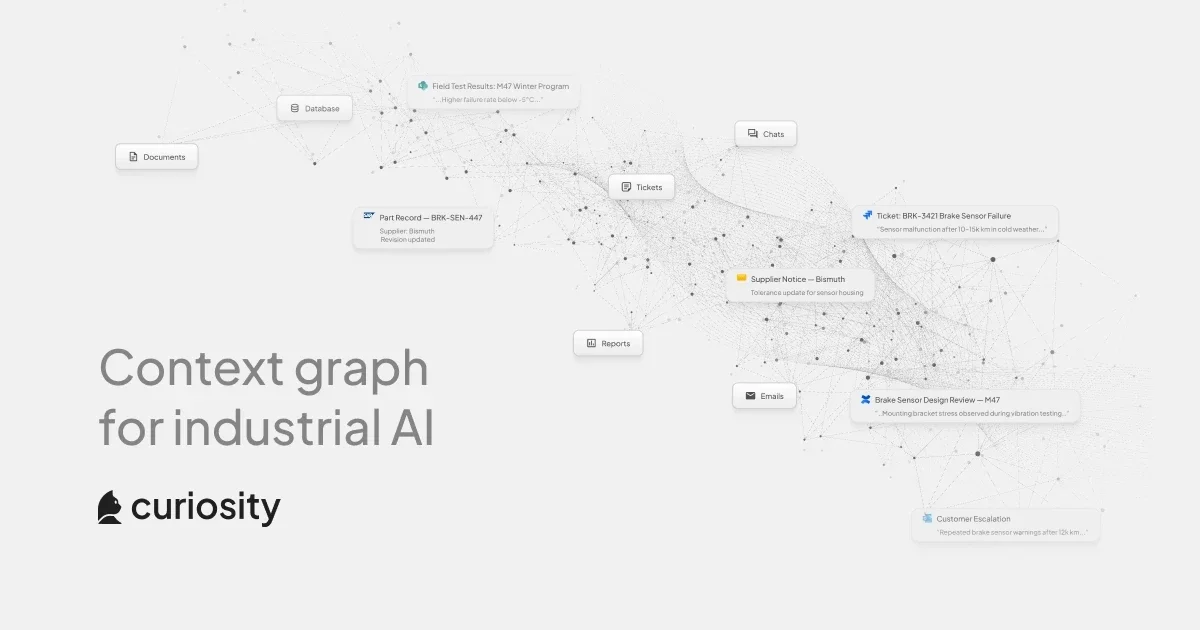
Curiosity is a context graph for industrial AI. It connects enterprise data into an AI-powered knowledge layer so teams can find, reuse, and trust answers across complex systems.
The product is designed for environments where information is spread across files, applications, and systems. Its core idea is to turn fragmented data into connected knowledge that can support search, analysis, and AI workflows in production.
Curiosity positions itself as an enterprise platform rather than a standalone chat tool. The site describes graph, search, and AI as a combined system that runs in the customer’s environment and can be deployed in cloud, private cloud, or on-premises setups depending on the plan.
Pricing and product pages show three workspace paths: a free Developer workspace for testing, a managed Cloud Workspace, and a custom Enterprise Workspace. That makes the platform suitable for pilots, operational teams, and larger deployments with security or deployment requirements.
Curiosity combines graph, search, and AI in one system so teams can work from connected context rather than separate tools.
The product connects data from files, applications, and other systems without replacing existing tools, then structures that information for search and analysis.
Search capabilities include typo-tolerant search, advanced search syntax, integrated filters, semantic search, and saved searches.
Curiosity supports a company knowledge graph, custom entities, and custom data types so teams can model domain-specific relationships and terms.
Teams can build AI assistants, private AI chat, custom workflows, prompt libraries, and AI answers over files and folders.
The platform exposes integration, data, and model APIs, and includes custom integrations and business-logic options for enterprise use.
Create a shared knowledge layer so employees can search across connected systems instead of hunting through separate tools and folders.
Use full system context to help support teams navigate large document sets, related records, and technical information when handling complex cases.
Model relationships in engineering, manufacturing, or quality data so teams can trace context across designs, decisions, and issues.
Build AI assistants and custom workflows on top of company data for tasks such as internal writing, information retrieval, and process automation.
Deploy a controlled workspace in cloud, private cloud, or on-premises environments when deployment location and access control are important.
Curiosity is presented as a workspace-based product. The pricing page offers a free Developer workspace for testing, a managed Cloud Workspace, and an Enterprise Workspace with custom deployment and support. The source does not provide a step-by-step setup timeline.
The site says Curiosity runs in your environment, with data encryption in transit and at rest, permissions management, audit logs, and a security-focused approach built for data sovereignty. The pricing page also notes private cloud and on-premises options.
Yes. The pricing page includes an Enterprise Workspace with private cloud or on-premises hosting, and the product page says Curiosity runs in your environment.
Yes. The integrations page lists API integrations for custom data, and the pricing page mentions custom integrations plus support for custom data sources and workflows in enterprise deployments.
The pricing page shows three workspace options: Developer, Cloud Workspace, and Enterprise Workspace. Cloud Workspace is listed at €500 per workspace per month, while Developer is free for test workspaces and Enterprise is custom pricing.