
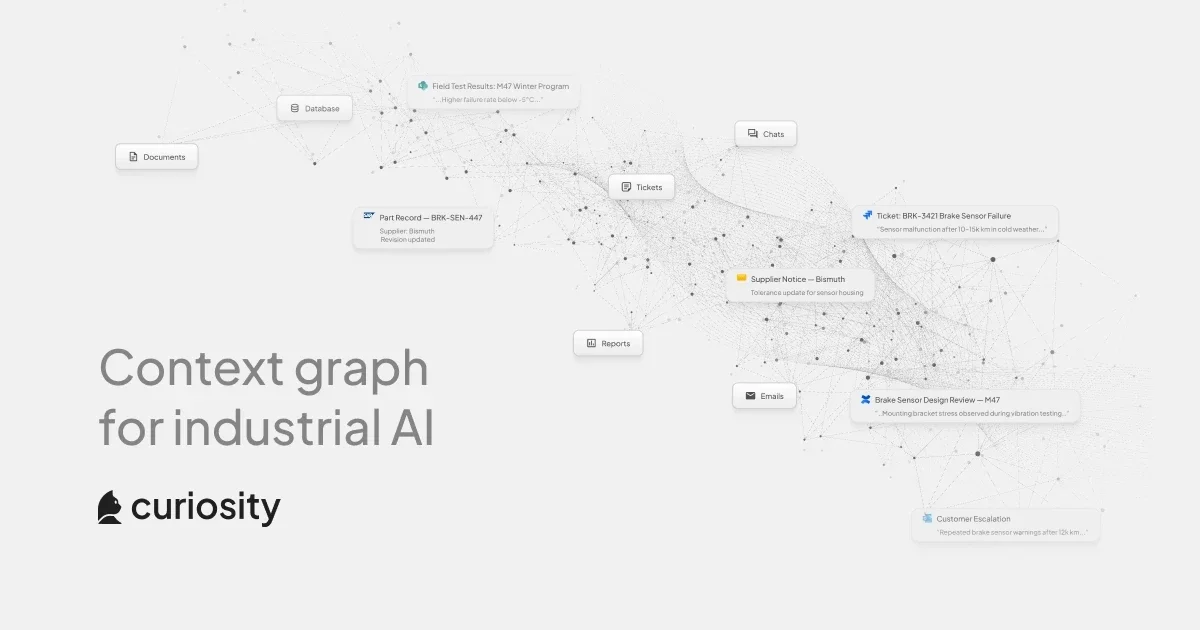
Connected search and answers
Search connected information and ask questions with links back to source records. The platform combines a graph with search and AI; semantic search is listed as an Enterprise feature.
Search connected company data, build internal apps in Studio, and choose how your AI workflows are hosted.
Curiosity connects business records and files into a knowledge graph for search, AI answers, and internal applications. Its Studio interface can turn a written description into a tool that works with connected company data.
Connectors copy the records and files you map into Studio and synchronize them with their source systems. Those systems remain the authoritative records. Teams can choose their deployment and model providers, including local models, rather than treating every workflow as a public chatbot.
Search connected information and ask questions with links back to source records. The platform combines a graph with search and AI; semantic search is listed as an Enterprise feature.
Describe an internal application in Studio, then work with it on the same graph as search and agents. Enterprise options include APIs, custom data types, and business logic.
Connectors synchronize access permissions, which Studio checks at query time down to individual records. Custom integrations need to use the appropriate user-scoped queries to preserve this access boundary.
Use an on-premises, private-cloud, or hosted deployment and select hosted or local models. An air-gapped configuration requires local models, an offline license, and disabled usage reporting.
Find related records across existing business systems and trace an answer back to the information that supports it.
Build a focused application for a repeated question or process, using connected data instead of manually combining exports.
Give teams AI-assisted access to internal information while selecting the deployment, providers, and permissions appropriate to that data.
The Developer version supports up to ten test users with no time limit for development. Its terms restrict it to testing and evaluation and prohibit production use. Enterprise Studio starts from fifty users and uses a custom quote and separate Enterprise terms.
The source remains the system of record, but mapped records and files are copied into Studio and synchronized by connectors. Hosting and storage therefore depend on your chosen deployment.
Hosted AI providers receive the chats and referenced content sent to them. On-premises installations also send usage data, including user names and email addresses, to Mixpanel and error reports to Curiosity until disabled. Local models and an appropriately configured offline deployment can avoid those transfers.
The vendor describes a developer installation as taking minutes, while a connected pilot usually takes weeks for connectors and permission synchronization. Enterprise timing depends on the custom work required.
Traffic data is for reference only.
neo4j.com
Neo4j Graph Intelligence Platform connects data as a graph so teams can query relationships, analyze connected data, and build knowledge layers for AI systems. It supports fully managed cloud services and self-managed deployments.

memgraph.com
Memgraph is an in-memory graph database for GraphRAG, AI memory, agentic AI, and real-time graph analytics. It uses Cypher and provides tools for querying, visualization, algorithms, and streaming data workflows.
www.stardog.com
Stardog is an enterprise knowledge graph-powered semantic AI platform that unifies distributed data and adds ontology-based context for analytics, AI applications, and connected decision-making. It is available for on-premises and cloud enterprise deployments, with a free commercial license for exploration.