
Unified telemetry
Observability combines metrics, traces, logs, and user experience data so teams can investigate issues from multiple angles in one place.

SolarWinds is a hybrid IT observability and management platform for monitoring infrastructure, database performance, service desk operations, and incident response.
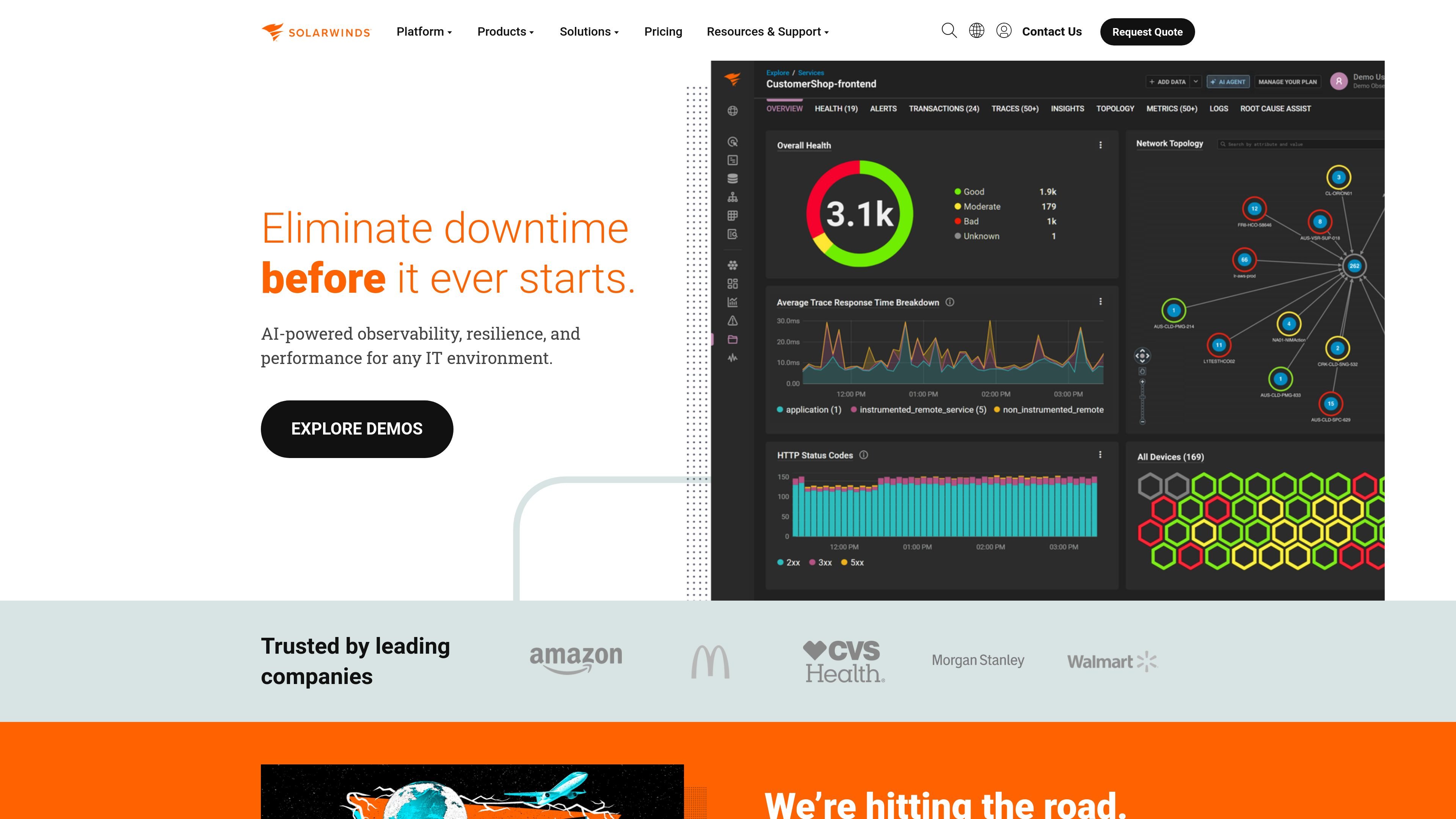
SolarWinds is a hybrid IT software platform that spans observability, database observability, incident response, and IT service management. The site positions it around helping teams reduce downtime, improve visibility, and resolve issues faster across on-premises, cloud, and hybrid environments.
The observability product line focuses on full-stack monitoring with metrics, traces, logs, and user experience data. The database products focus on monitoring, diagnosing, and optimizing performance, while ITSM centers on service desk workflows, assets, CMDB, and AI-driven automation. Pricing is available for each main product area, with trial options shown for several offerings.
Observability combines metrics, traces, logs, and user experience data so teams can investigate issues from multiple angles in one place.
The platform supports SaaS, self-hosted, and hybrid deployment models, letting teams choose where observability runs.
AI/ML-powered anomaly detection and insights are designed to filter noise and surface issues faster in hybrid IT environments.
ITSM brings incident management, service catalog, knowledge, change, and service level management into a single service management workflow.
ITSM includes asset management and CMDB features for managing assets, mapping dependencies, and visualizing relationships between configuration items.
The database products emphasize deep diagnostics, optimization, real-time query tuning, proactive alerts, and support for multiple database platforms.
Use the observability platform to watch hybrid IT estates from one view, combining metrics, traces, logs, and user experience when investigating performance issues.
Use the database products to diagnose query slowness, tune performance, and manage database health across supported environments such as SQL Server, PostgreSQL, Oracle, MySQL, and cloud platforms.
Use ITSM to consolidate incident intake, service requests, knowledge, change, and asset records into a single service desk workflow for support teams.
Use the CMDB and asset tools to map dependencies, manage configuration items, and keep hardware and software records connected to service operations.
Use AI-assisted insights and automation to reduce manual triage, route work, and move from reactive troubleshooting toward faster remediation.
SolarWinds Observability is offered as SaaS and self-hosted options, including deployment in the cloud, in a data center, or as a hybrid setup. The pricing page describes a fully functional 30-day trial for the observability product.
The observability platform is designed for hybrid IT environments and focuses on visibility across apps, microservices, containers, logs, metrics, traces, and user experience. The source material does not list every integration by name, but it does note an open framework, public API, and out-of-the-box third-party integrations.
SolarWinds ITSM brings together service management, asset management, CMDB, reporting, AI-driven automation, and enterprise service management capabilities. The source also describes Service Desk as supporting unlimited users with pricing per technician.
The database product page and pricing page describe database observability and performance monitoring for environments including Windows, Linux, Azure, AWS, MySQL, Oracle, PostgreSQL, and SQL Server. The source highlights deep diagnostics, query tuning, alerts, and optimization.
The pricing page shows starting prices for multiple product lines, including Monitoring & Observability, Database, IT Service Management, and Incident Response. It also indicates trials for several products and a contact-sales flow for Incident Response.