
Project and workflow management
Create projects for labeling and annotation, then manage them through the data manager, project settings, and labeling guide in the documentation.

Label Studio is an open source data labeling and AI evaluation platform for annotation, human-in-the-loop review, and model evaluation workflows.
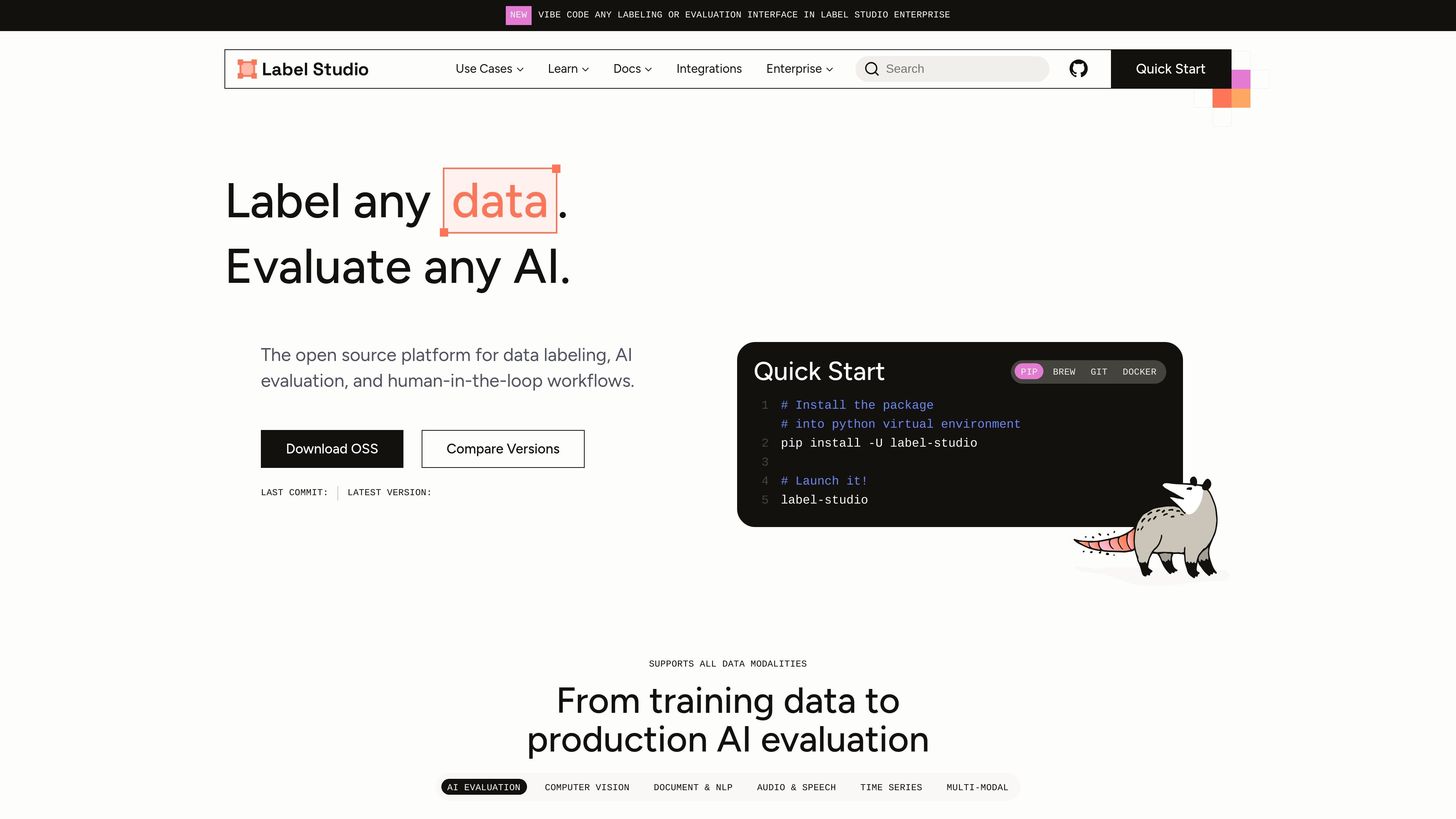
Label Studio is an open source data labeling and AI evaluation platform for building annotation workflows across many data types. The product site positions it for human-in-the-loop labeling, AI evaluation, and model training data preparation.
Its documentation and template gallery show support for computer vision, document AI, NLP, audio transcription, time series, conversational AI, RLHF, agent traces, RAG and retrieval evaluation, and other multi-modal workflows. Teams can start from templates, customize interfaces, connect storage and models, and export annotations for downstream use.
Create projects for labeling and annotation, then manage them through the data manager, project settings, and labeling guide in the documentation.
Use pre-built labeling templates and customizable tags to start faster and adapt interfaces to different data types and evaluation criteria.
Import data from local sources and external storage, and export annotations and data when labeling is complete.
Connect machine learning models through the documented machine learning integration, custom ML backends, API, Python SDK, and webhooks.
Work across computer vision, NLP, documents, audio, time series, multi-modal data, and agent or LLM evaluation workflows.
Use the integrations directory to connect Label Studio with storage, model, observability, and infrastructure tools such as S3, GCS, Azure Blob Storage, Docker, Kubernetes, TensorFlow, PyTorch, and LangSmith.
Prepare labeled datasets for image classification, object detection, segmentation, keypoint labeling, and OCR using the computer vision templates and workflow examples.
Label text, documents, chat data, and speech for named entity recognition, sentiment analysis, question answering, audio transcription, speaker diarization, and related workflows.
Build evaluation workflows for LLMs, RAG systems, and agent traces, including side-by-side comparisons, custom rubrics, and human preference collection.
Sync data from external storage, connect models, and export annotations to support training, active learning, benchmarking, and continuous evaluation pipelines.
Adapt a template or programmable interface for specialized layouts such as robotics, structured data parsing, rank-and-score tasks, and multi-turn conversation review.
Label Studio is designed for creating and managing labeling projects, importing data, configuring labeling interfaces, and exporting annotations for downstream use.
The documentation lists quick-start installation, Kubernetes installation, airgapped server setup, database setup, persistent storage, and upgrade and security guidance.
Yes. The documentation includes machine learning integration, a way to write your own ML backend, an API, Python SDK, and webhooks for connecting labeling and evaluation workflows to external systems.
Label Studio includes out-of-the-box templates for computer vision, NLP, audio, time series, conversational AI, LLM evaluation, RLHF, robotics, document AI, and other workflows.