
Multi-channel document intake
Bring in documents from email, scanners, PEPPOL, shared drives, portals, SFTP/API, and manual upload, then classify and route them into the right queue.

Rossum is an AI document processing platform for transactional workflows, automating intake, extraction, validation, approvals and reporting for high-volume business documents.
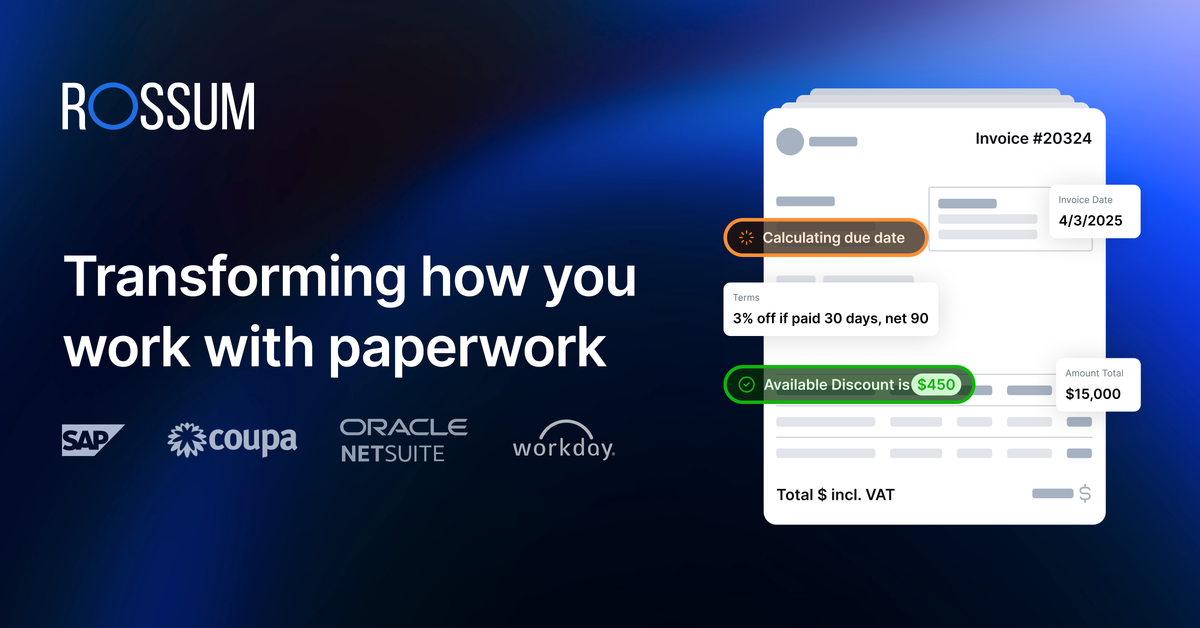
Rossum is an AI document processing platform for transactional workflows. It is designed to read incoming documents, extract and validate the needed data, and move that information into downstream systems with less manual handling.
The product positions itself as an end-to-end automation platform rather than a capture-only tool. Its published pages describe document intake, extraction, validation, approval handling, reporting, search, and integrations as parts of one workflow, with pricing offered through tiered plans and a quote-based sales process.
Bring in documents from email, scanners, PEPPOL, shared drives, portals, SFTP/API, and manual upload, then classify and route them into the right queue.
Process transactional PDFs, images, e-invoices, and structured files such as JSON, XML, and UBL in a single workflow.
Use Rossum Aurora and its proprietary transactional LLM to extract data from complex documents in many languages, including handwritten content.
Cross-check extracted values against master data, ERP records, third-party APIs, Gen AI, and business rules before data reaches downstream systems.
Automate approvals, exception handling, and vendor communication with rule-based workflows, auto-approve/reject logic, and AI-generated emails.
Track errors, exceptions, turnaround time, and straight-through processing in a unified platform with audit trails and document search.
Automate accounts payable or other invoice-heavy workflows by ingesting documents, extracting fields, validating them against master data, and routing exceptions for review.
Handle supply chain or logistics documents such as bills of lading, packing lists, and certificates of analysis while keeping structured and unstructured inputs in one flow.
Standardize document handling for enterprises that receive files across multiple channels, including email, scanners, portals, PEPPOL, shared drives, and APIs.
Support teams that need approvals, rejection logic, and exception messaging for vendors or internal reviewers without building all of the workflow from scratch.
Give operations teams a searchable archive, audit trail, and performance metrics for document turnaround, errors, exceptions, and straight-through processing.
Rossum supports document ingestion through email, scanners, PEPPOL, shared drives, SFTP/API, portals, and manual upload. Its platform can also split bundled PDFs, detect duplicates, and route documents into queues for processing.
Rossum is built for transactional documents such as invoices, purchase orders, bills of lading, packing lists, certificates of analysis, and sales orders. It can process structured formats like JSON, XML, and UBL alongside PDFs and image files.
Pricing is based on your business needs and automation scale, especially document or page volume and workflow complexity. Rossum offers tiered plans, a 14-day free trial, and a sales-led quote process for paid plans.
Rossum supports human-in-the-loop review through an ergonomic validation screen and AI-augmented workflows. When the system lacks confidence, it can bring in people for verification and learn from their inputs over time.
Rossum positions itself as a platform for end-to-end transactional document automation. The sources do not describe a public self-serve setup process in detail, but they do mention unlimited seats, integrations with downstream systems, and add-ons for workflows, reporting, and security needs.