
No-code multi-channel agent building
Build AI Voice Agents, Chat, Text, Email, and Real-Time Agent Assist workflows without writing code, with a no-code platform called out on the homepage and voice agent pages.

Floatbot is a no-code enterprise AI agent platform for automating phone calls, chat, text, email, and real-time agent assist. It is aimed at regulated teams in insurance, collections, banking, healthcare, lending, and contact centers.
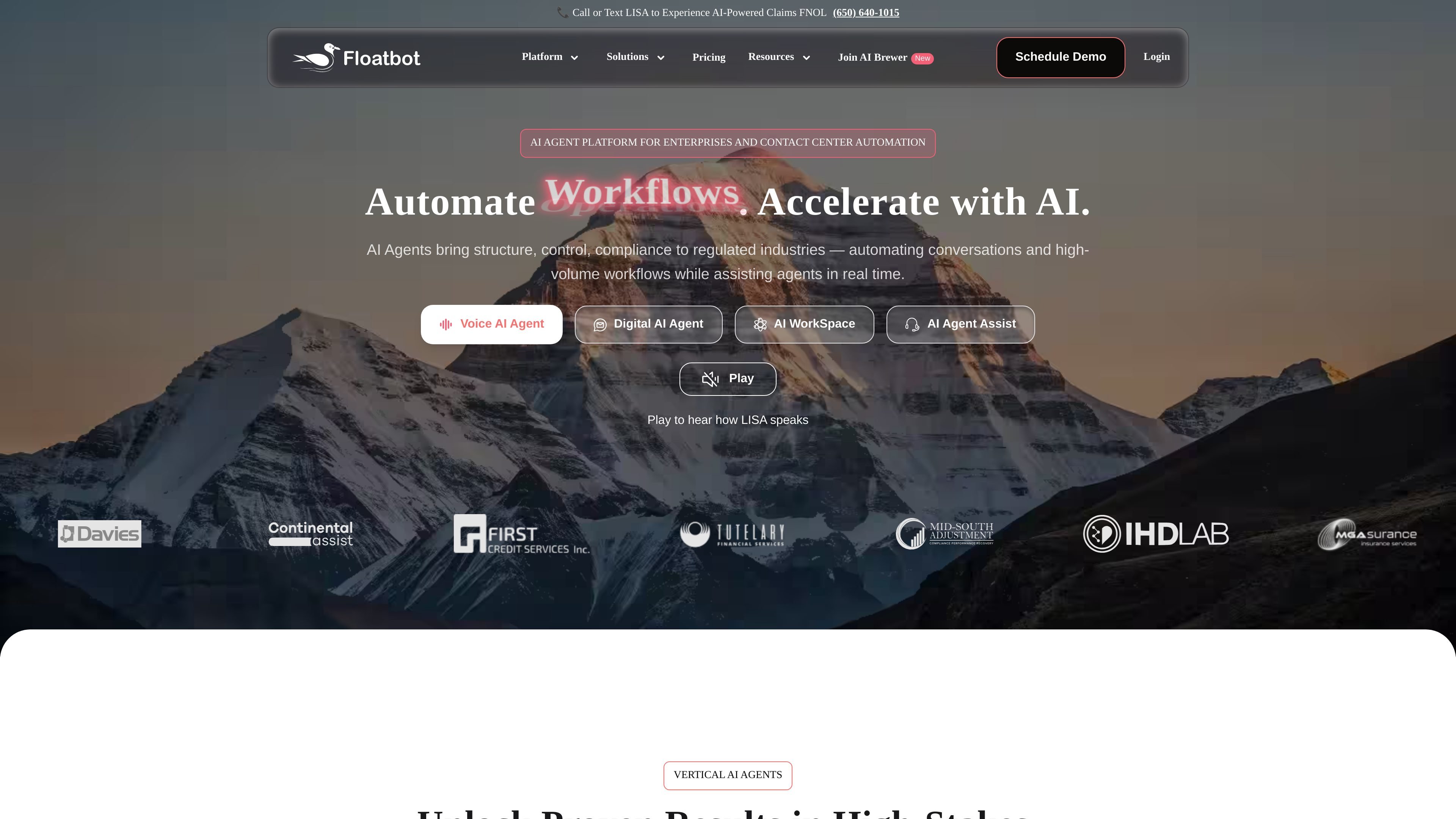
Floatbot is an enterprise AI agent platform for automating phone calls, chat, text, email, and real-time agent assist. The site positions it as a no-code platform for regulated workflows in insurance, collections, banking, healthcare, lending, contact centers, and BPO operations.
The product is built around AI agents that can handle inbound and outbound communication, assist human agents during live conversations, and retrieve information from connected knowledge sources. The site also emphasizes workflow control features such as testing, integration, analytics, warm handoff, and compliance-oriented handling for sensitive interactions.
Floatbot’s homepage and industry pages focus on practical operational tasks such as claims FNOL, debt recovery, patient engagement, loan servicing, customer support, onboarding, and appointment scheduling. The pricing page shows tiered monthly plans for self-service AI agents and related products, along with an Enterprise option that requires contacting sales.
Build AI Voice Agents, Chat, Text, Email, and Real-Time Agent Assist workflows without writing code, with a no-code platform called out on the homepage and voice agent pages.
The platform is designed for inbound and outbound voice automation, including call handling, call deflection, customer support, lead qualification, reminders, and call transfer to live agents.
Source pages describe a build, test, integrate, go-live, and analyze workflow, including simulation-style testing and analytics to monitor interactions after launch.
Floatbot highlights live handoff with full context retained, next-best actions, summaries, and compliance prompts for human-assisted service scenarios.
The site references cognitive search for knowledge-base retrieval, privately hosted and fine-tuned LLMs, custom NLP, speech AI, and LLM models for enterprise use cases.
The pricing page and product pages mention analytics, custom reports, multilingual support, and security features such as ISO 27001, SOC 2 Type 2, HIPAA compliance, and PII redaction.
Use AI voice agents to answer inbound calls, capture claim details, send updates, and route complex cases to a human adjuster with context preserved.
Automate payment reminders, RPC/PTP negotiation support, and customer follow-up across collections workflows while keeping compliance and escalation in view.
Deploy conversational agents for onboarding, authentication, servicing, and support across voice and digital channels, with multilingual handling where needed.
Use AI to handle appointment scheduling, patient triage, billing questions, refill reminders, and after-hours engagement for healthcare teams.
Support live agents with summaries, next-best actions, and compliance prompts during regulated customer interactions that require quick resolution.
Floatbot is positioned as a no-code or low-code enterprise AI agent platform for automating phone calls, chat, text, email, and real-time agent assist. The source pages emphasize regulated workflows in insurance, collections, banking, healthcare, lending, contact center operations, and BPO settings.
The pricing page lists self-service AI agents, AI Agent Assist, NEO speech-to-text, cognitive search, and voice biometrics among the available solution areas. The homepage and voice agent page also describe build, test, integrate, go-live, and analyze workflows.
The pricing page includes monthly plans for Lite, Essential, and Growth, plus an Enterprise option with custom pricing and contact sales. It also mentions a 14-day free trial with no credit card required.
The source content says AI agents can connect with contact center, CRM, telephony, and messaging platforms, and the pricing page mentions CPaaS integrations such as Twilio or Plivo by customer API key. It also refers to pre-integration with popular CCaaS, but does not list a complete integration catalog.
No-code build flows, vertical workflows, real-time handoff to human agents, analytics, and private or fine-tuned models suggest the product is aimed at teams that need controlled automation rather than a general-purpose chatbot builder. The site repeatedly frames the platform around enterprise operations and regulated industries.