
Webhook and endpoint testing
Connect an agent through an endpoint, webhook, or LangChain workflow. The homepage states that setup takes about two minutes and does not require an SDK.

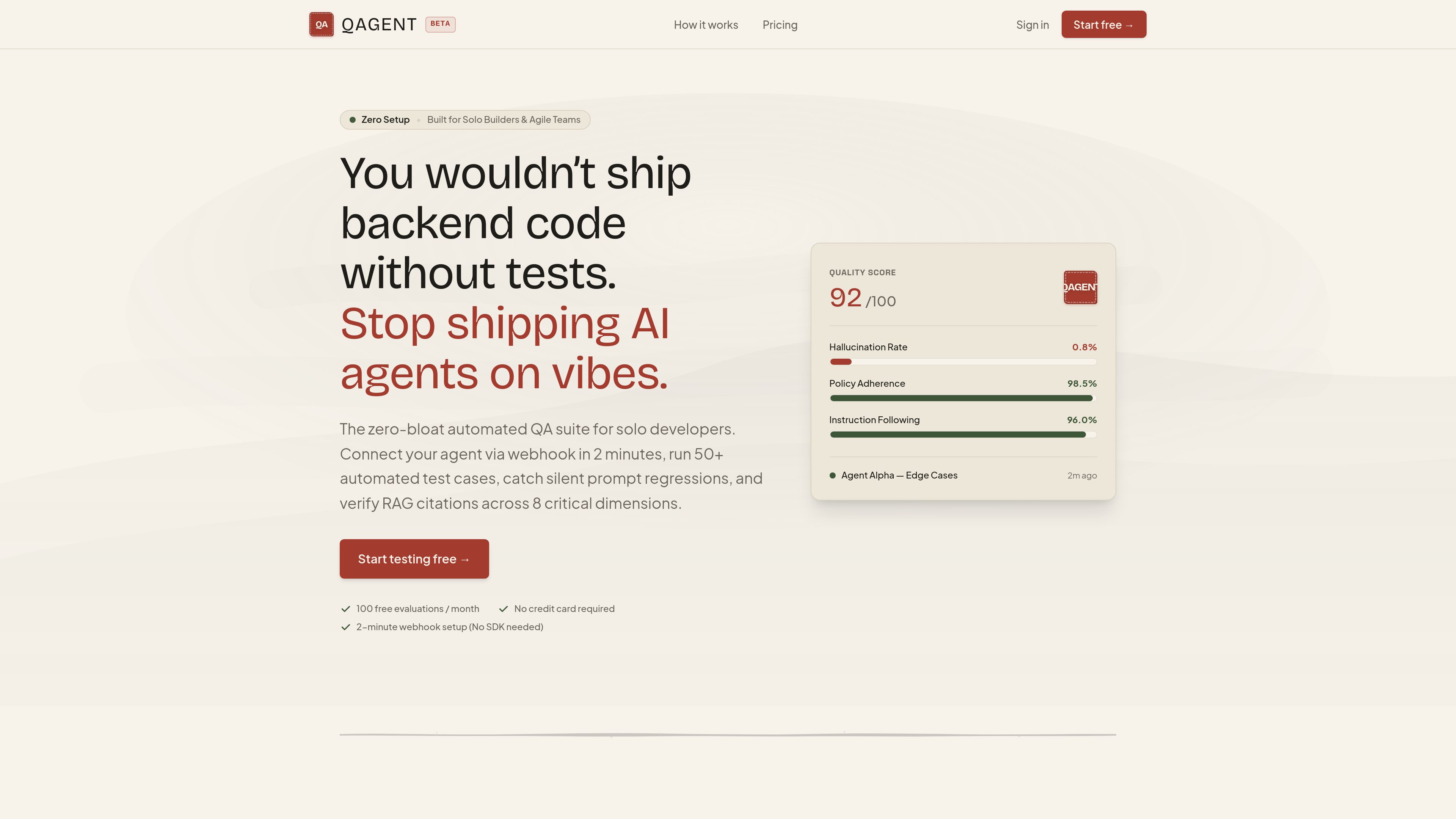
QAgent is an AI agent testing and quality assurance platform for developers and agile teams. It connects to an agent through a webhook or endpoint, runs automated test cases, and evaluates responses for groundedness, policy adherence, prompt compliance, and related quality dimensions.
QAgent is an automated testing and quality assurance platform for production AI agents. It connects to an agent endpoint, webhook, or LangChain workflow, then compares live responses with user-defined ground truth and expected-behavior rubrics.
The platform is designed to replace ad hoc manual checks with repeatable evaluations for correctness, hallucination risk, prompt adherence, policy constraints, retrieval-augmented generation behavior, escalation decisions, and multi-turn context. It is positioned for solo developers and agile teams shipping AI agents.
Connect an agent through an endpoint, webhook, or LangChain workflow. The homepage states that setup takes about two minutes and does not require an SDK.
Define official rules, documentation, and expected behavior using explicit MUST or MUST NOT requirements, then compare those requirements with the agent's actual response.
The documented evaluation areas include answer quality, anti-hallucination and factual groundedness, policy adherence, escalation correctness, RAG faithfulness, contextual relevancy, context recall, and multi-turn context memory.
Run edge cases, adversarial attacks, and multi-turn conversations in parallel to examine behavior beyond simple one-question checks.
Receive deterministic pass/fail ratings, quality scores, evaluator findings, confidence indicators in example reports, and step-by-step failure root causes.
Track score changes across prompt iterations so teams can identify when a change improves one behavior but causes regressions elsewhere.
A solo developer can run a saved test suite after changing a system prompt and check for regressions before deploying the updated agent.
Teams can test requirements such as refund windows, discount restrictions, forbidden topics, or other official boundaries against live agent responses.
Teams using retrieval-augmented generation can compare responses with ground-truth documentation and inspect whether retrieved knowledge was used faithfully.
Support or service agents can be tested with adversarial requests and edge cases to verify refusal behavior and determine whether the agent hands difficult cases to a human instead of making unsupported promises.
Builders delivering an AI agent to a client can generate quality audit reports and scorecards documenting checks such as factual groundedness, RAG faithfulness, and policy adherence.
The homepage says users can provide an agent endpoint URL, webhook, or LangChain workflow. It describes approximately two-minute setup and says no SDK is required.
A test can include a user query, ground-truth information, and an expected-behavior rubric. The rubric can specify requirements using MUST or MUST NOT language, which QAgent compares with the live response.
The documented workflow provides quality scores, deterministic pass/fail ratings, evaluator findings, and failure root causes. The site also shows audit-style reports with the tested query, expected rubric, agent response, and evaluator conclusion.
The homepage states that users receive 100 free evaluations per month and do not need a credit card. The available pricing page is a not-found page, so paid-plan prices, billing terms, and cancellation details cannot be confirmed.
流量数据仅供参考。

deepeval.com
DeepEval is an open-source LLM evaluation framework for testing and benchmarking AI applications. It helps developers run pytest-native evaluations, score outputs and agent traces, and iterate on systems across text, image, audio, and voice workflows.

www.galileo.ai
Galileo is an AI observability and evaluation platform for testing, debugging, and governing LLM and agent systems across development and production. It helps teams turn evaluation results into production guardrails and monitor AI behavior at scale.

jev-state.vercel.app
Jev State is a workspace for defining, testing, and regression-checking conversational decisions powered by Jev. It helps teams inspect why an agent takes a step and export runnable TypeScript and tests for an application.
www.giskard.ai
Giskard is an AI security and evaluation platform for testing conversational LLM agents before and after deployment. It combines automated red teaming, quality evaluation, runtime guardrails, and remediation workflows for teams responsible for reliable AI systems.

www.promptfoo.dev
Promptfoo is an AI security and testing platform for evaluating LLM applications, agents, models, and workflows. It helps developers and security teams find vulnerabilities, validate guardrails, map findings to security frameworks, and track remediation through development and deployment.
www.mcpjam.com
MCPJam is a testing and evaluation platform for MCP servers. It helps developers inspect servers locally, run user and model-based tests, and add behavior checks to CI/CD workflows.