
Ground-truth dataset creation
Build datasets from synthetic, development, and live production data, and add subject matter expert annotations so evaluation criteria can reflect the target environment.

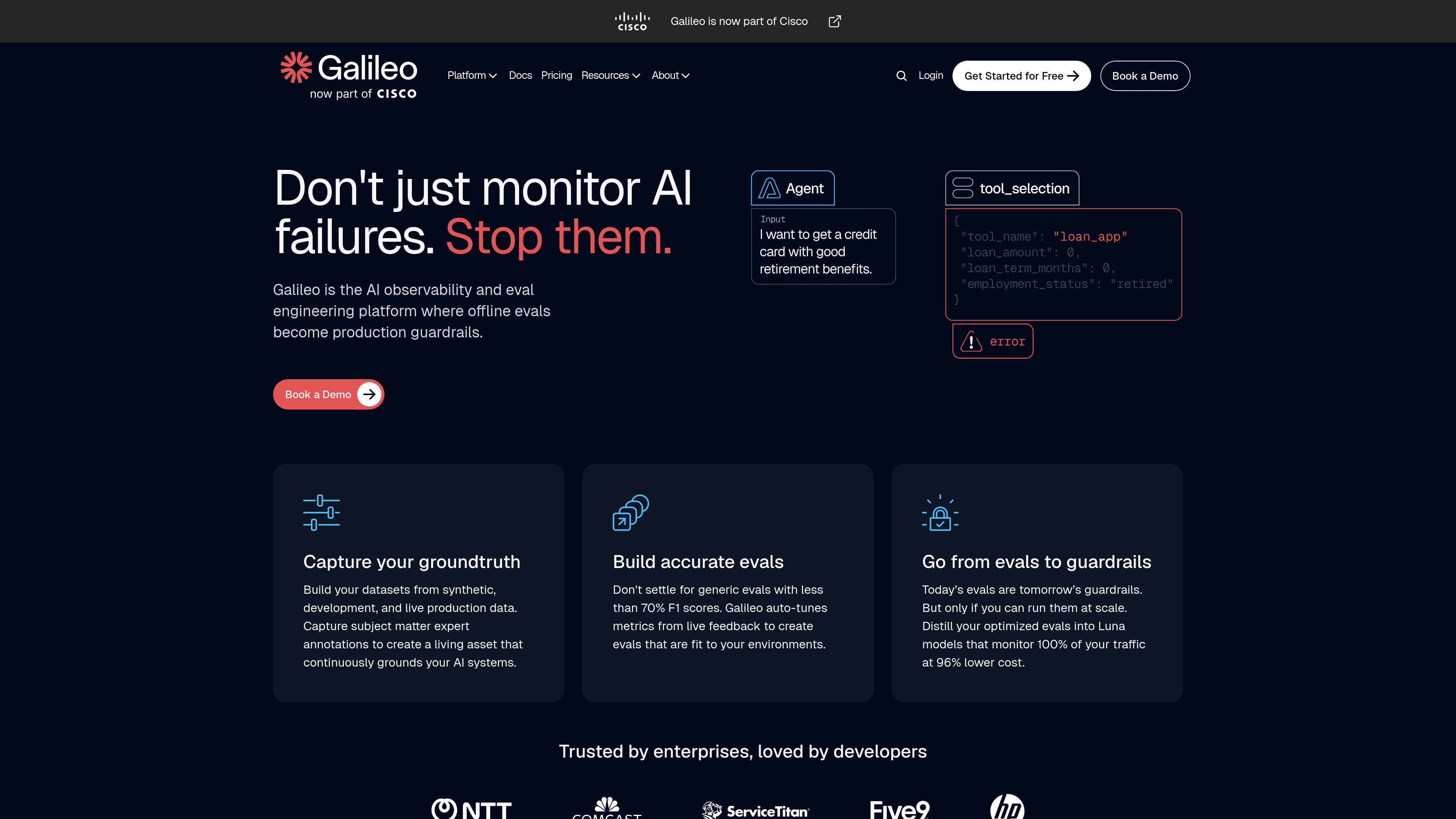
Galileo is an AI observability and evaluation platform for testing, debugging, and governing LLM and agent systems across development and production. It helps teams turn evaluation results into production guardrails and monitor AI behavior at scale.
Galileo is an AI observability and evaluation platform for teams building LLM applications and AI agents. It supports the evaluation lifecycle from dataset creation and expert annotation through offline testing, production monitoring, failure analysis, and guardrail deployment. Its stated focus is helping teams identify and address issues such as hallucinations, policy drift, security leaks, and agent failures before they affect users at scale.
The platform combines evaluation and observability rather than treating them as separate workflows. Teams can create ground-truth datasets from synthetic, development, and live production data, run prebuilt or custom evaluations, inspect agent behavior, and use evaluation results to define production controls. Galileo describes Luna models as a way to run optimized evaluations with lower latency and cost across production traffic.
Galileo Signals analyzes production traces for failure patterns that may not be covered by existing evaluations or manual searches. Its Insights engine adds analysis of agent behavior and related execution data to support root-cause investigation and corrective action. Deployment options listed by Galileo include SaaS, virtual private cloud, and on-premises environments.
Build datasets from synthetic, development, and live production data, and add subject matter expert annotations so evaluation criteria can reflect the target environment.
Start with more than 20 evaluations for RAG, agents, safety, and security, then create custom evaluators to encode domain-specific requirements.
Galileo Signals analyzes production traces to surface unknown failure patterns, including issues such as security leaks, policy drift, and cascading failures, without requiring teams to search for a problem first.
The Insights engine examines agent behavior and related execution data—including traces, prompts, functions, context, datasets, and signals—to identify failure modes and support debugging.
Optimized evaluations can be distilled into Luna models for low-latency production monitoring, while evaluation scores can control agent actions, tool access, and escalation paths through guardrail policies.
Development teams can assemble datasets, add expert annotations, and run RAG- or agent-focused evaluations before deploying an application.
AI engineers can use Signals to detect patterns across production traces and use Insights to examine likely causes instead of relying only on manual log searches.
Teams can apply safety and security evaluations to identify issues such as harmful behavior, data leaks, or policy drift in live AI interactions.
Teams operating agents can use evaluation scores to define controls for tool access, agent actions, and escalation paths as part of production governance.
Galileo monitors LLM and agent systems through evaluations, production traces, and agent execution data. The site describes coverage for RAG, agents, safety, security, prompts, functions, context, datasets, and related signals.
Galileo Signals is designed to find unknown failure patterns in production traces, including patterns that teams may not know to search for or have not yet encoded as evaluations. An identified signal can be used to generate an LLM judge.
Galileo describes a workflow in which optimized evaluations are distilled into Luna models for production monitoring. Evaluation scores can then be used in guardrail policies to control agent actions, tool access, and escalation paths.
The site lists three deployment options: SaaS, virtual private cloud, and on premises. The appropriate option depends on the team's deployment and enterprise requirements.
Yes. The pricing page lists a Free plan at $0 per month with 5,000 traces per month, unlimited users, and unlimited custom evaluations. It also lists Pro and custom Enterprise options.

getbluejay.ai
Bluejay 是面向 AI 语音和聊天代理的 QA 平台,支持部署前后测试、监控与优化。

www.lyzr.ai
OpenController is Lyzr’s control plane for discovering, evaluating, governing, and monitoring AI agents, models, tools, data, and workflows across an enterprise AI estate. It is intended for teams managing agents across clouds, frameworks, runtimes, and environments.
getbasalt.ai
通过分析真实用户交互追踪、检测失败模式并生成经过验证的拉取请求,帮助团队改进 AI 代理。

hamming.ai
用于测试和监控语音及聊天代理的企业级平台

canyontechs.ai
CanyonTechs AI 是一款由 LLM 驱动的自动修复产品,可解析生产环境日志、检测故障事件,并以经过签名的拉取请求提交修复方案。它采用工作区服务模式,支持个人和企业用户注册与登录。
www.langchain.com
LangSmith is an observability and evaluation platform for AI agents and LLM applications. It helps development and production teams trace agent behavior, monitor quality and cost, investigate failures, and evaluate changes.