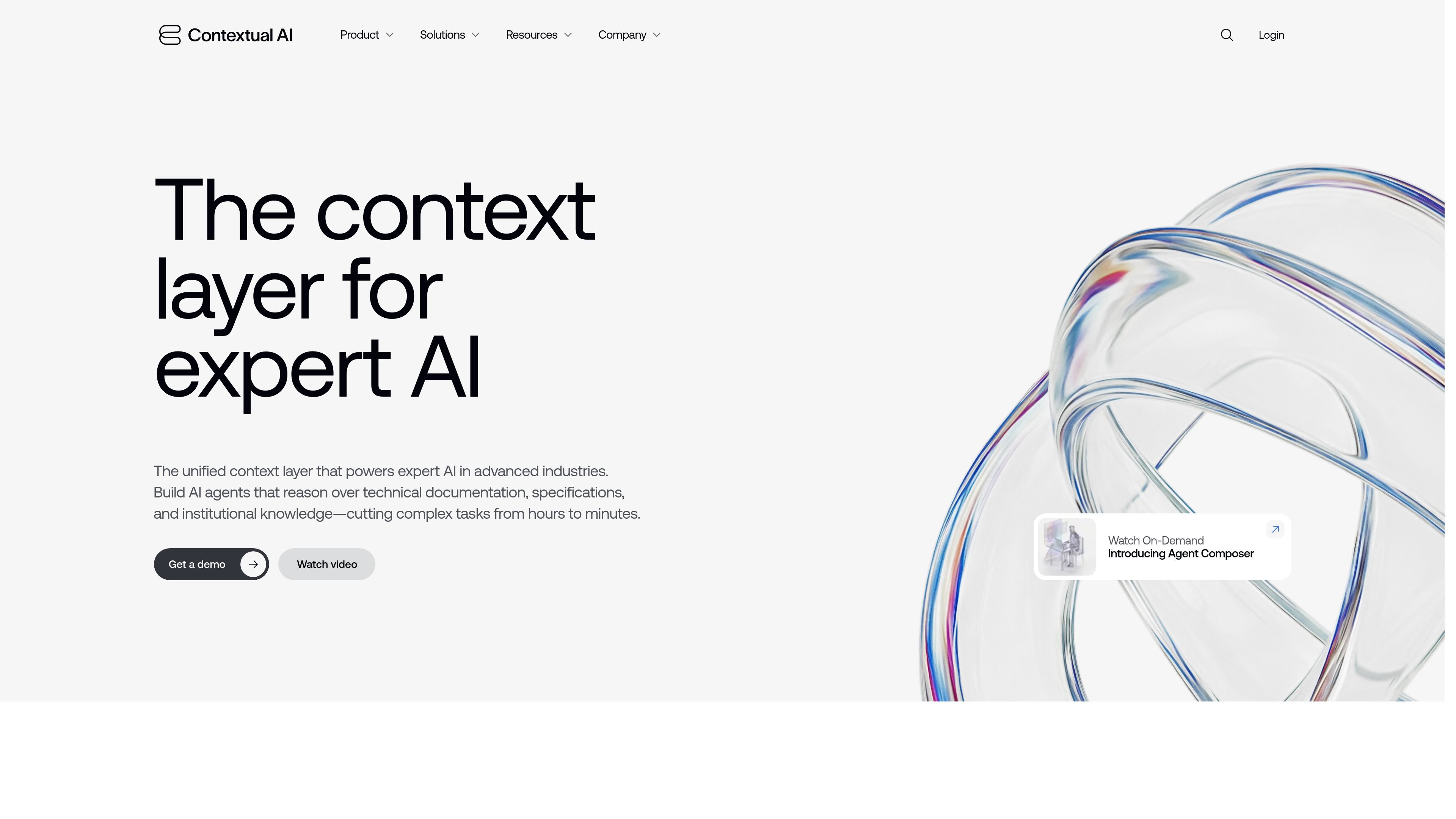
Contextual AI is a context engineering platform for building production-grade AI agents and workflows on enterprise data.

Contextual AI preview

Overview

Contextual AI is a context engineering platform for building production-grade AI agents and workflows on top of enterprise data. Its core focus is to help teams turn messy technical, institutional, and multimodal content into context that can be retrieved, evaluated, and used by AI systems.

The platform combines agent composition, data ingestion, parsing, retrieval, grounded generation, and evaluation in one environment. The site positions it for expert and technical tasks such as technical support, device log analysis, deep research, knowledge management, structured extraction, and other document-heavy workflows.

Teams can work through prebuilt agents, natural-language prompts, a visual editor, or APIs, and the platform is offered with usage-based on-demand pricing as well as Enterprise plans with custom pricing. Security and deployment options include SaaS and private or dedicated environments, along with enterprise controls for access and compliance.

Features

Agent Composer for configurable workflows

Define agents with pre-built templates, a prompt-based builder, or a drag-and-drop editor. The builder exposes workflow controls for model selection, prompts, retrieval parameters, external tools, guardrails, limits, and user feedback settings.

Enterprise data ingestion

Ingest documents and other enterprise data through managed connectors, MCP, API integrations, or file uploads. The platform supports continuous ingestion so connected sources can stay current.

Multimodal parsing and extraction

Parse complex documents and extract structured information from multimodal sources, including PDFs, HTML with images, charts, and tables, as well as databases, spreadsheets, CSVs, and other structured data.

Retrieval and grounding pipeline

Use retrieval components such as query optimization, retrieve, rerank, filtering, and grounded generation to improve the quality of answers built from enterprise knowledge bases.

Traceable outputs and evaluation

Review outputs with sentence-level citations, bounding boxes, groundedness scoring, and feedback collection tools that help teams evaluate and improve agent behavior over time.

Enterprise deployment and access controls

Deploy across multi-tenant SaaS, single-tenant SaaS, dedicated cloud, or private VPC setups, with enterprise controls such as RBAC, SSO, document entitlements, and compliance support.

Use cases

  • Customer engineering support

    Teams can build agents that answer technical inquiries by pulling context from product data, datasheets, call logs, and related documentation.

  • Device log and anomaly analysis

    Engineering teams can analyze large log files and anomaly data to identify likely root causes and summarize issues faster.

  • Enterprise knowledge management

    Knowledge workers can search across scattered internal sources to surface answers from institutional knowledge for enterprise search and knowledge management.

  • Qualification and compliance workflows

    Operations and compliance teams can cross-reference documents across systems to assemble audit-ready traceability matrices and structured reports.

  • Structured document extraction

    Analysts can extract key fields from dense, multimodal document sets such as data rooms, reports, and spreadsheets for downstream review.

Pros and Cons

Pros

  • Combines agent building, data ingestion, parsing, retrieval, and evaluation in a single platform.
  • Supports both no-code and API-based workflows, which helps different technical teams adopt it.
  • Provides grounded outputs with sentence-level citations and bounding boxes for traceability.
  • Offers multiple deployment choices, including SaaS and private VPC options.
  • Includes enterprise controls such as SSO, RBAC, document entitlements, and compliance support.

Cons

  • The source does not provide a complete integrations catalog, so the full connector list is unclear from the available pages.
  • Some pricing and enterprise details require contacting sales, which limits upfront comparison for larger deployments.
  • The site gives fewer implementation specifics for team setup, limits, and operational workflow than it does for core platform capabilities.

FAQ

What does Contextual AI do?

Contextual AI is a context engineering platform for building production-grade AI agents and workflows. It combines agent configuration, data ingestion and extraction, retrieval tools, grounded generation, and evaluation in one enterprise platform.

How do teams build agents on the platform?

The platform is built around Agent Composer, which lets teams define and configure agents with pre-built templates, natural-language prompts, or a visual editor. The platform also exposes APIs and supports integrations with existing SDKs.

How is Contextual AI priced?

The pricing page shows an on-demand, usage-based plan and an Enterprise option with custom pricing. It also mentions a free credit offer for the on-demand plan and sales contact for enterprise.

What deployment and security options are available?

The site describes deployment options including multi-tenant SaaS, single-tenant or dedicated cloud, and private VPC environments. It also mentions enterprise security features such as SOC 2, HIPAA, GDPR, SSO, RBAC, and document entitlements.

What kinds of use cases is it designed for?

The platform is aimed at technical, knowledge-heavy workflows such as agentic search, log analysis, deep research, structured extraction, and enterprise knowledge management. The use-case library also includes domain-specific workflows in aerospace, semiconductors, manufacturing, energy, and other industries.

Quick Facts

Category
AI platform
Primary use
Context engineering for enterprise AI agents
Pricing
Usage-based on-demand plan plus Enterprise pricing by contact sales
Deployment
Multi-tenant SaaS, single-tenant SaaS, dedicated cloud, and private VPC
Source domain
contextual.ai
Notable workflows
Agentic search, log analysis, deep research, structured extraction