
Workforce AI security controls
Protect employee AI usage across public chatbots, copilots, browser tools, desktop apps, IDEs, and MCP-connected workflows. The product is designed to find shadow AI and control how employees interact with AI systems.

Lakera is an AI-native security platform for enterprises using generative AI, AI agents, and employee AI tools. SaaS and self-hosted options.
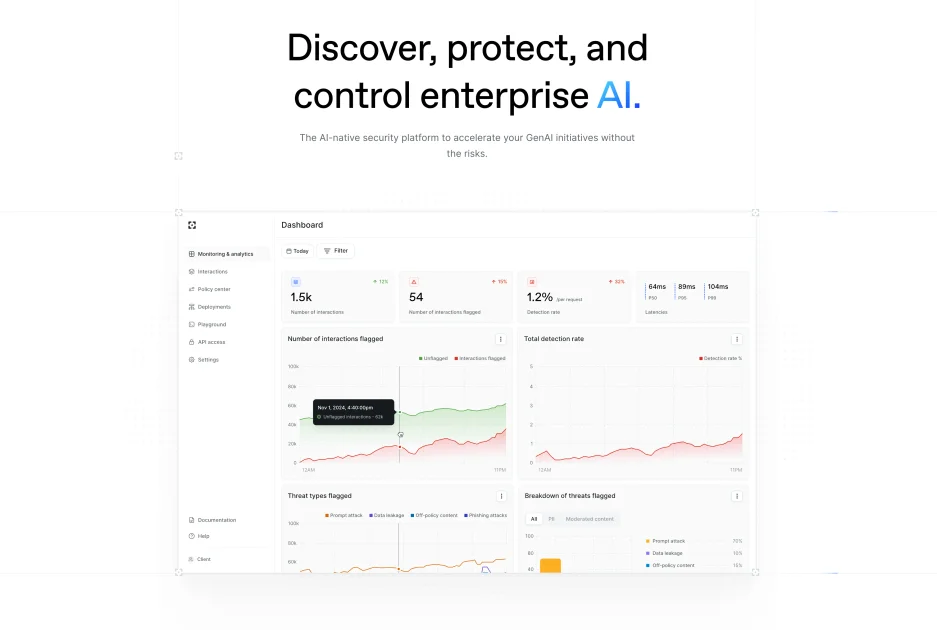
Lakera is an AI-native security platform for enterprises building or using generative AI, AI agents, and MCP-connected workflows. The site positions it as a way to secure what AI does, not only what it can access, across employee usage, production applications, and autonomous agents.
The product family shown on the site includes Workforce AI Security, AI Agent Security, and AI Red Teaming. Together, these products focus on shadow AI discovery, runtime protection, adversarial testing, and policy enforcement for AI systems that interact with prompts, tools, data, and connected services.
The pricing page shows a Community plan with limited free access and an Enterprise plan that requires contacting sales. It also indicates SaaS and self-hosted deployment options, plus enterprise controls such as SSO, role-based access control, SIEM integration, and version pinning for self-hosted use.
Protect employee AI usage across public chatbots, copilots, browser tools, desktop apps, IDEs, and MCP-connected workflows. The product is designed to find shadow AI and control how employees interact with AI systems.
Inspect prompts, outputs, and actions in real time to block prompt injection, jailbreaks, data leakage, and unsafe tool use. This capability is described for AI Agent Security and the broader AI security platform.
Run adversarial testing against AI applications and agents to surface security, safety, and responsible-AI risks before they reach production. The red-teaming workflow includes simulated real-world interactions and vulnerability identification.
Apply policy controls by user, app, data type, and action instead of relying on broad allow/block decisions. The source also highlights central policy control for horizontal application coverage without code changes.
Deploy through an API-first, cloud-native architecture with SaaS or self-hosted options. The platform notes enterprise features such as dashboards, reports, SSO, RBAC, SIEM integration, and version pinning for self-hosted deployments.
Support high-volume, low-latency operation with real-time threat detection and sub-50 ms runtime latency noted on the site. The product is also described as model agnostic and multimodal, with support for chatbots and audio bots.
Use Workforce AI Security to discover shadow AI and govern how employees use chatbots, copilots, browser tools, desktop apps, IDEs, and MCP-connected workflows.
Use AI Agent Security to discover agents across your environment, assess what they can access, and block unsafe actions or data exposure at runtime.
Use AI Red Teaming to test AI applications and agents with adversarial scenarios, then identify safety, security, and responsible-AI gaps before release.
Use the platform’s policy controls, dashboards, and reports to enforce organization-wide rules without rebuilding applications or changing prompts.
Use the deployment and enterprise controls to support regulated or security-sensitive environments that need SaaS or self-hosted hosting, access control, and audit-oriented features.
Lakera offers an AI security platform with separate workflows for workforce AI security, AI agent security, and AI red teaming. The source pages describe it as protecting prompts, outputs, actions, and connected systems across enterprise AI usage.
The source describes deployment for enterprise teams using AI apps, agents, copilots, browser tools, IDEs, MCP-connected tools, and other AI-enabled workflows. It is positioned for organizations that need policy control, runtime protection, and adversarial testing across those environments.
The pricing page shows a Community plan with free access to a limited number of requests and an Enterprise plan that requires contacting sales. It also lists SaaS and self-hosted hosting options, with enterprise features such as SSO, RBAC, SIEM integration, and version pinning for self-hosted deployments.
Lakera AI Agent Security is described as deployable in minutes, with no changes to models or prompts and no meaningful latency impact. The pricing page also says the product is API-first and cloud-native.
The source emphasizes protection for AI apps and agents, but it does not provide a complete public list of integrations or detailed setup requirements on these pages. Teams would need to confirm exact workflow and integration fit with sales or documentation.
Os dados de tráfego são apenas para referência.
| abr. | 274828 |
|---|---|
| mai. | 305851 |
| jun. | 259130 |