
Agent orchestration
Agents can plan, build, test, and verify work across a codebase, with approval once and parallel execution across tasks.

Zencoder is an AI coding agent platform for software teams, with planning, coding, testing, and review in coordinated workflows.
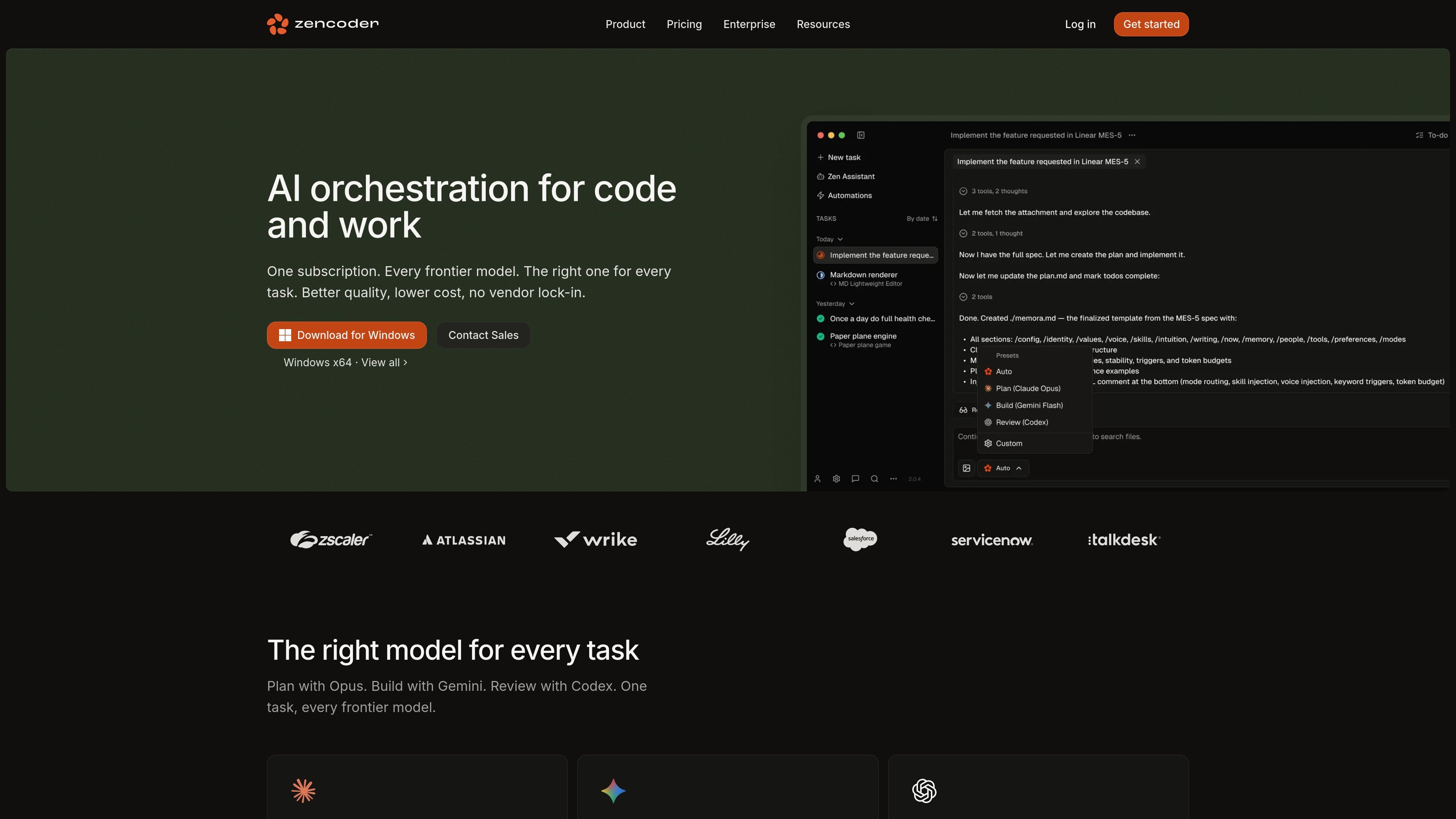
Zencoder is an AI coding agent platform for teams that want software work handled through coordinated agents rather than a single chat interface. The product is positioned around planning, implementation, verification, and review, with agents that can work in a desktop app, inside IDEs, or in CI/CD pipelines.
Its core purpose is to help teams ship code with more structure and less context switching. The site describes workflows for features, bug fixes, refactors, code review, and recurring automation, and it emphasizes multi-repository awareness, spec-driven execution, and built-in quality checks.
Agents can plan, build, test, and verify work across a codebase, with approval once and parallel execution across tasks.
The product indexes multiple repositories, maps dependencies, and gives agents architectural awareness before they write code.
Tests, linting, and code review run as built-in quality gates so changes are checked against project standards.
Zenflow and the coding agent support spec-driven workflows, including pre-built paths for features, bugs, refactors, and custom steps.
The platform connects to GitHub, GitLab, Jira, Slack, CI/CD systems, and custom MCP endpoints through its integration layer.
Deployment options include cloud, on-premise, or hybrid setups, with BYOK support for OpenAI and Anthropic agreements.
Use Zencoder to turn a specification into code by drafting the plan, implementing changes, and running verification before review.
Use the coding agent to triage bugs, reproduce issues, and apply fixes while keeping tests and review in the loop.
Use multi-agent workflows to review pull requests, run checks, and catch issues with a different model than the one that wrote the code.
Use scheduled workflows for recurring engineering tasks such as dependency updates, PR reviews, and bug triage.
Use Zenflow Work or the coding agent to coordinate tasks across connected tools and repositories when work spans Jira, GitHub, Slack, and related systems.
Zencoder is an AI coding agent platform. It coordinates agents for planning, coding, testing, and code review across a codebase, with support for desktop, IDE, and CI/CD workflows.
The source shows Zencoder in a standalone desktop app, IDE plugins for VS Code and JetBrains, and CI/CD-oriented workflows. It also offers Zenflow, which is a separate orchestration app that coordinates AI work.
The pricing page shows paid plans with a free trial, plus support for BYOK on all plans. It also lists shared team credits, usage analytics, SSO, audit logs, and priority support on higher tiers.
The product pages describe workflows for features, bug fixes, refactors, PR reviews, dependency updates, and other recurring tasks. The right fit is teams that want spec-driven, multi-agent execution rather than one-off chat prompting.
The source emphasizes workflows that use specs, verification, and cross-agent review. It does not claim that every task is fully autonomous, and human approval gates remain part of the product for controlled execution.