
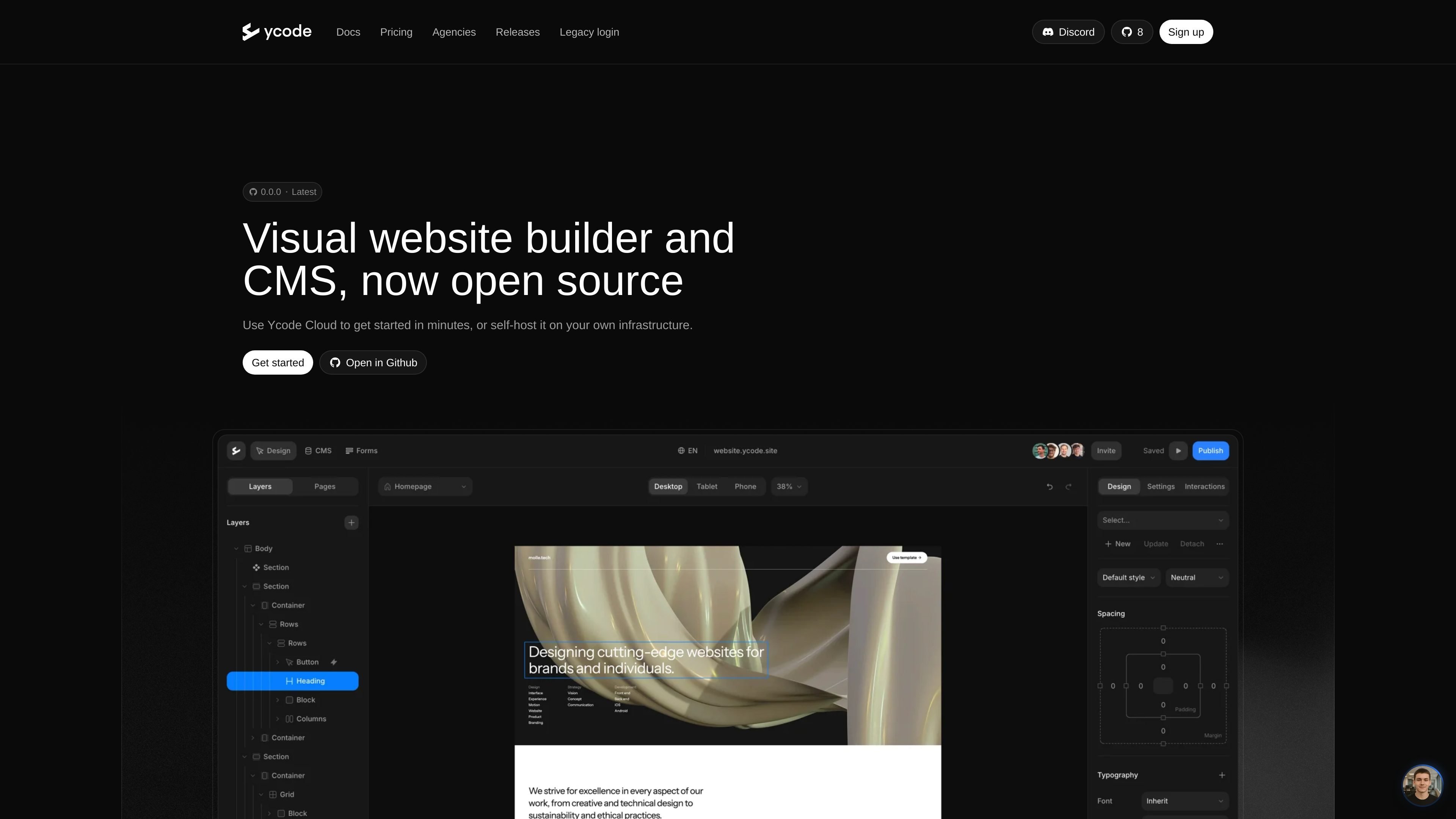
Visual builder with CMS
Design websites in a visual interface while managing structured content with the built-in CMS.

Ycode is an open-source website builder and CMS for custom sites, with self-hosting, Ycode Cloud, and agency workflows.
Ycode is an open source website builder and CMS for designing, hosting, and updating custom websites. The site presents it as a visual builder that can run on Ycode Cloud or on your own infrastructure, giving teams a choice between a managed setup and self-hosting.
The product is aimed at people who want a website platform with more control over code and deployment. The homepage emphasizes self-hosting, while the agency page adds a white-label workspace for client sites and the comparison pages position Ycode as an alternative for teams moving from Framer or Webflow.
Design websites in a visual interface while managing structured content with the built-in CMS.
Choose between Ycode Cloud or self-hosting, depending on whether you want a managed setup or control over your own infrastructure.
Start from a GitHub repository, deploy to Vercel, and connect Supabase when running Ycode yourself.
Import Figma designs, migrate from Webflow, or build directly from AI tools through Ycode MCP.
Use a white-label dashboard and builder on the Agency plan to present the platform under your own brand.
Manage unlimited client websites and collaborators under a single agency subscription.
Teams that want to build a website visually while keeping the code and hosting outside a closed ecosystem can use Ycode’s open source setup.
Agencies managing several client sites can use the white-label workspace, unlimited users, and fixed monthly pricing to keep delivery and billing predictable.
Designers and product teams can move from Figma into a site build without rebuilding everything from scratch, based on the Figma import workflow mentioned on the agency page.
Existing Webflow users who want an open source path can treat Ycode as a migration target, with pages describing movement of CMS content, pages, and designs.
Teams adopting AI-assisted workflows can use Ycode MCP to build pages and manage content from tools such as Claude or OpenAI, according to the agency page.
Ycode can be run as an open source website builder and CMS, with the option to self-host it on your own infrastructure or use Ycode Cloud for a managed setup.
Yes. The agency page says Ycode supports unlimited projects and users under one fixed monthly price, with a white-label dashboard and builder for client work.
The source describes Ycode as a visual website builder with a built-in CMS. The comparison pages also mention moving from Figma and Webflow, and building websites directly from AI tools through Ycode MCP.
The pricing content shows three options: self-hosting on a free open source tier, Ycode Cloud, and an Agency plan. The pricing page itself returns a not found page, so plan details should be taken from the homepage and related pages rather than a dedicated pricing page.
The source supports use as an alternative to Framer and Webflow for teams that want more control over code and infrastructure, but it does not provide a full feature-by-feature comparison.
Traffic data is for reference only.

www.dograh.com
Dograh is an open-source, self-hostable platform for building and deploying production voice agents, connecting telephony, speech, language models, text-to-speech, workflows, and observability on your infrastructure or its managed cloud.

baserow.io
Baserow is an open-source no-code database platform for building databases, apps, dashboards, and automations with cloud or self-hosted deployment.

getgrist.com
Grist is a relational spreadsheet-database for organizing structured data, building workflows, and collaborating on documents, with cloud, self-hosted, enterprise, free, and paid trial options.

tolgee.io
Open-source localization platform for translating apps with in-context editing, integrations, and team workflows.

webiny.com
Webiny is an open-source, self-hosted headless CMS for teams managing structured content, websites, and files on their own infrastructure, with enterprise AWS deployments.

imagine.dev
Appwrite is an open-source application platform for backend services, file storage, realtime features, and hosted web deployment. Build and scale apps with Auth, Databases, Storage, Functions, Messaging, and Sites in one place.