
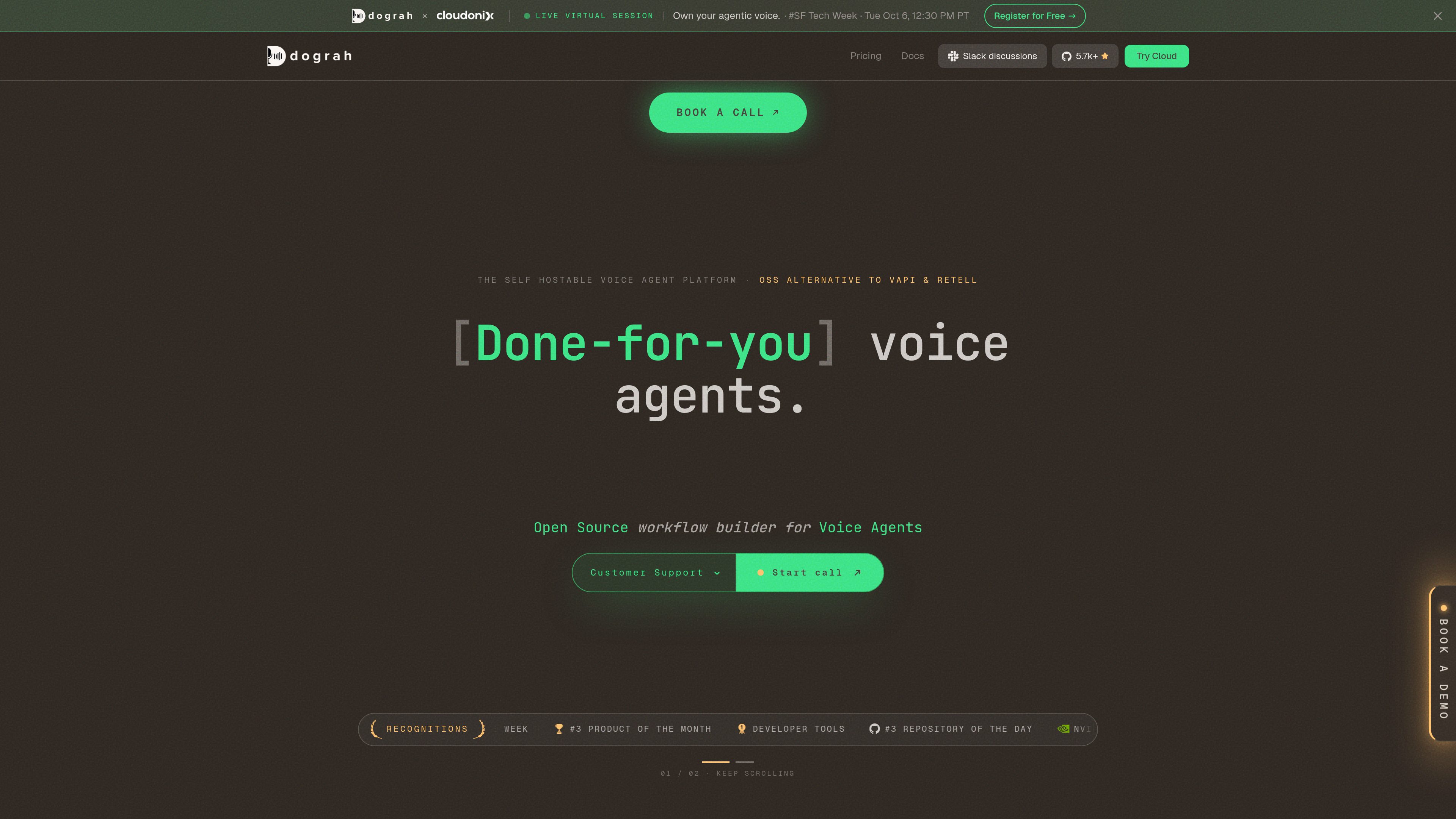
Visual voice-agent workflow builder
Build production voice agents with a no-code workflow builder for inbound and outbound calling. Workflows can include call logic, webhooks, and pre-call steps such as fetching CRM context.

Dograh is an open-source, self-hostable platform for building and deploying production voice agents, connecting telephony, speech, language models, text-to-speech, workflows, and observability on your infrastructure or its managed cloud.
Dograh is an open-source, self-hostable platform for building production voice agents. Its workflow builder connects telephony with speech-to-text, language models, text-to-speech, webhooks, and related call logic, while also supporting direct speech-to-speech pipelines.
Organizations can run the stack on their own servers, inside a private cloud or VPC, or use Dograh’s managed cloud. The platform is positioned for teams that want control over model providers and data location, including regulated organizations with requirements around data residency and auditability.
Build production voice agents with a no-code workflow builder for inbound and outbound calling. Workflows can include call logic, webhooks, and pre-call steps such as fetching CRM context.
Select providers for telephony, speech-to-text, language models, and text-to-speech, or replace the multi-step cascade with a speech-to-speech model. The site lists integrations including OpenAI, Google, Groq, OpenRouter, Azure, AWS, Hugging Face, Plivo, Telnyx, Twilio, Vonage, Asterisk, and multiple speech providers.
Dograh ships a Model Context Protocol server that lets compatible clients such as Claude Code, OpenClaw, Cursor, and Codex create, modify, and deploy voice agents from an IDE or agent runtime.
Audio-to-audio pipelines avoid the text round trip of a conventional STT, LLM, and TTS cascade. Dograh describes this mode as supporting real-time turn-taking and interruption handling, with Gemini and GPT Realtime options shown on the site.
Agents can combine prerecorded voice clips with live text-to-speech in the same cloned voice. A prerecorded line is used when it fits the interaction, with TTS available for responses that require generation.
The full stack can run on a customer’s servers, in a private cloud or VPC, or in a fully air-gapped environment. Dograh also offers managed cloud and private-cloud operations, with the private option keeping deployment inside the customer’s environment.
Create inbound or outbound support agents that handle voice interactions using configurable call workflows and connected telephony providers.
Use voice agents to contact or respond to property leads, gather qualifying information, and automate an initial lead-generation workflow.
Build outbound calling flows for activities such as sales outreach, event invitations, or EMI reminder and soft-collection scripts.
Use voice agents for patient scheduling, reminders, support automation, or law-firm call intake and routing, with deployment options intended for organizations managing sensitive information.
Deploy claim-status, banking, fintech, or public-sector voice workflows within an organization’s infrastructure when data residency and an existing compliance perimeter are important considerations.
Dograh can be run on the customer’s own servers, used as a managed cloud service, or deployed and operated inside the customer’s VPC. The site also describes fully air-gapped and in-perimeter deployments for supported environments.
Yes. Dograh is designed around bringing your own models and selecting providers for telephony, speech-to-text, language models, and text-to-speech. The site also lists self-hosted options such as Whisper, Voxtral, Kokoro, and Chatterbox; it notes that LLM swapping for self-hosted models is in beta.
Dograh provides an MCP server that compatible clients can use to create, modify, and deploy voice agents. The site names Claude Code, OpenClaw, Cursor, and Codex as examples of clients or runtimes that can connect to it.
Yes. In addition to the conventional STT-to-LLM-to-TTS cascade, Dograh supports speech-to-speech pipelines in which audio is sent in and audio is returned directly.
The self-hosted open-source platform is described as free forever with no platform limits. Dograh also offers managed options, including usage-based cloud service, committed volume, and custom private or on-premise plans.
Traffic data is for reference only.

thunderphone.com
ThunderPhone is an AI phone agent platform for building, testing, and deploying voice agents for inbound, outbound, and web or app-based calls. It is aimed at teams that need production call handling with telephony, language support, and workflow integrations in one stack.

vdf.ai
VDF AI is an enterprise AI agent orchestration platform for coordinating agents, models, tools, retrieval, and workflows under centralized governance. Run it as a managed cloud service or deploy it in a private cloud, data centre, sovereign environment, AWS account, or air-gapped infrastructure.

baserow.io
Baserow is an open-source no-code database platform for building databases, apps, dashboards, and automations with cloud or self-hosted deployment.

ycode.com
Ycode is an open-source website builder and CMS for custom sites, with self-hosting, Ycode Cloud, and agency workflows.

openship.io
Openship is an open-source deployment platform for building and running applications from Git repositories, local folders, or templates. Teams can use its dashboard, CLI, desktop app, or MCP interface to deploy on Openship Cloud, connected servers, or their own infrastructure.

getgrist.com
Grist is a relational spreadsheet-database for organizing structured data, building workflows, and collaborating on documents, with cloud, self-hosted, enterprise, free, and paid trial options.