
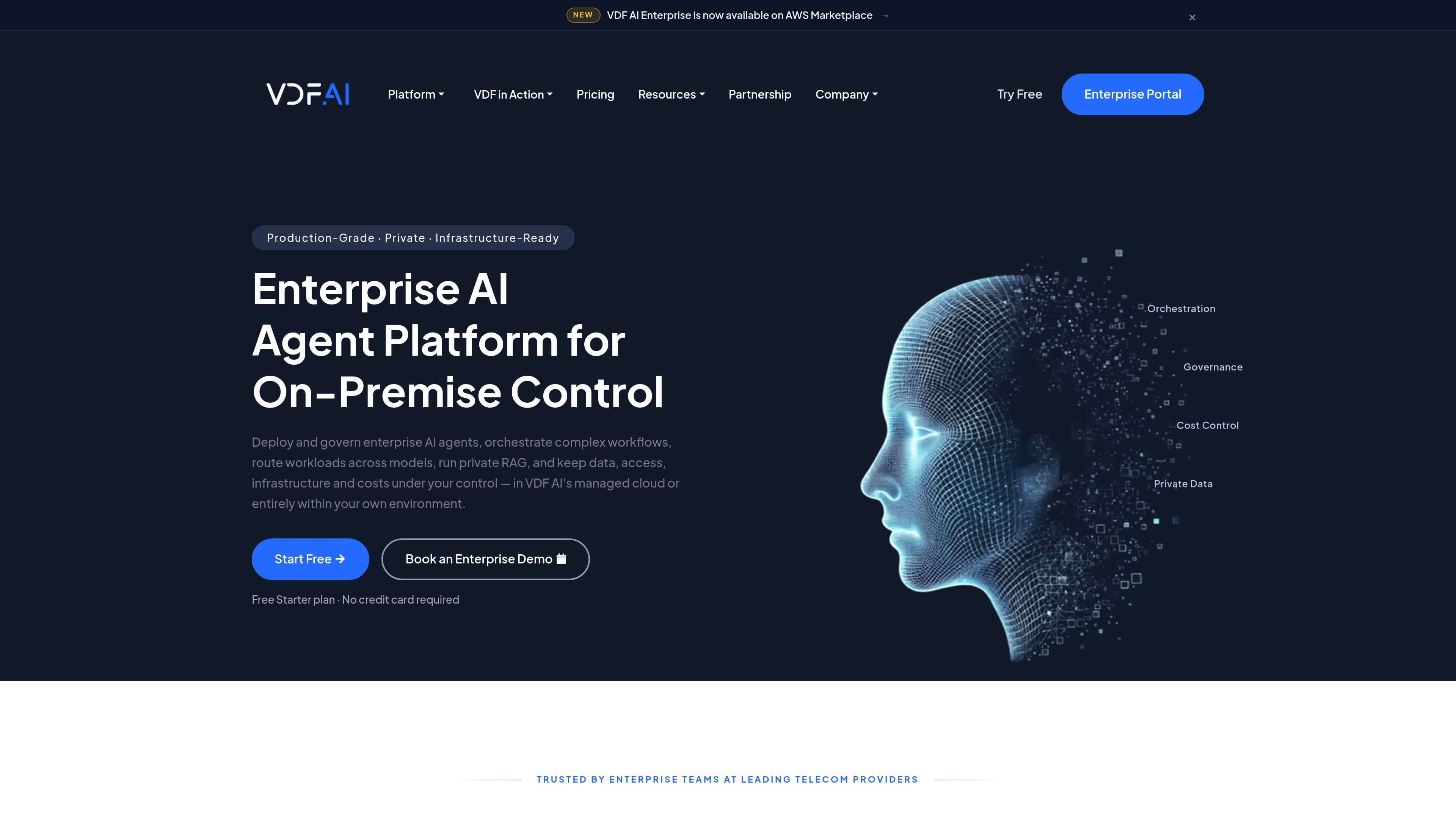
Governed multi-agent Networks
Decompose a request into typed sub-tasks, map dependencies, select agents, tools, and models at runtime, and validate the result before returning it. Execution paths are recorded.

VDF AI is an enterprise AI agent orchestration platform for coordinating agents, models, tools, retrieval, and workflows under centralized governance. Run it as a managed cloud service or deploy it in a private cloud, data centre, sovereign environment, AWS account, or air-gapped infrastructure.
VDF AI is an enterprise AI orchestration platform for turning AI agents and models into governed workflows. It coordinates multi-agent execution, retrieval from enterprise knowledge sources, model selection, tool calls, approvals, and result validation while recording the execution path for review.
The platform is available as a managed cloud service or as a self-deployed installation in a data centre, private cloud, sovereign environment, AWS account, or air-gapped setting. Its product suite includes VDF AI Networks for multi-agent orchestration, VDF AI Agents for deployable agent workflows, VDF AI Chat for private-RAG conversations, and VDF AI Data for data preparation and model validation.
Decompose a request into typed sub-tasks, map dependencies, select agents, tools, and models at runtime, and validate the result before returning it. Execution paths are recorded.
Use private RAG and knowledge-graph capabilities to ground responses in connected enterprise information rather than relying only on pasted context.
Select models against task complexity, cost, latency, and capability. Routing decisions are logged for operational review.
Apply centralized controls for access, permissions, policies, retrieval, tool calls, and execution logging so decisions can be reconstructed later.
Run the platform in VDF AI’s managed cloud or deploy it on private infrastructure, including on-premises, private-cloud, sovereign, and air-gapped environments.
Monitor cost and energy metrics, usage, execution activity, and governance data. Capacity licensing includes dashboards, monthly consumption statements, and usage alerts.
Build chat or agent experiences that retrieve information from private enterprise sources while keeping the data and deployment under the organization’s control.
Coordinate multiple agents, models, tools, APIs, databases, business systems, decisions, and approval steps as one repeatable workflow.
Route different tasks to suitable models based on complexity, latency, capability, and cost, then review the routing and usage records.
Operate agents and retrieval inside a company data centre, private or sovereign environment, or disconnected infrastructure where external API dependencies are not acceptable.
Move a validated use case from a pilot into a controlled production workflow with defined inputs, owners, access controls, monitoring, and auditable execution records.
VDF AI can run as a managed cloud service or be deployed on an organization’s infrastructure, including a data centre, private cloud, sovereign environment, AWS account, or air-gapped environment. The on-premises platform uses container deployment.
VDF AI parses intent, breaks the request into typed sub-tasks, maps dependencies, selects agents, tools, and models, coordinates work that may run in parallel, validates the result, and records the execution path and outcome.
Yes. The platform provides enterprise RAG and knowledge-graph grounding, and its deployment options are intended for organizations that need to keep data, models, agents, and infrastructure within their own perimeter.
On-premises capacity licensing uses an annual organization-wide pool with separate token and platform-transaction meters. Capacity is shared across included environments, while human users are unlimited. VDF AI provides a usage dashboard, monthly consumption statements, and alerts.
The managed cloud version has a free Starter plan with no credit card required. VDF AI also describes a controlled 90-day pilot for on-premises evaluation, with a defined allowance, throughput ceiling, and one non-production environment; the pilot fee is credited toward an annual Capacity Bundle ordered shortly afterward.
Traffic data is for reference only.

www.dograh.com
Dograh is an open-source, self-hostable platform for building and deploying production voice agents, connecting telephony, speech, language models, text-to-speech, workflows, and observability on your infrastructure or its managed cloud.

getgrist.com
Grist is a relational spreadsheet-database for organizing structured data, building workflows, and collaborating on documents, with cloud, self-hosted, enterprise, free, and paid trial options.
kiiboard.khare.co.in
Kiiboard is a customizable Android keyboard for everyday writing, coding, terminal input, private credentials, and local clipboard workflows. It is designed for users who want configurable typing tools and on-device or direct-device data handling without an account.

release.com
Release is an Environments as a Service platform for preview, staging, development, and production in your cloud, with full-stack, GitOps, and Enterprise pricing.

deplo.build
Deplo is a self-hosted deployment platform that builds, deploys, and serves applications on servers you own. It provides repository-based deployments, HTTPS, managed data services, access controls, and optional AI-assisted infrastructure operations.

kelam.sh
Kelam gives AI assistants a phone number for making and receiving calls. It supports browser-based agents and coding-agent workflows, with live transcripts, recordings, extracted call facts, and English, Spanish, and French voice conversations.