
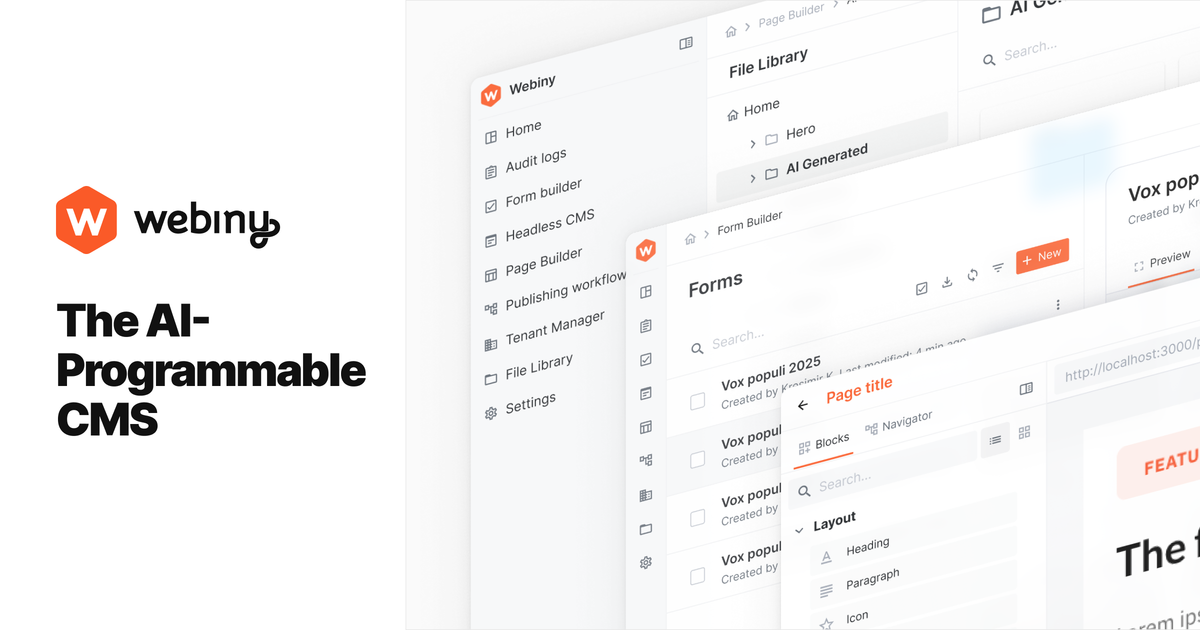
Flexible headless CMS modeling
Define content models through the UI, through code, or through the API, then expose them through GraphQL for application development.

Webiny is an open-source, self-hosted headless CMS for teams managing structured content, websites, and files on their own infrastructure, with enterprise AWS deployments.
Webiny is an open-source, self-hosted headless CMS platform built for teams that want to own their content infrastructure. The platform combines a headless CMS, website builder, and file manager with a TypeScript-based framework and GraphQL API.
The product is designed for enterprise-scale deployments and multi-tenant content operations. According to the source, developers can define content models, extend APIs, automate workflows, and build on a production-ready foundation that can be deployed to an AWS account.
Define content models through the UI, through code, or through the API, then expose them through GraphQL for application development.
Create and customize websites with a drag-and-drop editor and pre-built components.
Manage digital assets in a dedicated file manager for organizing and using content files across projects.
Set up publishing workflows, role-based access control, multi-tenancy, and team management depending on the plan.
Deploy into your own AWS account and choose between DynamoDB and DynamoDB plus OpenSearch for different scaling needs.
Use TypeScript, SDKs, lifecycle events, and the built-in GraphQL playground to extend the platform and connect custom logic.
Build structured content systems where developers define models and APIs, while editors manage entries through the UI.
Launch or extend marketing sites with a visual website builder and reusable components without rebuilding the core platform.
Organize and serve assets through a dedicated file manager when teams need to manage many digital files in one place.
Run multi-tenant platforms or branded instances from a single Webiny installation when one deployment has to support multiple projects.
Deploy content infrastructure into a customer-owned AWS account when self-hosting, infrastructure control, and scaling choices matter.
Webiny is designed to be deployed into your own AWS account. The quickstart explains how to create a project, deploy it, and open the Admin panel after the first deployment.
The quickstart says Webiny supports two database setups: Amazon DynamoDB for smaller or evaluation projects, and Amazon DynamoDB plus Amazon OpenSearch for larger or enterprise-level projects.
The pricing page shows a free Community plan, a Business plan for commercial projects and small teams, and an Enterprise plan with contact sales pricing.
The source highlights Headless CMS, Website Builder, and File Manager as core apps, with additional capabilities such as workflows, permissions, multi-tenancy, and SSO available in higher plans.
Traffic data is for reference only.

baserow.io
Baserow is an open-source no-code database platform for building databases, apps, dashboards, and automations with cloud or self-hosted deployment.

getgrist.com
Grist is a relational spreadsheet-database for organizing structured data, building workflows, and collaborating on documents, with cloud, self-hosted, enterprise, free, and paid trial options.

www.dograh.com
Dograh is an open-source, self-hostable platform for building and deploying production voice agents, connecting telephony, speech, language models, text-to-speech, workflows, and observability on your infrastructure or its managed cloud.

relaticle.com
Relaticle is an open-source CRM for teams that combines shared records, pipeline and task management with built-in AI chat and a 39-tool MCP server. Teams can use the hosted workspace or self-host the AGPL-3.0 application and connect external AI agents through MCP and REST API access.

deplo.build
Deplo is a self-hosted deployment platform that builds, deploys, and serves applications on servers you own. It provides repository-based deployments, HTTPS, managed data services, access controls, and optional AI-assisted infrastructure operations.

contentful.com
Model content once in Contentful, then manage and deliver it through APIs to websites, apps, and other digital channels. Editors work with structured entries while developers connect that content to their products.