
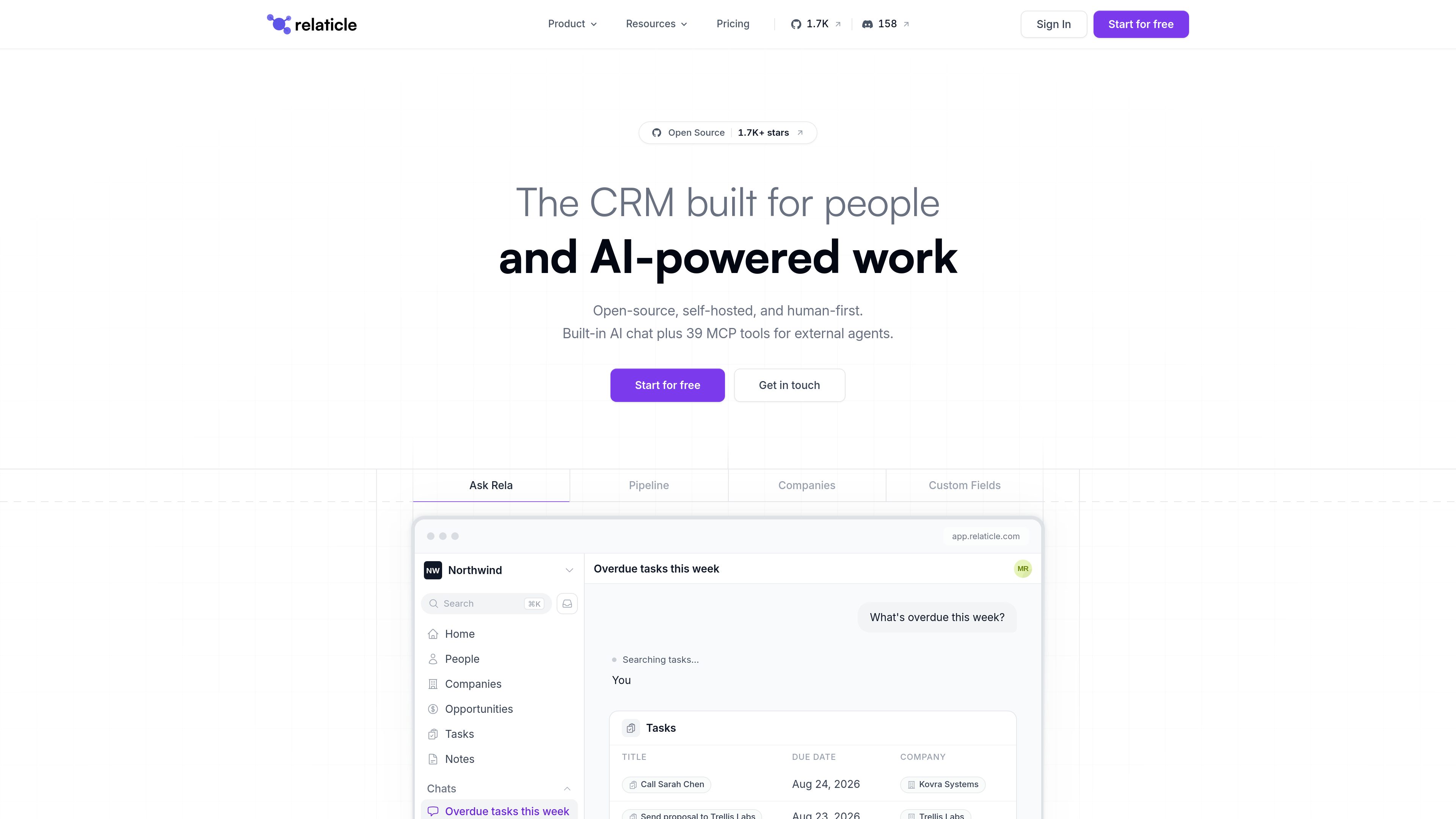
Built-in AI assistant
Ask Rela about CRM records in natural language, request summaries, find information, or create and change companies, people, opportunities, tasks, and notes.

Relaticle is an open-source CRM for teams that combines shared records, pipeline and task management with built-in AI chat and a 39-tool MCP server. Teams can use the hosted workspace or self-host the AGPL-3.0 application and connect external AI agents through MCP and REST API access.
Relaticle is a CRM for managing companies, people, opportunities, tasks, notes, custom fields, and customer activity in shared workspaces. It gives teams a standard web application for pipeline and relationship work, alongside chat-based access to the same records.
The built-in Rela assistant can answer questions, find and summarize records, and propose CRM changes. Relaticle also exposes its data through a REST API and a 39-tool MCP server, allowing external AI clients to work with the CRM. Teams can use the hosted service or self-host the AGPL-3.0 codebase.
Ask Rela about CRM records in natural language, request summaries, find information, or create and change companies, people, opportunities, tasks, and notes.
In-app creates, updates, and deletions appear as proposals that show the relevant values before saving. Users can approve or reject each proposal, and unanswered proposals expire after one day.
The built-in 39-tool MCP server connects the CRM to MCP-compatible clients including Claude, ChatGPT, Gemini, and custom agents. A REST API is available for custom integrations.
Manage company and people profiles, connect related records, add notes, assign tasks, and move opportunities through custom stages on a visual pipeline board.
Teams can define custom fields and import records through CSV with column mapping and validation review. Companies, people, opportunities, tasks, and notes can be exported as CSV.
The AGPL-3.0 application can be deployed on a team’s own server using Docker Compose. Self-hosted teams control the infrastructure and can connect an external provider or a local model through Ollama.
A sales team can ask Rela for a pipeline rollup or a deal summary instead of opening each record, then use the opportunity board and linked notes to prepare for the next conversation.
Teams can link tasks to people, companies, or opportunities, set due dates, and use chat to identify overdue work or propose a new follow-up task.
A user can ask the assistant to mark a deal as won, change a close date, or add a contact. The proposed field changes can be reviewed individually before they are written.
Teams already using an MCP-compatible agent can authorize it to query, create, update, delete, or analyze CRM records through Relaticle’s MCP tools. Developers can use the REST API for custom integrations.
Organizations that need to run the CRM on their own server can deploy the open-source codebase with Docker Compose and choose their own hosted or local AI model endpoint.
Rela can search and summarize CRM data, answer questions, and create, update, or delete companies, people, opportunities, tasks, and notes. It can also handle batches of up to 25 proposed records and answer questions using Relaticle’s documentation.
Not in the in-app chat. Every proposed create, update, or delete is shown in an approval card, and nothing is saved until the user approves it. Proposals that are not answered expire after one day.
Relaticle includes a 39-tool MCP server for MCP-compatible clients such as Claude, ChatGPT, Gemini, and custom agents. The tools can read, create, update, delete, and analyze CRM data. Direct MCP calls made by an authorized client apply immediately rather than waiting for in-app approval.
Yes. Relaticle is available under the AGPL-3.0 license and can be deployed with the published Docker Compose file. Self-hosted data remains on the team’s own server, and the assistant can use a supplied provider key or a local model through Ollama.
Cloud Pro is priced per workspace rather than per seat and includes unlimited users and records. The pricing page lists $19 per month when billed yearly or $24 per month when billed monthly, with a 14-day trial and no card required to start. AI usage is metered through credits.
Traffic data is for reference only.

omniline.app
Omni Line is a self-hosted package registry for teams that publish and consume packages across multiple ecosystems. It provides hosted, proxy, and virtual registries through one UI and REST API, with organization access controls and OSV-backed vulnerability checks.

baserow.io
Baserow is an open-source no-code database platform for building databases, apps, dashboards, and automations with cloud or self-hosted deployment.

webiny.com
Webiny is an open-source, self-hosted headless CMS for teams managing structured content, websites, and files on their own infrastructure, with enterprise AWS deployments.

www.dograh.com
Dograh is an open-source, self-hostable platform for building and deploying production voice agents, connecting telephony, speech, language models, text-to-speech, workflows, and observability on your infrastructure or its managed cloud.

imagine.dev
Appwrite is an open-source application platform for backend services, file storage, realtime features, and hosted web deployment. Build and scale apps with Auth, Databases, Storage, Functions, Messaging, and Sites in one place.

www.openscience.sh
OpenScience is an open-source AI workbench for scientific research. Bring literature search, scientific databases, code, experiments, compute, and results into one workspace, with included models, external provider keys, subscriptions, and local model support.