
Model-agnostic workspace
Use the models included with OpenScience, connect models from providers such as Claude, GPT, and Gemini, or continue using your own keys, subscriptions, and local models.

OpenScience is an open-source AI workbench for scientific research. Bring literature search, scientific databases, code, experiments, compute, and results into one workspace, with included models, external provider keys, subscriptions, and local model support.
OpenScience is an open-source workbench for agent-assisted scientific research. Its workspace combines literature, code, experiments, compute, and results so a research task can move from a question to sourced analysis and generated artifacts in one project. The product is designed to work with different model providers rather than tying the workflow to a single model.
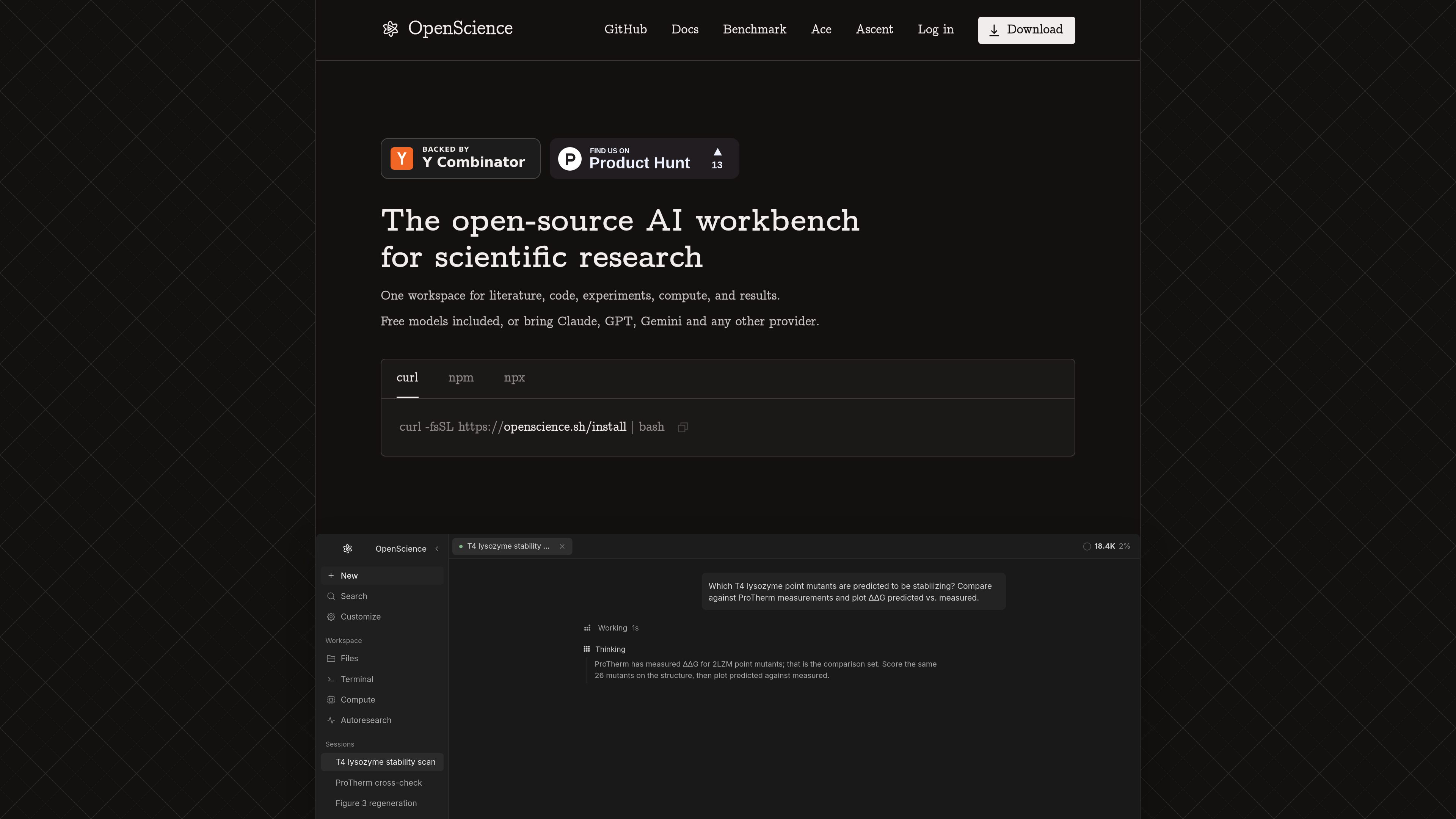
The research agent can search literature through OpenAlex and arXiv, read full-text papers, access scientific databases through 42 connectors, and use tools and compute while working. Its skill library contains 371 procedures across 18 categories, covering areas such as biology, chemistry, physics, machine learning, data analysis, and scientific writing. The site’s example workflow compares predicted protein-stability changes with ProTherm measurements, runs Python code, and produces a plot with its result location.
Use the models included with OpenScience, connect models from providers such as Claude, GPT, and Gemini, or continue using your own keys, subscriptions, and local models.
Search OpenAlex and arXiv, read papers, and use 42 connectors to scientific databases across six domains, including examples such as UniProt, PDB, ChEMBL, and PubChem.
The agent has access to an indexed library of 371 skills in 18 categories. It loads a skill’s full instructions when a task requires a particular research procedure.
Run work in long-lived Python and R kernels or a shell. Heavier jobs can be dispatched, with approval, to an SSH host, Slurm or PBS cluster, or Modal as durable jobs.
A lead agent can assign bounded tasks to seven workers, including an exploration worker and specialists for machine learning, biology, physics, chemistry, data, and general tasks. Worker reports include verification requirements.
Ace provides a reviewed roster of 21 models from providers including OpenAI, Anthropic, Google, and xAI, along with managed research search through one Wallet. Users can set a monthly cap and use Ace beside their own model routes.
Start with a scientific question, search relevant literature, read source papers, and use the resulting evidence in an analysis or report.
Ask the agent to write and run Python or R code, inspect files, generate figures, and retain outputs such as a plotted image in the project workspace.
Apply domain skills and database connectors to workflows involving biological structures, protein measurements, biomedical datasets, or related research data.
Break a broad question into bounded literature, data, coding, or domain-specific tasks and run specialist workers in parallel.
Send approved, compute-intensive jobs to a workstation, SSH host, Slurm or PBS cluster, or Modal while keeping the research task connected to its results.
OpenScience is an open-source AI workbench and scientific research agent for reading papers, writing code, running experiments, accessing scientific data, and organizing results.
No. The site says free models are included, and users can also connect their own provider keys, subscriptions, or local models. ChatGPT Plus or Pro users can sign in with OpenAI to use an existing subscription.
Yes. It supports Python and R kernels and a shell. Approved heavier jobs can be sent to an SSH host, Slurm or PBS cluster, or Modal as durable jobs.
Ace is an optional managed service built into OpenScience. It offers a reviewed set of models and managed research search through one Wallet, with pay-per-request usage and an optional monthly spending cap.
The site provides a browser workspace and also lists a download and CLI installation flow. The available material does not document the full platform differences or CLI capabilities.
Traffic data is for reference only.

baserow.io
Baserow is an open-source no-code database platform for building databases, apps, dashboards, and automations with cloud or self-hosted deployment.

relaticle.com
Relaticle is an open-source CRM for teams that combines shared records, pipeline and task management with built-in AI chat and a 39-tool MCP server. Teams can use the hosted workspace or self-host the AGPL-3.0 application and connect external AI agents through MCP and REST API access.

appwrite.io
Build app backends and deploy web frontends with an open-source platform for auth, databases, files, and functions.

www.dograh.com
Dograh is an open-source, self-hostable platform for building and deploying production voice agents, connecting telephony, speech, language models, text-to-speech, workflows, and observability on your infrastructure or its managed cloud.

imagine.dev
Appwrite is an open-source application platform for backend services, file storage, realtime features, and hosted web deployment. Build and scale apps with Auth, Databases, Storage, Functions, Messaging, and Sites in one place.

openship.io
Openship is an open-source deployment platform for building and running applications from Git repositories, local folders, or templates. Teams can use its dashboard, CLI, desktop app, or MCP interface to deploy on Openship Cloud, connected servers, or their own infrastructure.