
Instant branching
Create isolated branches from a production Postgres database using copy-on-write storage, so branches share data with the parent instead of making full copies.

Xata is a PostgreSQL platform with isolated, copy-on-write branches and anonymized production data for teams, agents, and CI/CD workflows.
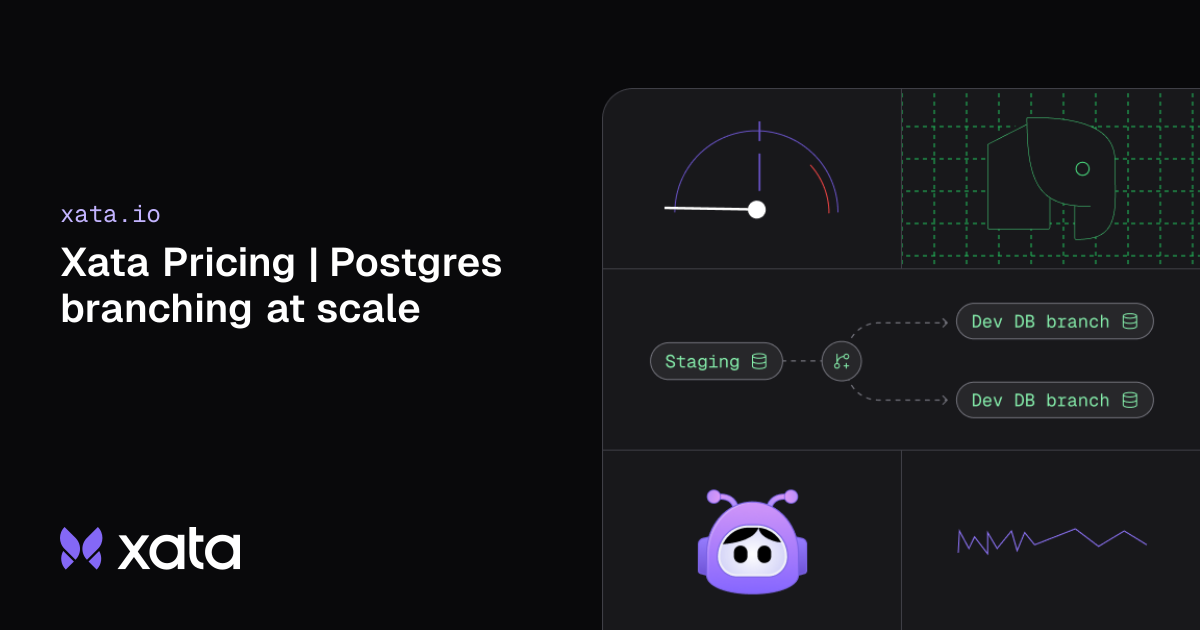
Xata is a PostgreSQL platform for teams that need many isolated databases for development, testing, and agentic workflows. It creates branches from a source Postgres database with copy-on-write storage, so new branches are fast to provision and do not require a full duplicate of the data.
The product is designed to work with real production data while reducing risk through anonymization and branch isolation. The source materials say teams can use Xata just for development workflows or extend it to production, and that it is available as a managed cloud service or as BYOC in the customer’s own cloud account.
Create isolated branches from a production Postgres database using copy-on-write storage, so branches share data with the parent instead of making full copies.
Automatically remove or mask sensitive data during replication so development branches start with anonymized production data.
Suspend idle branches and resume them on demand, reducing compute usage when branches are not active.
Use Xata as a managed service or deploy the data plane in your own cloud account through BYOC.
Run on upstream PostgreSQL and connect to existing Postgres environments such as RDS, Aurora, Cloud SQL, or self-hosted databases.
Track production database health with built-in observability for uptime, query latency, throughput, and active connections.
Give each pull request or coding agent its own isolated Postgres branch so changes can be tested against production-like data without interfering with shared environments.
Create short-lived databases for simulations, reinforcement learning episodes, load tests, or regression runs, then discard them after execution.
Replace slow SQL dump restores or shared staging replicas with instant branches that are ready in about a second and start from anonymized data.
Support teams that want to keep their production database in an existing cloud provider while using Xata only for development branches.
Run a production database on Xata when the team wants built-in branching, observability, read replicas, and point-in-time recovery in the same platform.
Xata can be used with existing Postgres databases, including databases hosted on RDS, Aurora, Cloud SQL, or self-hosted Postgres. The docs also say you can start with development workflows first and keep production where it is.
The source materials describe Xata as a PostgreSQL platform with instant branching, copy-on-write storage, scale-to-zero branches, anonymization, and the option to run as SaaS or BYOC.
The pricing page describes resource-based pricing with no per-user or per-branch fees. It also states that branches can scale to zero when idle, so compute is only billed while they are active.
The documentation says branches can be created in seconds, and the home page says Xata can clone a Postgres database in under a second, regardless of size.
The pricing page and docs indicate Xata is aimed at engineering teams, agents, CI/CD workflows, and platforms that need isolated Postgres branches with production-like data.