
All-in-one data governance platform
Secoda combines data cataloging, lineage, observability, quality, and governance so teams can search, understand, monitor, and control data in one place.

Secoda is an AI platform for data and analytics that helps teams catalog, govern, monitor, and understand data with metadata, lineage, docs, and AI workflows.
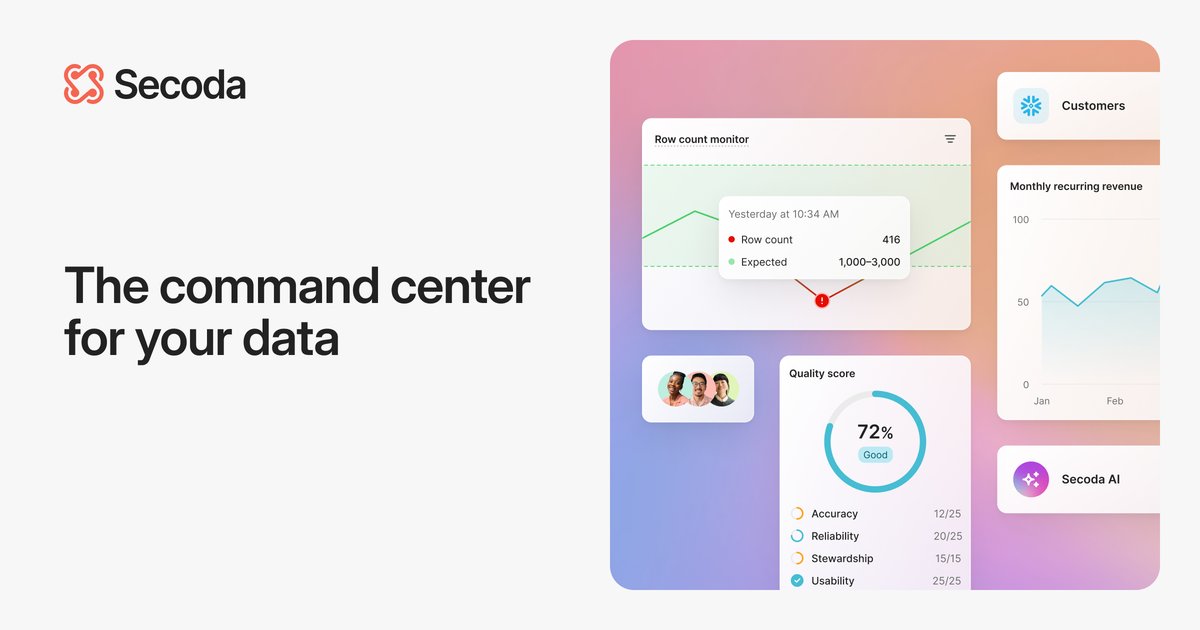
Secoda is an AI platform for data and analytics that brings together cataloging, lineage, observability, quality, documentation, and governance. Its homepage positions the product as a way to deliver trusted answers fast by combining enterprise data governance with context across the data stack.
The product is designed to connect directly to data sources, understand metadata and lineage, and surface that context through search, AI agents, docs, monitoring, and governance workflows. The pricing page splits the platform into Core, Premium, and Enterprise plans, with higher tiers adding controls such as policies, single-tenant or self-hosted deployment, access request management, SIEM logging, and unlimited integrations.
Secoda combines data cataloging, lineage, observability, quality, and governance so teams can search, understand, monitor, and control data in one place.
Users can find assets, trace their journey, and organize documentation with features for search, lineage, cataloging, documentation, and questions.
Monitoring features include data health checks, query monitoring, data profiling, usage insights, schema change alerts, and impact/root cause analysis.
Governance tools include policies, access requests, RBAC, groups, audit logs, PII scanning, and workspace management.
Secoda supports automated workflows such as automated cataloging, metadata ingestion, schema ingestion, bulk monitor creation, and AI-powered workflow assistance.
The platform offers integrations and administration features such as API access, SAML, SSH tunnels, VPC peering, SCIM, single-tenant deployment, and self-hosted deployment on higher plans.
Create a shared data catalog so analysts and operators can search for assets, understand definitions, and find the right resource without relying on repeated manual support.
Trace table and column relationships, surface dependencies, and understand how changes affect downstream work before data is updated.
Monitor data health, query performance, schema changes, and anomalies so teams can catch issues earlier and prioritize fixes.
Standardize governance with policies, RBAC, access requests, PII scanning, and audit logs for teams handling sensitive data.
Use AI-assisted workflows to automate documentation, catalog enrichment, and repetitive metadata tasks across the stack.
Secoda provides an API for docs, collections, lineage, dictionary, catalog, and questions. The pricing page says API access is included on the Core plan, and the FAQ notes API access on Business and Enterprise plans as well.
Secoda lists integrations with common data warehouses, BI tools, dbt, Git, and identity providers. The FAQ names Snowflake, BigQuery, Redshift, Databricks, Postgres, Oracle, Microsoft SQL, MySQL, and S3, plus Tableau, Looker, Metabase, Redash, Mode, Sigma, Power BI, and Google Data Studio.
Secoda says it works with both dbt Cloud and dbt Core, and can bring in YAML metadata, tests, tags, metrics, and column-level lineage.
Secoda is positioned as an all-in-one platform for data cataloging, observability, governance, lineage, documentation, and AI-powered workflows. The homepage says it connects directly to data sources to understand lineage, documentation, and metadata, while the pricing page separates capabilities across Core, Premium, and Enterprise plans.
Secoda says it does not pull in data itself; it pulls in metadata about data such as resource names, popularity, lineage, queries, descriptions, and frequent usage.