
Per-project backend stack
Each project gets its own isolated Postgres stack, with auth, object storage, realtime, and RLS available as part of the backend.

Powabase is a backend platform for AI apps with per-project Postgres, auth, storage, realtime, retrieval, and agents for coding agents and AI builders.
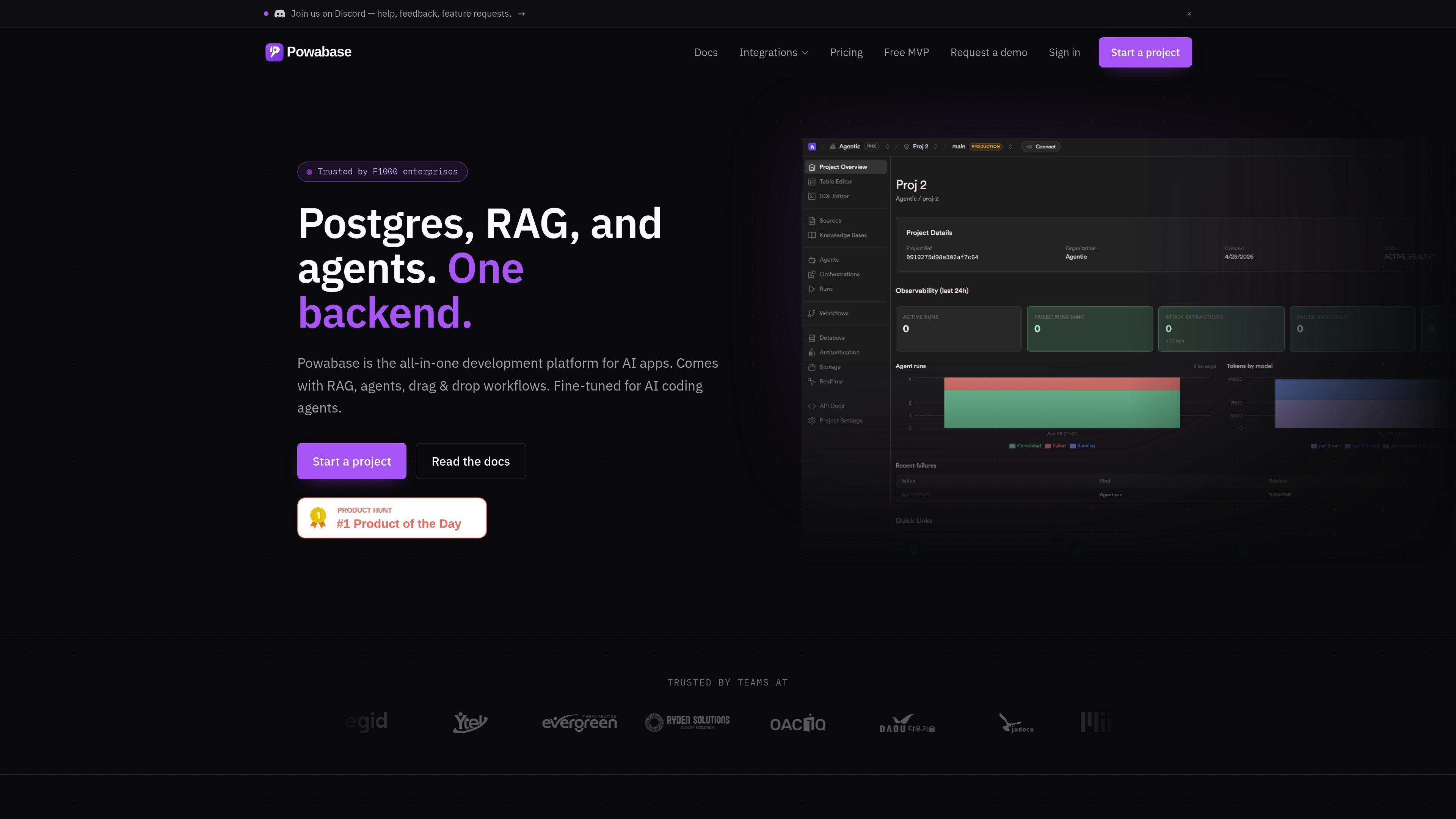
Powabase is a backend platform for AI applications built around Postgres, retrieval, agents, and workflows. The product combines per-project Postgres with auth, storage, realtime, a RAG pipeline, and an agent runtime so teams can build against one backend instead of stitching together separate services.
The site positions Powabase for developers using coding agents and vibe tools such as Claude Code and Codex. It can be accessed through the Powabase agent skill, a REST API, and auth connections, and it supports managed cloud deployment as well as self-hosting with Docker or Kubernetes.
Each project gets its own isolated Postgres stack, with auth, object storage, realtime, and RLS available as part of the backend.
Upload PDFs, images, office files, or URLs and let Powabase extract, chunk, embed, index, and search them with built-in retrieval options.
Define ReAct-style agents with multiple LLMs, knowledge bases, tools, session state, streamed events, and citations.
Build multi-step flows by connecting triggers, conditions, agents, HTTP calls, and code blocks, then deploy them as HTTP endpoints.
Connect through the agent skill, REST API, or auth guide so coding agents and generated apps can use the backend directly.
Run on Powabase Cloud or self-host with Docker Compose or Kubernetes, while bringing your own LLM keys if you want separate model billing.
Use Powabase when you want a coding agent to create an application and provision the backend in the same workflow, with schema, auth, retrieval, and agents available from one project.
Use the RAG pipeline to turn product docs, help centers, PDFs, images, office files, or URLs into a searchable knowledge base with citations and streamed answers.
Use project-level isolation, row-level security, and auth to build internal tools or customer-facing apps that need scoped access by team, department, or organization.
Use visual workflows and callable HTTP endpoints to chain agents, conditions, code, and API calls into multi-step automations.
Use managed cloud, Docker Compose, or Kubernetes depending on whether you want a hosted backend, a small self-hosted deployment, or a cluster-based install.
Powabase combines an isolated Postgres database, auth, storage, realtime, a RAG pipeline, and an agent runtime in one backend. The site frames it as the backend layer for AI apps built with coding agents and other vibe tools.
The integrations page says Powabase connects through the agent skill, the REST API, or the auth guide. It lists support for tools such as Claude Code, Codex, Antigravity, OpenCode, Replit, Lovable, v0, Base44, and Bolt.new.
The site says you can use the managed Powabase Cloud, self-host with Docker Compose on a single host, or deploy to your own cluster with Kubernetes. It also says you can bring your own LLM keys.
The pricing page says plans start free, with paid tiers at Self Serve and Scale, plus an Enterprise option with sales-led terms. It also says paid plans use monthly credits that roll over and can be spent on compute, per-call costs, MAU overages, and storage.
The source describes Powabase as centered on Postgres, RAG, workflows, and agents. It does not provide a detailed list of every supported framework or model beyond named LLM providers and selected agent tools.