
Multimodal pipeline orchestration
Coordinate voice, video, text, and images in a single pipeline with frame-level control over conversation steps.

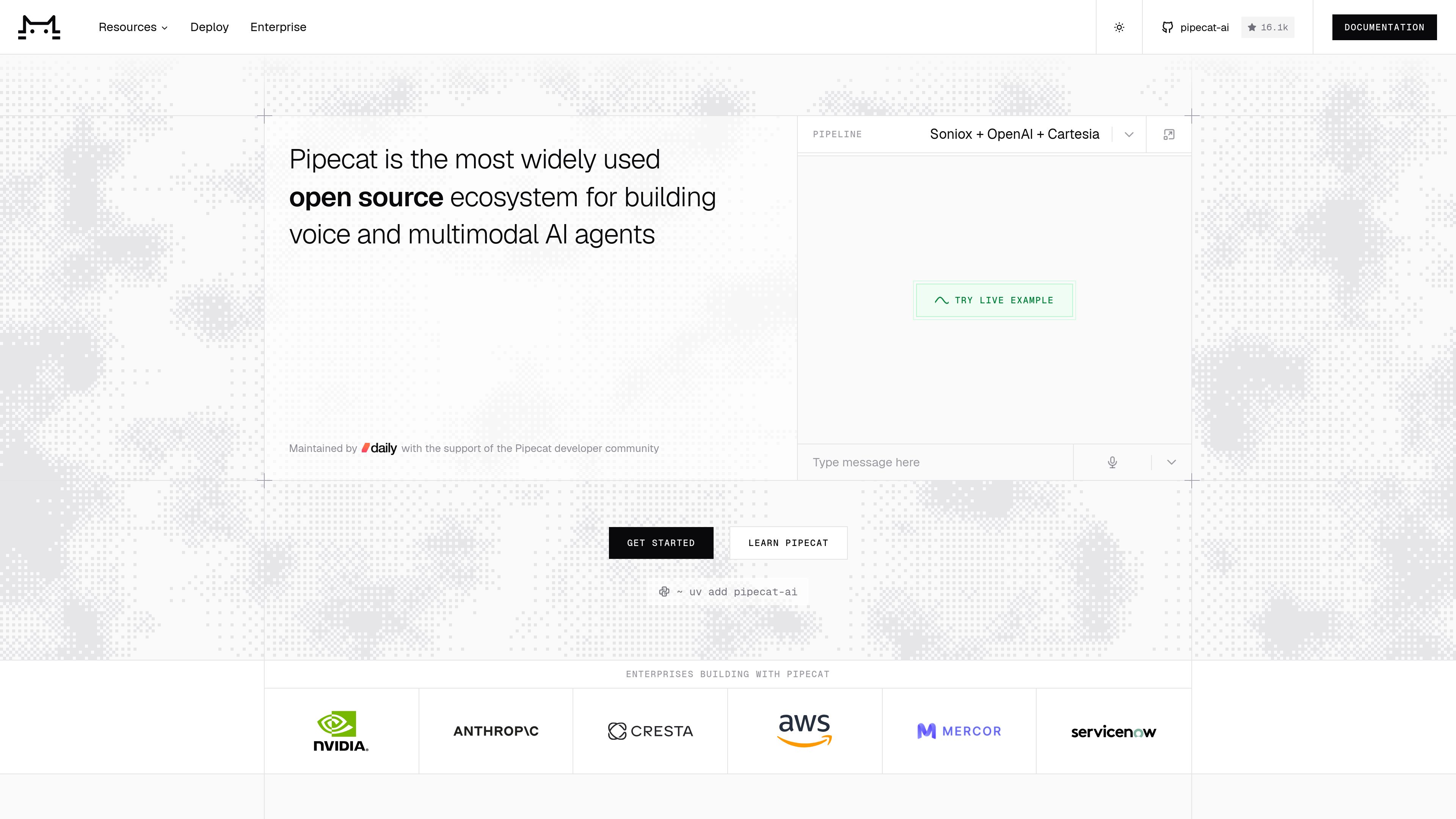
Pipecat is an open-source Python framework and ecosystem for building real-time voice and multimodal AI agents. It helps developers compose pipelines that coordinate speech, language, vision, video, text, tools, and telephony transports.
Pipecat is an open-source framework for building real-time voice and multimodal conversational AI agents. Maintained by Daily with support from the Pipecat developer community, it provides a pipeline-based way to coordinate voice, video, text, images, models, tools, and transports in one application.
The framework processes data as frames through a real-time pipeline. Developers can connect a transport, select speech, language, and vision services, add tools, and control how each step of a conversation runs. The site says Pipecat can work with more than 200 integrated providers and services, with model and service changes generally made in one line of code.
Projects can be run on infrastructure where Python runs, deployed through Pipecat Cloud, or supported through Pipecat Enterprise for organizations that want Pipecat Cloud in their own AWS, Azure, or GCP environment.
Coordinate voice, video, text, and images in a single pipeline with frame-level control over conversation steps.
Swap speech, language, and vision services from a stated ecosystem of more than 200 integrated providers and services, typically with a small code change.
Frames move through the pipeline as they are produced, allowing the agent to begin responding without waiting for every preceding stage to finish.
Interruption handling, turn detection, and context management support conversational voice experiences.
Hand off work to subagents for long-running tools and complex tasks, or use Pipecat Flows when a conversation must follow a defined path.
The CLI scaffolds runnable projects, while client SDKs, a UI kit, metrics, traces, and OpenTelemetry support help teams build and inspect applications.
Build agents that listen and respond during a live conversation, with turn detection and interruption handling for a more interactive exchange.
Connect conversational agents to SIP or PSTN transports when the interaction needs to take place over phone infrastructure rather than only in a browser.
Combine voice with video, text, and images in one application when users need more than a voice-only interface.
Route complex or long-running work to subagents and give the conversation tools to perform tasks within a composed pipeline.
Use Pipecat Flows for interactions that need a defined path, rather than relying solely on an open-ended conversational exchange.
Pipecat is an open-source framework and ecosystem for building voice and multimodal conversational AI agents.
The site describes pipelines that coordinate voice, video, text, and images, with frame-level control over each conversation step.
The reviewed product page lists WebRTC, SIP, and PSTN transports.
The open-source framework can run on infrastructure where Python runs. The site also describes Pipecat Cloud as a managed deployment option and Pipecat Enterprise as Pipecat Cloud deployed in a customer's own AWS, Azure, or GCP environment.
Yes. Pipecat states that developers can use speech, language, and vision services from more than 200 integrated providers and services, although the reviewed pages do not list them individually.

platform.claude.com
Claude Platform gives developers programmatic access to Claude models and managed agent infrastructure for building agents and applications. It includes a REST API, official client SDKs, a web Console, and documentation for direct integrations.
learn.microsoft.com
Semantic Kernel is Microsoft’s public GitHub software project for integrating large language model technology into applications. The repository includes implementation and documentation directories for .NET, Python, and Java development.
modelcontextprotocol.io
The official TypeScript SDK for building Model Context Protocol servers and clients. It provides a repository-organized foundation for MCP development, with separate client, server, core, middleware, documentation, and example areas.
learn.microsoft.com
Microsoft Agent Framework is a developer framework for building, orchestrating, and deploying AI agents and multi-agent workflows. It supports implementations in Python and .NET.
adk.dev
Agent Development Kit (ADK) is an open-source framework for building, evaluating, and deploying conversational and non-conversational AI agents. It supports multi-agent systems, tools, structured workflows, and production runtimes across Python, TypeScript, Go, Java, and Kotlin.
ai-sdk.dev
AI SDK is a TypeScript toolkit for building AI-powered applications and agents across supported model providers and web frameworks. It provides shared APIs for model generation, tool use, streaming, structured output, and AI user interfaces.