
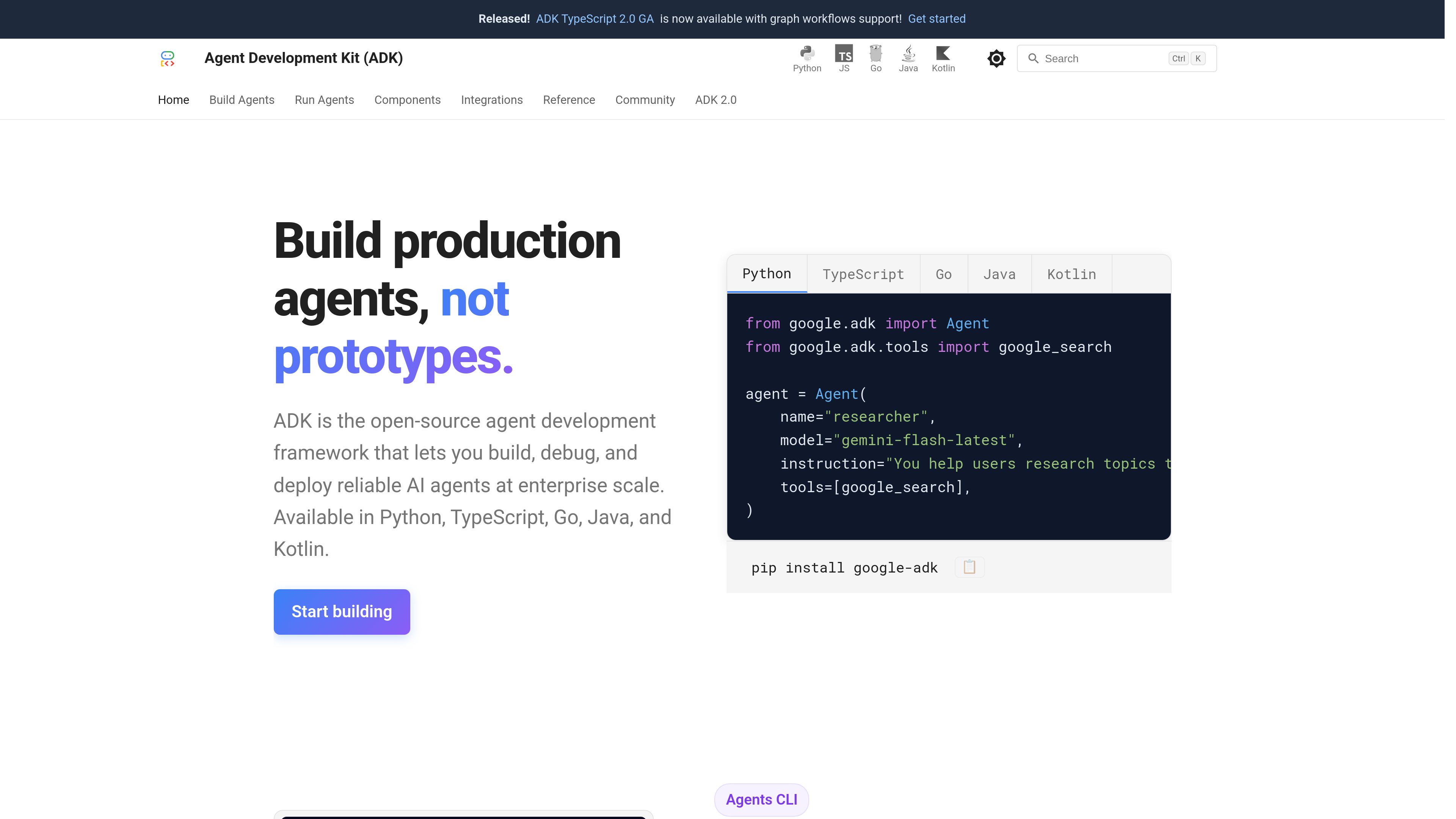
Multi-agent orchestration
Compose specialized agents into hierarchical systems and delegate subtasks through model-driven transfer or explicit agent-tool invocation.
Agent Development Kit (ADK) is an open-source framework for building, evaluating, and deploying conversational and non-conversational AI agents. It supports multi-agent systems, tools, structured workflows, and production runtimes across Python, TypeScript, Go, Java, and Kotlin.
Agent Development Kit (ADK) is an open-source framework for building, managing, evaluating, and deploying AI-powered agents. It supports conversational and non-conversational applications, including individual tool-using agents, structured workflows, and multi-agent systems.
The framework is built around agents, tools, callbacks, sessions, memory, artifacts, events, models, and runners. Agents can use language models for reasoning or act as deterministic workflow controllers. Tools extend agents to external APIs, search, code execution, and other services; sessions manage interaction history and state; memory supports context across sessions; and artifacts store files or binary data associated with an interaction.
ADK also provides development and runtime capabilities for building, testing, evaluating, observing, and deploying agents. Its documented ecosystem includes an Agents CLI, web interface, visual builder, API server, evaluation tools, logging, metrics, traces, and deployment options such as Cloud Run and GKE. It is available in Python, TypeScript, Go, Java, and Kotlin.
Compose specialized agents into hierarchical systems and delegate subtasks through model-driven transfer or explicit agent-tool invocation.
Create sequential, parallel, loop, routing, and custom-template workflows that combine deterministic execution with adaptive model reasoning.
Extend agents with custom function tools, built-in tools, other agents, MCP tools, OpenAPI tools, search, code execution, and service calls.
Use sessions, events, state, memory, callbacks, and artifacts to manage interaction history, longer-term context, execution events, files, and binary data.
Use the Agents CLI and runtime tools to scaffold, run, test, evaluate, and debug agents, with documented support for evaluation criteria, simulations, and custom metrics.
Develop in Python, TypeScript, Go, Java, or Kotlin, then use documented agent-runtime deployment paths including Cloud Run and GKE.
Create an agent that searches for information and uses tools to help users investigate topics, with session context and artifact handling available when the workflow needs them.
Represent a process with sequential, parallel, loop, or routing steps when some actions require fixed execution paths and others require language-model reasoning.
Divide a complex task among purpose-built agents and coordinate their work through hierarchical delegation or explicit agent-tool calls.
Build agents that interact with APIs, OpenAPI services, MCP tools, custom functions, code execution, or other services rather than only returning conversational text.
Develop and evaluate an agent, run it through an agent runtime, deploy it to documented environments such as Cloud Run or GKE, and inspect logs, metrics, or traces.
No. ADK supports conversational and non-conversational agents. Agents can participate in workflows, call tools, execute code, manage artifacts, and coordinate with other agents.
The site lists Python, TypeScript, Go, Java, and Kotlin, with installation examples and API references for these ecosystems.
Yes. Documented options include custom function tools, agent tools, MCP tools, OpenAPI tools, search, code execution, and calls to external APIs or services.
Sessions contain the context and history of an interaction through events and state. Memory is a separate mechanism for recalling information across sessions, while artifacts manage files or binary data associated with a session or user.
The documentation includes an agent runtime and deployment guidance for Cloud Run and GKE, along with runtime configuration and testing for deployed agents.
learn.microsoft.com
Microsoft Agent Framework is a developer framework for building, orchestrating, and deploying AI agents and multi-agent workflows. It supports implementations in Python and .NET.

platform.claude.com
Claude Platform gives developers programmatic access to Claude models and managed agent infrastructure for building agents and applications. It includes a REST API, official client SDKs, a web Console, and documentation for direct integrations.

context.ai
Context is an enterprise AI agents platform for building, deploying, and improving agents on customer infrastructure, with workspace, runtime, context, evaluation, connectors, and IdP access controls.

cloud.google.com
Gemini Enterprise Agent Platform, formerly Vertex AI, is Google Cloud’s platform for developers and technical teams to build, deploy, govern, and optimize AI agents, generative AI applications, and machine learning models.

onereach.ai
OneReach.ai GSX orchestrates, runs, and governs enterprise AI agents at scale.

octomind.run
Octomind Cloud runs AI agents on persistent cloud machines for research, writing, web work, software development, and scheduled routines. Users give instructions in plain language and can receive results through the web panel, Telegram, WhatsApp, or Slack.