
Automated model testing
Run more than 100 built-in and customizable tests to evaluate hallucination, completeness, relevance, toxicity, bias, and other output qualities.

Openlayer is an AI governance and observability platform for testing, monitoring, and controlling ML and LLM systems before release and in production.
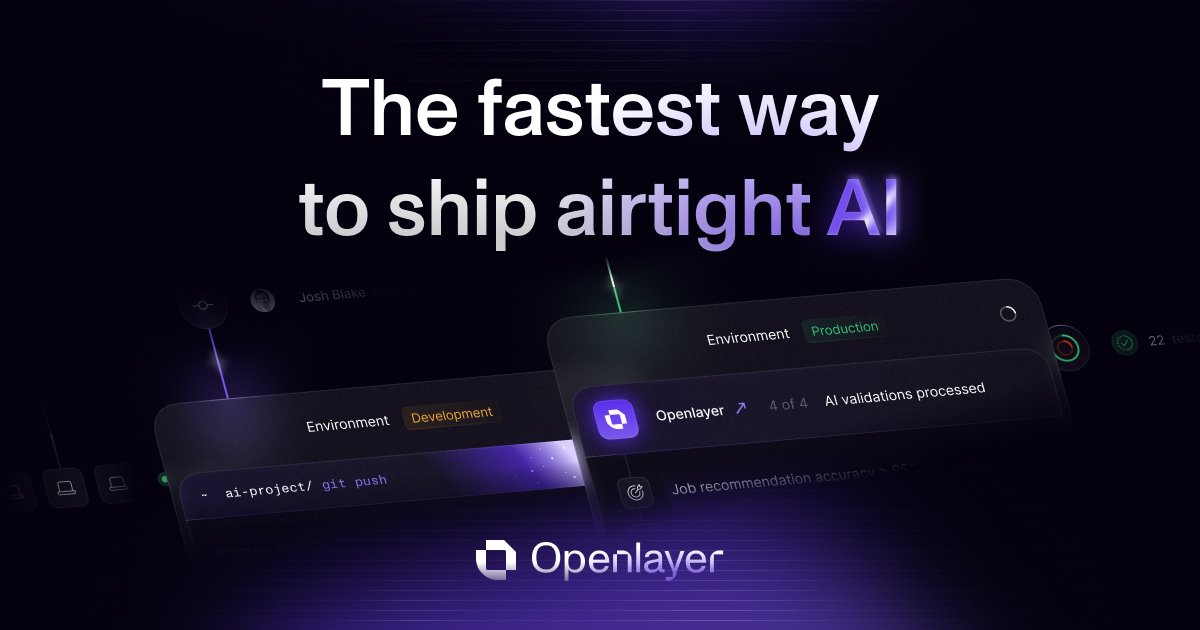
Openlayer is an AI governance and observability platform for evaluating, monitoring, and controlling ML and LLM systems. The product combines offline evaluation, production tracing, live guardrails, and automated compliance workflows so teams can test systems before release and watch them in production.
The site positions Openlayer for builders working on GenAI apps, agents, copilots, retrieval-augmented generation, and traditional ML models. It supports structured testing, request tracing, data quality checks, and compliance alignment with standards such as NIST, ISO/IEC 42001, OWASP, and the EU AI Act.
Run more than 100 built-in and customizable tests to evaluate hallucination, completeness, relevance, toxicity, bias, and other output qualities.
Compare prompts, model providers, and system changes to spot regressions and track improvements over time.
Trace prompts, tool calls, intermediate steps, responses, latency, and cost across LLM pipelines and agent workflows.
Run live safety and performance checks and set alerts for issues such as prompt injection, data leaks, latency spikes, and inappropriate content.
Use SDKs, APIs, CLI workflows, GitHub Actions, and Git-based processes to trigger tests as part of development and deployment.
Support shared review and feedback across engineers, product managers, researchers, and other stakeholders in a single workspace.
Evaluate prompts, model outputs, and release candidates before shipping by using test suites, comparisons, and LLM-as-a-judge scoring to catch regressions early.
Monitor live GenAI systems for prompt injection, toxic output, data leaks, latency, and cost issues, then investigate failures with full request traces.
Run automated checks on incoming data to detect schema changes, drift, and anomalies before bad data reaches models.
Coordinate review among engineers, PMs, researchers, and other stakeholders with shared evaluation results, comments, and comparison workflows.
Align AI systems with governance and compliance frameworks by using testing and monitoring workflows that support standards such as NIST, ISO/IEC 42001, OWASP, and the EU AI Act.
Openlayer supports structured testing for LLMs and ML models, including LLM-as-a-judge scoring, rubric-based evaluation, prompt test coverage, and comparisons across versions or prompts.
The source pages state support for OpenAI, Anthropic, Hugging Face, LangChain, OpenTelemetry, Snowflake, GitHub Actions, GitLab CI, and more, depending on the workflow and product area.
Openlayer can trace prompts, tool calls, latency, cost, model responses, and failure modes across multi-step and retrieval-based workflows.
The pricing page shows a Basic trial plan and an Enterprise plan. Basic includes 20,000 inferences per month, CLI/SDK/API access, and community support, while Enterprise adds options such as team access controls, on-prem deployment, explainability, SAML SSO, and white-glove onboarding.