
MCP server Inspector
Connect to a local MCP server, call its tools, inspect raw requests and responses, and review trace information. The open-source Inspector can be launched with npx.
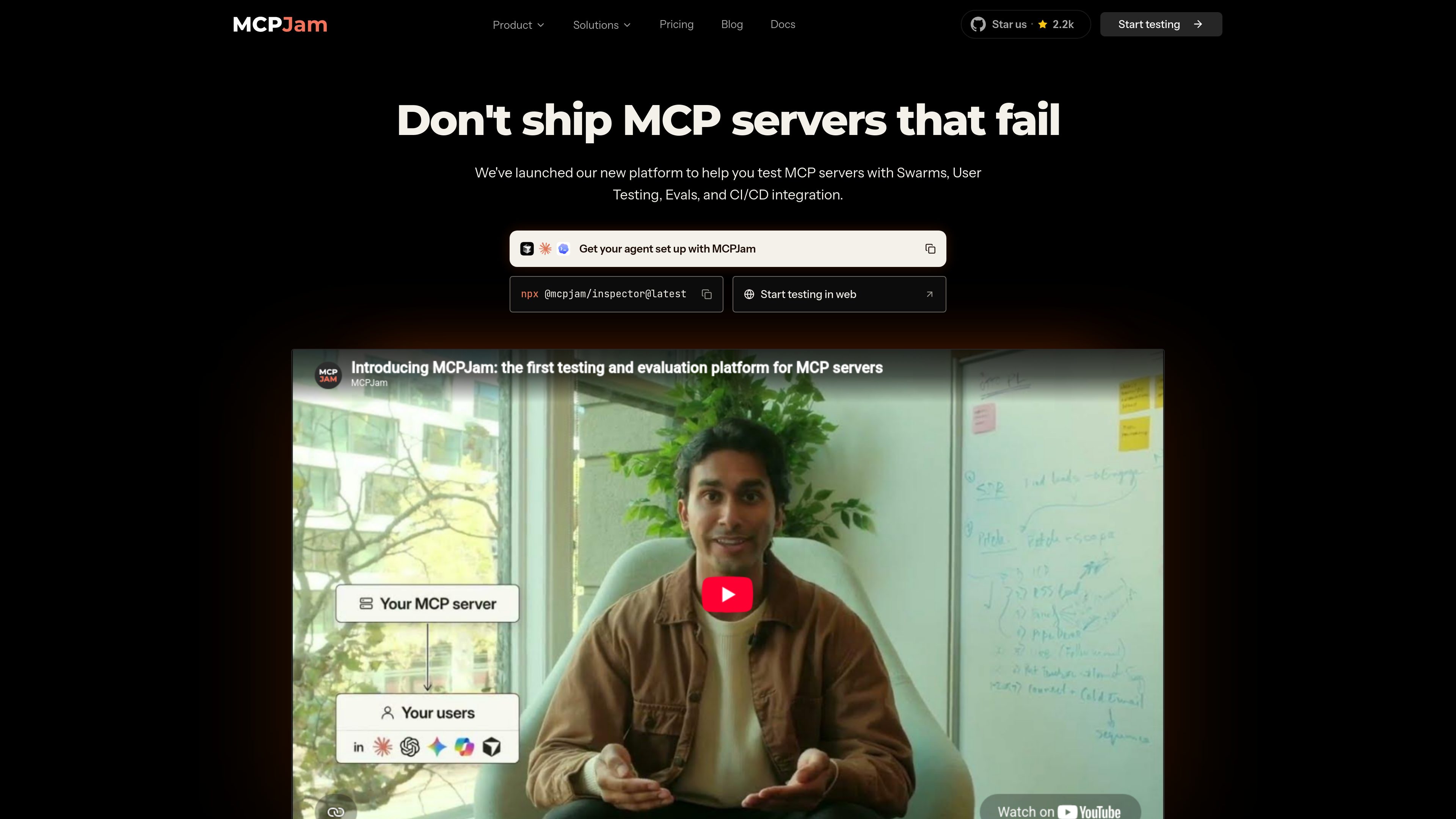
MCPJam is a testing and evaluation platform for MCP servers. It helps developers inspect servers locally, run user and model-based tests, and add behavior checks to CI/CD workflows.
MCPJam is a developer tool for testing, debugging, and evaluating Model Context Protocol (MCP) servers. It covers the workflow from local inspection and OAuth troubleshooting to model-based evaluations, user testing, simulated swarms, and CI/CD checks.
Its core purpose is to show whether an MCP server works correctly in realistic client and model interactions. Developers can inspect tool calls and protocol behavior locally, then turn workflows into repeatable suites that measure outcomes such as accuracy, latency, and failure patterns. CI/CD integrations can use those evaluations as release gates.
Connect to a local MCP server, call its tools, inspect raw requests and responses, and review trace information. The open-source Inspector can be launched with npx.
Trace OAuth and XAA or EMA authentication flows step by step and use conformance checks to identify where an authorization flow breaks.
Generate evaluation suites from an MCP server’s tools and run them with a real model. Results can include accuracy, latency, and diagnosed failure patterns rather than protocol checks alone.
Create hosted, shareable acceptance-testing environments that mirror major AI hosts. Tester sessions can expose usability gaps and become replayable regression tests.
Run multi-turn journeys for generated or selected user personas across selected clients in parallel, helping expose edge cases across different interaction paths.
Use the MCPJam CLI or SDK in GitHub Actions or another pipeline. Eval suites return pass/fail exit codes, while hosted runs track accuracy over time so behavior regressions can block a merge.
A developer can launch the Inspector locally, connect an MCP server, call tools, and read the underlying requests, responses, and traces before integrating the server with an AI client.
An engineer investigating a protected MCP server can step through its OAuth and cross-app access flow, use conformance checks, and locate the stage where authorization fails.
A team can generate eval suites from its server tools and run workflows across selected clients to measure whether models choose and use tools correctly, including accuracy and latency.
Product and engineering teams can share a hosted testing environment with testers, collect per-turn feedback on conversations, and preserve useful sessions as regression cases.
A team can run MCPJam SDK evals through its existing test runner or use CLI gates in CI. A failing pass-rate check can return a non-zero status and block a merge before the change reaches users.
The product provides an open-source Inspector that can be launched with npx. You can connect a server locally, call its tools, and inspect requests, responses, and traces. MCPJam also provides web and desktop entry points.
No. Its eval workflow is intended to test real model behavior, including whether a model uses tools correctly. Results can include accuracy, latency, and diagnosed failure patterns; CI gates are designed to catch regressions that unit tests may miss.
Yes. The CLI and SDK can be used with GitHub Actions or another pipeline. SDK eval suites run through a test runner such as Jest or Vitest, and a failing suite returns a pass/fail status that can prevent a merge.
MCPJam’s published workflows show cross-client testing and specifically reference ChatGPT, Claude, Cursor, and Copilot. The available clients depend on the testing workflow and configuration.
The published pricing information lists a free plan with core testing tools, including the Playground, OAuth Debugger, Evals, User Testing, Swarm, and CI/CD checks. It includes 200 credits per day and unlimited seats; paid plans provide higher usage and additional collaboration, history, and support options.

deepeval.com
DeepEval is an open-source LLM evaluation framework for testing and benchmarking AI applications. It helps developers run pytest-native evaluations, score outputs and agent traces, and iterate on systems across text, image, audio, and voice workflows.

www.galileo.ai
Galileo is an AI observability and evaluation platform for testing, debugging, and governing LLM and agent systems across development and production. It helps teams turn evaluation results into production guardrails and monitor AI behavior at scale.

jev-state.vercel.app
Jev State is a workspace for defining, testing, and regression-checking conversational decisions powered by Jev. It helps teams inspect why an agent takes a step and export runnable TypeScript and tests for an application.

modelcontextprotocol.io
MCP Inspector is an open-source visual testing tool for Model Context Protocol (MCP) servers. It is intended for developers who need to inspect and test MCP server behavior through a visual interface.
www.giskard.ai
Giskard is an AI security and evaluation platform for testing conversational LLM agents before and after deployment. It combines automated red teaming, quality evaluation, runtime guardrails, and remediation workflows for teams responsible for reliable AI systems.

www.promptfoo.dev
Promptfoo is an AI security and testing platform for evaluating LLM applications, agents, models, and workflows. It helps developers and security teams find vulnerabilities, validate guardrails, map findings to security frameworks, and track remediation through development and deployment.