
Output compression for agents
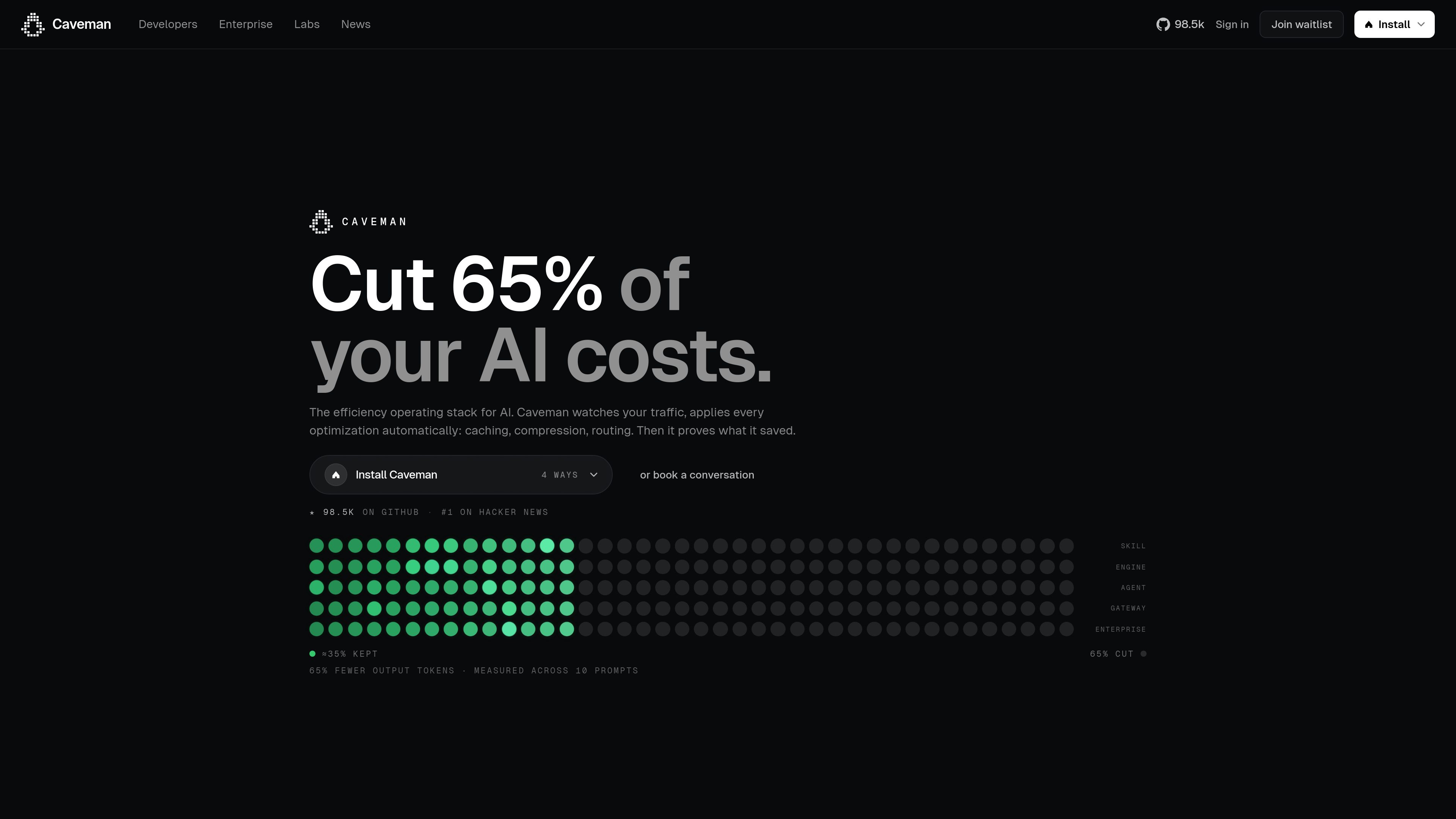
The Caveman Skill rewrites agent replies into shorter outputs while keeping code, commands, and errors byte-for-byte exact. The source describes a roughly 65% average reduction in output tokens for supported prompts.

Caveman is a token-efficiency stack for AI agents and production workflows. It helps teams reduce eligible context, route traffic, and measure verified savings across local tools, a TypeScript SDK, and a managed cloud layer.
Caveman is an efficiency stack for agent-native development and AI operations. It combines local compression tools, a TypeScript agent SDK, and an in-development cloud gateway so teams can reduce eligible context, track token spend, and verify where savings come from.
The product is organized as layered components that can be adopted separately. The site presents the Caveman Skill for output compression in Claude Code and 30+ agents, Caveman Proxy for recoverable local context compression, and Caveman Agent SDK for setting spend guards and context rules in TypeScript. Caveman Cloud and Caveman Enterprise extend the same system to hosted and on-prem traffic with eval-gated optimization and verified savings workflows.
The Caveman Skill rewrites agent replies into shorter outputs while keeping code, commands, and errors byte-for-byte exact. The source describes a roughly 65% average reduction in output tokens for supported prompts.
Caveman Proxy runs locally and compresses eligible context on the user’s machine without requiring an account. The product text says the original bytes are recoverable.
Caveman Agent SDK lets developers define tools, context, evals, and spend guards in TypeScript so each run can follow declared checks before a cheaper context plan is locked in.
The workspace shows AI spend by cause, model, key, member, and workflow, using provider-reported usage against public catalog list prices rather than guessed averages.
Caveman Cloud applies caching, compression, and routing only when traffic qualifies. The site emphasizes fail-closed behavior and rollback when gates do not pass.
The pricing page describes a causal-cache ledger, receipt verification, receipt export, and Ed25519 verification in preview, with automatic signing and gainshare charging disabled.
Teams using Claude Code, Codex, Cursor, Gemini, or similar tools can install the skill to make responses shorter while preserving exact code and command content.
Developers who want lower token usage without sending prompts to a hosted service can use the local wrap/Proxy flow on their own machine.
Teams building support, operations, or document agents can define context, tools, and evals in TypeScript and keep only context plans that pass their checks.
Organizations that need a clearer spend view can use the workspace to break costs down by member, key, model, workflow, and cause.
Teams that start local can move toward Caveman Cloud or Enterprise when they want eval-gated caching, routing, verified savings, or on-prem deployment.
Caveman provides tools for compressing AI output, reducing eligible context, applying spend guards, and measuring AI usage across local and hosted workflows.
The site presents Caveman as a stack of related products. Some parts are live, while Caveman Cloud and Enterprise are described as in development or preview.
No. The pricing page says the local wrap runs on your machine with BYOK and no account required, and a free account is optional for cloud sync and a dashboard seat.
The source names Claude Code, Codex, Gemini, Cursor, and 30+ agents.
The product pages describe recoverable compression for the proxy layer and byte-safe handling for supported transformations, with original bytes stored before lossy replacement.
Traffic data is for reference only.

apps.mergeable.io
Diffsmith is a native macOS app for reviewing local git changes made by AI coding agents such as Claude Code, Cursor, Codex, and Copilot. Add inline comments and send them back to the agent as a prompt or via a local MCP server.

hcompany.ai
AI products for browser automation, multimodal models, and enterprise workflows

extella.ai
Extella is a local AI platform that installs tools, runs workflows, and remembers reusable setups on your machine—automating repeatable tasks from plain-language requests without the terminal.

donely.ai
Donely is a multi-instance OpenClaw platform for deploying AI agents from one dashboard, with access control and unified billing for personal, team, and enterprise use.

www.tryargos.cc
Argos is a Chrome extension and desktop/browser automation tool that lets you open tabs, fill out forms, research topics, and complete tasks in your logged-in browser. It also includes a CLI that runs locally and can be controlled via Telegram.

agents.craft.do
Craft Agents is an open-source desktop app for working with AI agents, models, APIs, MCP servers, local files, and a built-in browser.