
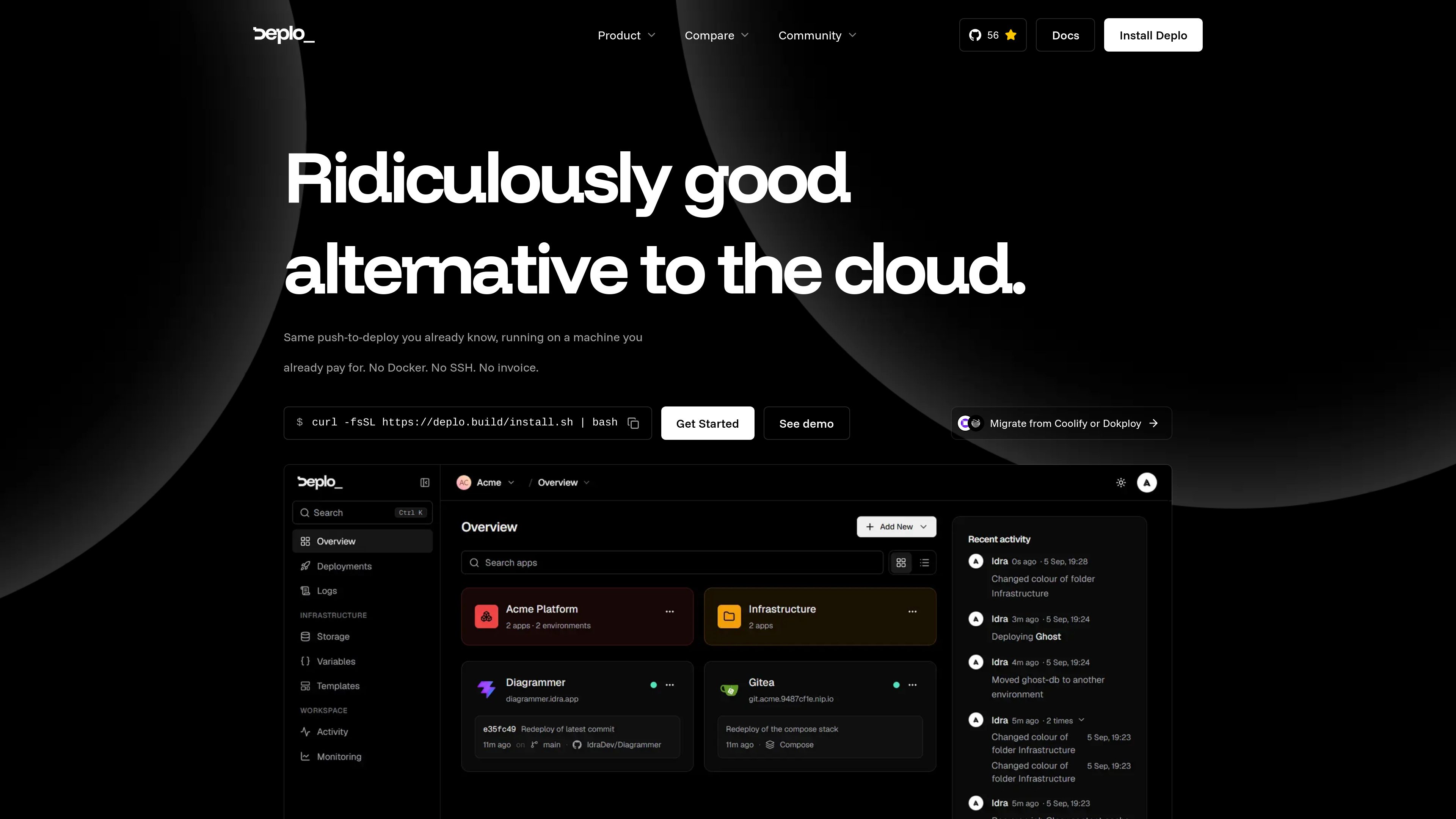
Repository-based deployments
Connect GitHub, GitLab, Bitbucket, or Gitea. Pushes to a production branch can deploy automatically, and pull requests receive preview URLs that disappear when the pull request closes.

Deplo is a self-hosted deployment platform that builds, deploys, and serves applications on servers you own. It provides repository-based deployments, HTTPS, managed data services, access controls, and optional AI-assisted infrastructure operations.
Deplo is a self-hosted deployment platform for running applications on servers you own. It deploys from repositories or templates, detects supported frameworks, builds applications, and serves them over HTTPS. Its dashboard covers routine deployment and infrastructure tasks without requiring Docker, SSH, or YAML knowledge, while Docker and a compose escape hatch remain available for users who need them.
The platform supports push-based deployments, pull-request preview URLs, rollback to a previously working image, encrypted build and runtime variables, and managed database services. It is open source under AGPLv3 and is currently in beta, with a stable release targeted for Q4 2026 according to the product site.
Connect GitHub, GitLab, Bitbucket, or Gitea. Pushes to a production branch can deploy automatically, and pull requests receive preview URLs that disappear when the pull request closes.
Deplo recognizes the application framework and fills in the port, build command, and start command. Node, Python, Go, PHP, Ruby, and Rust applications can build through Nixpacks.
A deployed web application receives a public URL with HTTPS, and a custom domain can have its certificate issued. Managed Postgres, MySQL, MongoDB, and Redis services can be added and reached by name.
Fine-grained capabilities separate actions such as deploying and deleting, while per-folder grants restrict members to a defined part of the fleet. The activity trail records who performed an action and when.
The native MCP server allows Claude, Cursor, or another MCP client to deploy, read logs, and roll back using a user-controlled token. It is off by default and applies the same permission checks as the dashboard.
Point Deplo at a Next.js, Nuxt, SvelteKit, Astro, Remix, or other supported application repository. It detects the framework, builds the project, and provides a public HTTPS URL without requiring a Dockerfile.
Connect a repository and use the production branch for continuous deployment. Teams can also use temporary preview URLs for pull requests and return to the last working image when a release fails.
Add a managed Postgres, MySQL, MongoDB, or Redis service alongside an application. The service is reachable by name, allowing the application and its data layer to run on the same self-managed infrastructure.
Enable the MCP server and provide a minted, revocable token to Claude, Cursor, or another MCP client. The agent can deploy, inspect logs, and roll back while remaining subject to the permissions granted in Deplo.
No for the standard dashboard workflow. Deplo runs Docker underneath but handles the container work when deploying from a repository or template. A terminal and compose escape hatch are available when needed.
The documented self-install method runs a single shell command on a fresh compatible Linux server. The installer can install Docker if it is absent, deploy the control plane and reverse proxy, enroll the server, and print the dashboard address and setup link. Hosting-provider onboarding is also available on the site.
The web application use case specifically names Next.js, Nuxt, SvelteKit, Astro, and Remix. The site also says any Node application works, while Python, Go, PHP, Ruby, and Rust applications can build through Nixpacks.
For repository-based deployments, Deplo can roll back a bad release to the exact image that worked previously. Its optional MCP interface can also be used to read logs and roll back, subject to the same permissions as the dashboard.
The site states that Deplo is free and open source, with an AGPLv3 license. Users pay their server provider; the site says there are no per-seat charges, bandwidth tiers, or charges for additional environments. Deplo is currently in beta, with a stable release targeted for Q4 2026.
トラフィックデータは参考情報としてご利用ください。

mobilebuilds.app
Mobile Builds is a native app for iPhone, iPad, Mac, and Apple Vision Pro that lets Apple-platform developers monitor and manage Xcode Cloud runs. It provides run status and history, build controls, workflow editing, and optional access for Xcode and Claude Code through a local read-only MCP server.

omniline.app
Omni Line is a self-hosted package registry for teams that publish and consume packages across multiple ecosystems. It provides hosted, proxy, and virtual registries through one UI and REST API, with organization access controls and OSV-backed vulnerability checks.

www.udon.sh
Turn your Apple Silicon Mac into a browser-managed home server for files, photos, media, and self-hosted apps, with optional AI-assisted administration.

gigster.com
Gigsterは、マネージド型の企業向けソフトウェア開発、専任チーム、オンデマンドの技術人材を提供します。

webiny.com
構造化コンテンツ、Webサイト、ファイルを管理するオープンソースのセルフホスト型ヘッドレスCMS

openship.io
Openship is an open-source deployment platform for building and running applications from Git repositories, local folders, or templates. Teams can use its dashboard, CLI, desktop app, or MCP interface to deploy on Openship Cloud, connected servers, or their own infrastructure.