
Train on your content
Botsonic can ingest files, website content, and help center material, then use that information to answer questions and automate interactions.

Botsonic is an AI chatbot and AI agent platform for websites that trains on your content, embeds on your site, and connects to business tools for support and workflows.
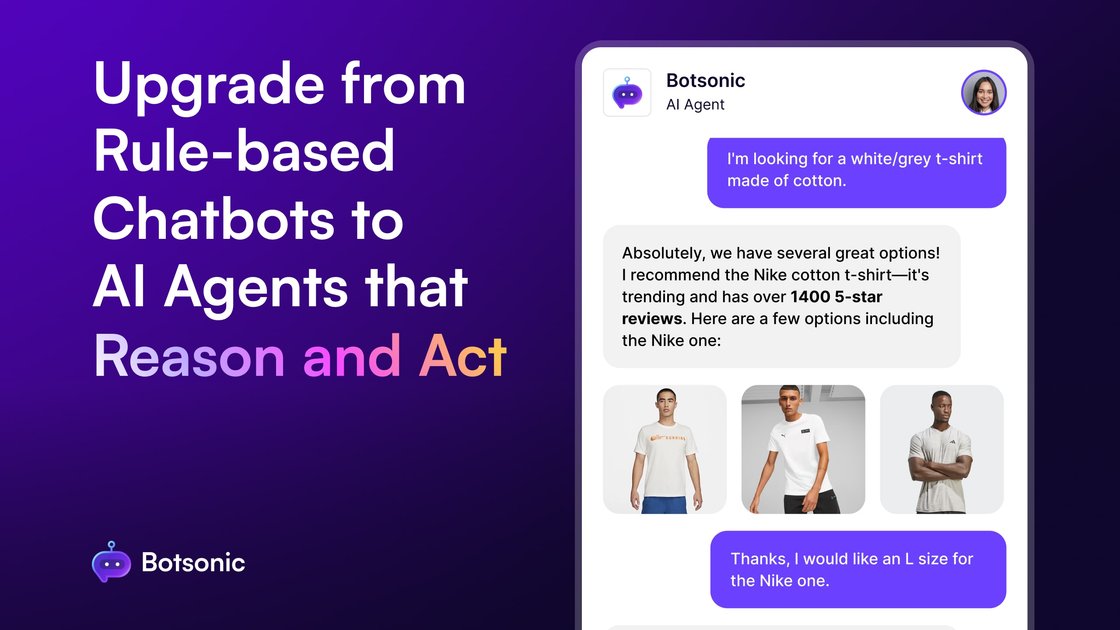
Botsonic is an AI chatbot and AI agent platform for websites and business workflows. It scans website content, files, and help center material to build a custom chatbot that can respond to questions, support customer service, and assist employees or sales teams.
The site positions Botsonic as a no-code way to train and deploy AI agents quickly, with website embedding, channel integrations, and controls for branding, analytics, and escalation. Pricing is plan-based, with monthly or annual billing, trial access, and add-ons for more messages, characters, users, and support handoff features.
Botsonic can ingest files, website content, and help center material, then use that information to answer questions and automate interactions.
The product supports a branded chat experience, including logos, color schemes, conversational tone, and embeddable chat widgets for a website.
The site highlights connections to tools and channels such as WhatsApp, Facebook Messenger, Slack, Zapier, Google Drive, Notion, Confluence, and more.
Pricing and feature pages describe AI agents that can reason, take agentic actions, and perform tasks such as scheduling, CRM updates, and handoffs.
Botsonic includes conversation monitoring and performance insights, with analytics, transcripts, and controls for escalation or human handoff on higher plans.
The security section says data at rest and in transit is encrypted, with workspace-level segregation and audit logs, and the platform is positioned as model-agnostic.
Use Botsonic to answer repetitive website questions from visitors by training on help center articles, web pages, and uploaded files, then embedding the chatbot on your site.
Deploy it as an internal assistant that points employees to HR policies, company resources, onboarding material, and operational knowledge stored in connected content sources.
Apply the agent to product guidance, recommendations, and sales conversations across web and messaging channels, with multilingual support and escalation when needed.
Connect the agent to business systems and use agentic actions for tasks such as scheduling, CRM updates, or handing complex requests to a human team member.
Botsonic is set up to scan website content, files, and help center material, then embed a custom chat widget for customer-facing support or internal assistance. The homepage says it can be trained and launched in under five minutes, while the pricing page shows trial options and paid plans for teams that need more usage or more integrations.
The source pages describe customer support, employee support, and conversational commerce use cases. Botsonic’s AI agents can answer customer questions, help employees access company information, and support sales or product guidance on web and messaging channels.
The pricing page lists message limits, team member counts, chatbot counts, and upload character limits by plan. It also shows add-ons such as extra messages, uploaded characters, additional team members, API access, and support handoff integrations.
Botsonic says it can connect with tools such as WhatsApp, Facebook Messenger, Slack, Zapier, Google Drive, Notion, Confluence, and others depending on the plan. The enterprise plan adds more integrations, along with options such as SSO/SAML and audit logs.
The site says Botsonic is model-agnostic and uses a GPT Router to route between multiple AI models. It also says agents are trained on your data and should not use that input for model retraining.