
Source connection and extraction
Point Atlas at a website, employee handbook, brand guide, or Notion workspace and it extracts company context from those sources.

Atlas turns company docs and website content into shared AI rules for Claude, Cursor, and ChatGPT to use the same company context.
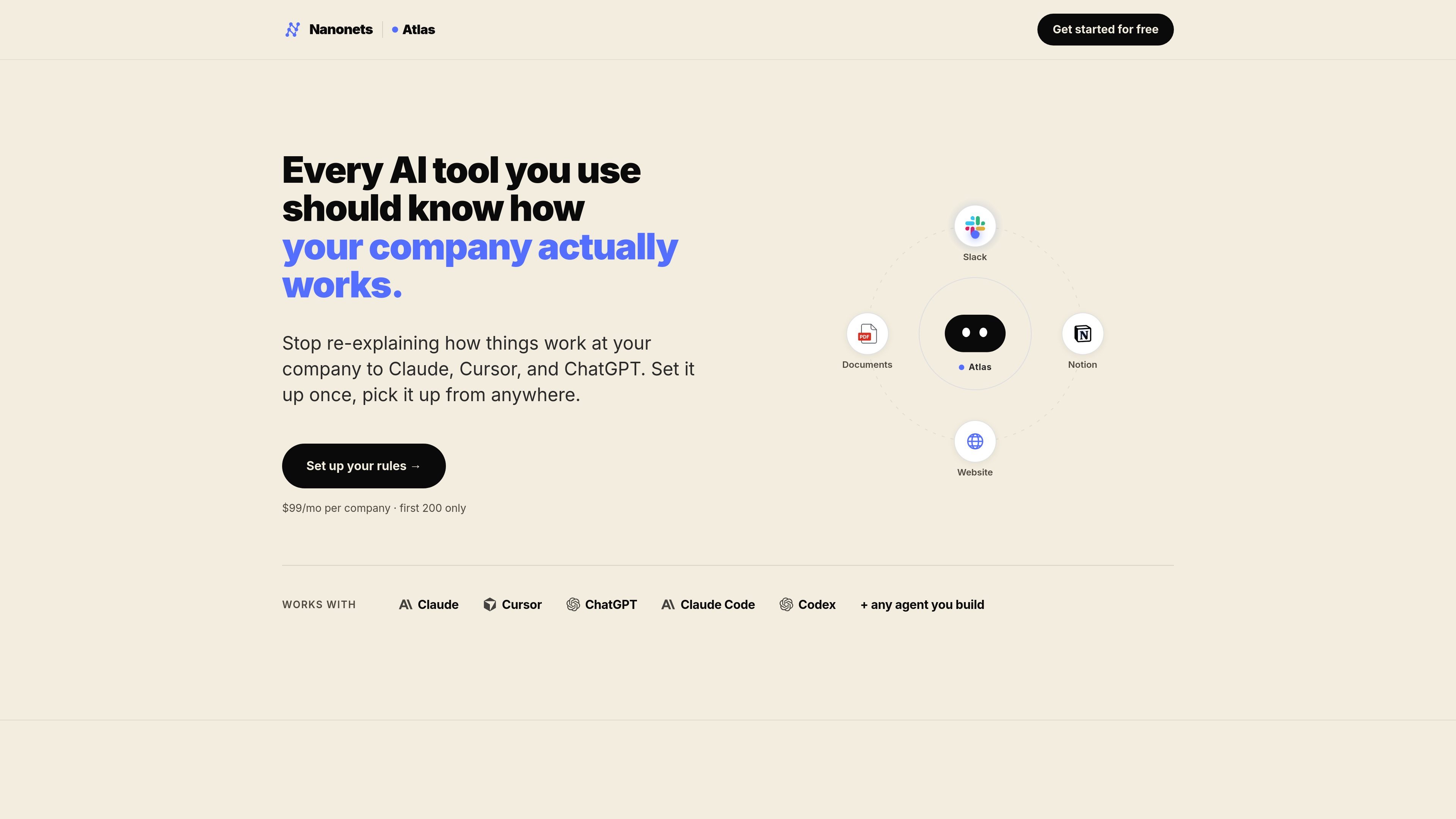
Atlas is a company-context layer for AI tools. It takes the rules, process knowledge, data definitions, and brand guidance that live in a company’s documents and makes them available to tools like Claude, Cursor, ChatGPT, Claude Code, and Codex.
The product is designed for teams that want AI outputs to reflect how the company actually works instead of starting from a generic prompt every time. Atlas lets teams connect source materials, extract structured context, and serve those rules through MCP or REST so they can be used across different agents and internal tools.
Point Atlas at a website, employee handbook, brand guide, or Notion workspace and it extracts company context from those sources.
Atlas organizes context into process, data, and brand layers so the output covers operational instructions, schema and metric context, and visual identity.
The product serves rules to Claude, Cursor, ChatGPT, Claude Code, Codex, and other agents through a single MCP URL or REST endpoint.
Rules remain in plain markdown and can be exported at any time, which the source presents as a no-lock-in setup.
A shared company layer is managed by admins, while personal rules stay on each user’s account and are not shared with teammates.
The pricing page notes a dashboard where users can view and edit rules, plus setup help from Atlas’s team on the paid plan.
A team can centralize how common requests should be handled so employees do not have to re-explain internal processes every time they ask an AI assistant for help.
A company can keep schema names and metric definitions available to AI tools so analysts and builders get answers that match the company’s data model.
Marketing, design, or go-to-market teams can load brand guidance so slide decks and visual outputs follow company colors, fonts, and identity conventions.
Developers can connect Atlas through MCP or REST and use the extracted rules inside custom agents or internal applications.
Individual users can keep private rules on their own account while the company maintains a shared layer for team-wide guidance.
Atlas connects a company’s own materials—such as a website, employee handbook, brand guide, and optional Notion content—and turns them into rules that AI tools can follow. The source also says the rules can be served through MCP or REST.
The pricing page shows a free option for trying website rule extraction and viewing/editing rules in the dashboard, plus a Founding plan at $99 per company per month that adds document and PDF extraction, rule serving to AI tools, and hands-on setup help.
Atlas is positioned for teams where employees use tools like Claude, Cursor, and ChatGPT regularly and want the same company rules applied across those tools.
The source says personal context stays on the user’s account, while company context is shared and curated by admins for the whole team.
The source says Atlas can export rules to markdown and that there is no lock-in.