
Fresh workers each cycle
Sends a bounded goal to fresh Codex workers so each cycle starts with clean context instead of continuing from a long, tangled chat thread.

AgentLoop est un outil local de boucle de développement qui confie des objectifs délimités à de nouveaux agents, fait examiner les résultats par un critique indépendant et itère jusqu’à respecter les standards du projet. Il est conçu pour le travail sans supervision dans un dépôt local, pas dans un espace de travail hébergé.
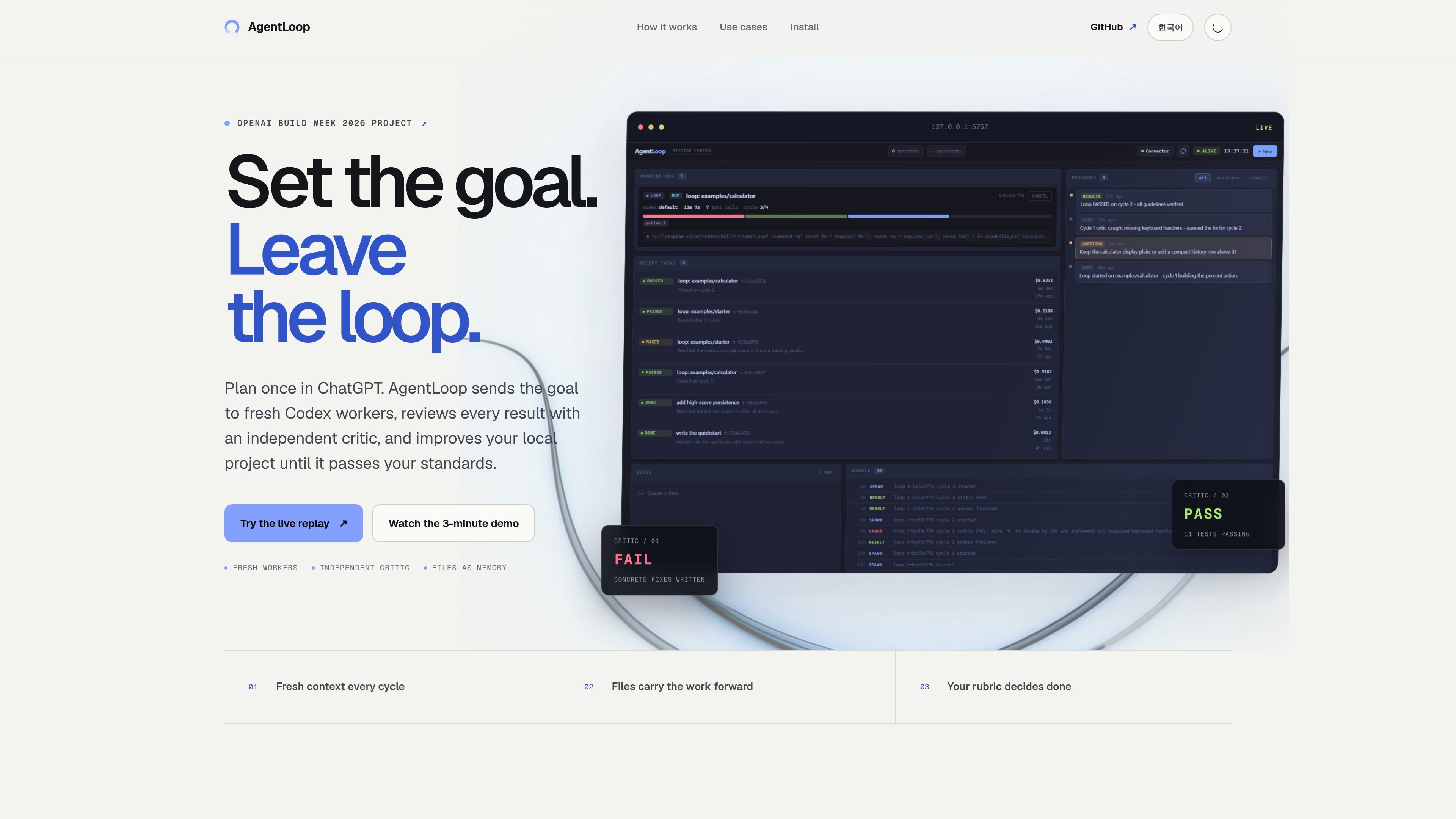
AgentLoop is a local coding loop tool that automates handoffs between planning, implementation, and review. The homepage describes it as “unattended local coding loops” with fresh workers, an independent critic, and standards applied on every cycle.
The intended workflow is to set the goal once, keep the rubric in GUIDELINES.md, and let the system keep iterating on the local project until the critic and your standards agree the work is done. It is presented as a local-first engine that runs in the repository where the code lives.
Sends a bounded goal to fresh Codex workers so each cycle starts with clean context instead of continuing from a long, tangled chat thread.
Uses a separate critic process to review results independently, so passing tests are treated as evidence rather than the only stopping condition.
Carries project files, logs, and feedback forward between cycles so the work can continue in the local repository without the user relaying every message.
Loads the definition of done from GUIDELINES.md, letting the project’s standards persist across iterations instead of living only in prompts.
Runs locally with Node.js 18+, Git, and an authenticated Codex CLI, and the source says it does not require an npm install or hosted workspace.
Provides observability through cycle logs, verdicts, transcripts, cost, file handoffs, and an interactive replay/dashboard view.
Assign a scoped feature and let the loop build, review, and refine it against acceptance criteria stored in your project files.
Use the worker/critic cycle for code changes that must preserve existing behavior while updating data handling, routes, or file formats.
Run an unattended pass on brittle areas of the codebase to add fixes, regression coverage, and documentation alignment.
Hand off a UI, copy, or developer-experience cleanup task when you want iterative polishing without staying in the loop for each step.
AgentLoop is described as running unattended local coding loops: you set a goal and standards once, then it sends work to fresh Codex workers, has an independent critic review the result, and carries evidence forward into the next cycle.
The source says it runs where your code lives and requires Node.js 18+, Git, and an authenticated Codex CLI. It also says there is no npm install and no hosted workspace.
The homepage describes a workflow where you define the finish line in ChatGPT, put your rubric in GUIDELINES.md, and let AgentLoop handle the worker/critic loop until the work passes your standards.
The site positions it for bounded coding work such as feature work, migrations, hardening passes, and product polish, especially when you want to avoid manually babysitting each handoff.
The pricing URL in the provided source returns a 404, so the collected pages do not confirm any pricing details.
Les données de trafic sont fournies à titre indicatif uniquement.

opencodesuper.app
OpenCode Superapp est un espace de travail natif pour Mac qui permet d’utiliser des modèles d’IA locaux, auto-hébergés ou dans le cloud, avec du code, de l’automatisation du navigateur, la voix, des extensions, des widgets et un accès à distance sécurisé. Il s’adresse aux personnes qui souhaitent un environnement OpenCode privilégiant le local, sans compte.

vi3ecode.com
Vi3ecode est un environnement de développement maintenu pour les agents de programmation, qui réunit espace de travail, terminal, Git, mémoire, flux, revue et accès à distance. Il permet aux développeurs de garder leur environnement de programmation IA connecté sans gérer chaque élément séparément.

kilo.ai
Kilo Code est un plugin de codage IA multi-agent pour les IDE JetBrains. Il permet d’exécuter et de gérer des agents de codage IA, d’examiner les modifications dans des worktrees isolés et de choisir parmi un vaste catalogue de modèles sans quitter l’IDE.

superset.sh
Superset est un outil de bureau qui permet d’exécuter plusieurs agents de codage IA en parallèle sur votre propre machine. Séparez le travail dans des Git worktrees isolés, examinez les changements et avancez sans attendre un seul agent à la fois.

postfleet.ai
Postfleet est une infrastructure e-mail pour les agents IA qui filtre les messages entrants, assainit leur contenu et extrait les e-mails nettoyés en JSON typé avant leur lecture par l’agent. Compatible avec MCP hébergé et local, ainsi qu’avec REST pour les flux sans MCP.

ollama.com
Exécutez des modèles ouverts en local ou dans le cloud pour le code, l’automatisation, l’analyse et les agents.