
AI patient identification
The platform mines EHR data to identify patients who appear eligible for lung cancer screening, including smoking histories that may be buried in clinical notes rather than structured fields.

Oatmeal Health is an AI-powered lung cancer screening and care-navigation platform for FQHCs, hospitals, and imaging centers with nodule risk scoring.
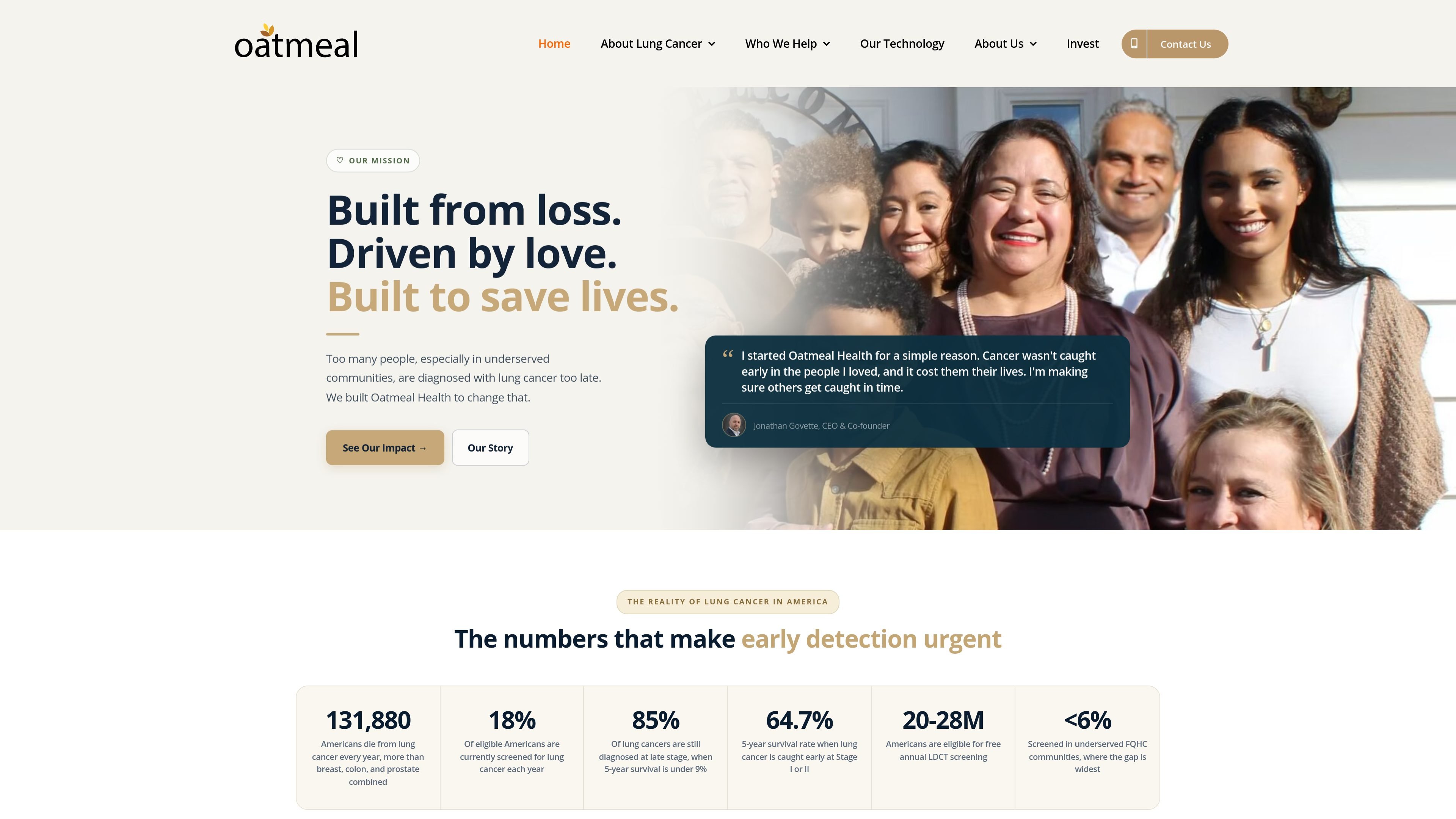
Oatmeal Health is an AI-powered cancer screening and care-navigation platform focused on lung cancer. The site describes a full-funnel workflow that identifies people who may be eligible for screening, reaches them by phone or text, helps coordinate low-dose CT screening, and provides AI-based nodule risk scoring for clinicians.
The product is aimed at organizations trying to close screening gaps in underserved communities, including FQHCs, health systems, hospitals, imaging centers, nonprofits, government agencies, and life sciences teams. The site also positions LungAI as a radiology tool that works inside the existing viewer, so clinicians do not need a new workstation or separate login.
The platform mines EHR data to identify patients who appear eligible for lung cancer screening, including smoking histories that may be buried in clinical notes rather than structured fields.
AI-powered voice calling, SMS, voicemail, and nurse navigator outreach are used to educate patients, confirm eligibility, and move them toward shared decision-making visits.
Oatmeal Health helps schedule SDM visits and low-dose CT scans through its partner imaging network so patients can complete screening and follow-up steps.
LungAI assigns each nodule a 0–100 malignancy risk score inside the radiologist's existing viewer, with results described as available in under 3 minutes.
The partnership pages describe dashboards for screening outcomes, gaps identified, outreach sent, and revenue captured, along with quality and HEDIS reporting for health systems and FQHCs.
Partnership structures are tailored for platform access, network access, or research and life sciences use cases, with setup that includes discovery, feasibility, and agreement steps.
An FQHC can use the platform to find patients who are due for lung cancer screening, contact them automatically, and track outreach and quality metrics in one place.
Hospitals and health systems can use the product to capture downstream referrals from lung screening while keeping follow-up and risk scoring aligned with in-system care pathways.
Imaging centers can use LungAI to score nodules inside the viewer they already use, helping radiologists triage cases without adding a new workstation or login.
Nonprofits, government agencies, and public health programs can use the network and reporting model to expand screening access across community partners and monitor outcomes.
Pharma, biotech, and diagnostics teams can use the partnership network for trial enrollment, real-world evidence work, and diagnostic validation in underserved communities.
Oatmeal Health is positioned for organizations that need to identify eligible patients, contact them, and move them into lung cancer screening and follow-up care. The source highlights FQHCs, hospitals, health systems, imaging centers, nonprofits, government agencies, pharma, and biotech partners.
The platform combines AI-based patient identification from EHR data, outreach by voice/text/voicemail, scheduling support for shared decision-making visits and scans, and LungAI scoring for nodules inside a radiologist's existing viewer.
The source says LungAI runs inside the radiologist's existing viewer with no new workstation or login. It produces a malignancy risk score for nodules and reports results in under 3 minutes.
The pricing page is not available and the site does not publish pricing on the pages provided. Partnership pages say engagements start with discovery, feasibility and scoping, agreement and setup, then go live.
The site states LungAI is a medical device pending FDA 510(k) clearance and that clinical performance data reflects retrospective studies on held-out datasets. The company notes results may differ in prospective clinical use.