
Graph-first program model
Agents work with the semantic graph instead of raw text, so edits target nodes, fields, calls, declarations, and other program facts directly.

Zero is an experimental graph-first programming language for agent-assisted development. Checked semantic edits, readable projections, compiler validation.
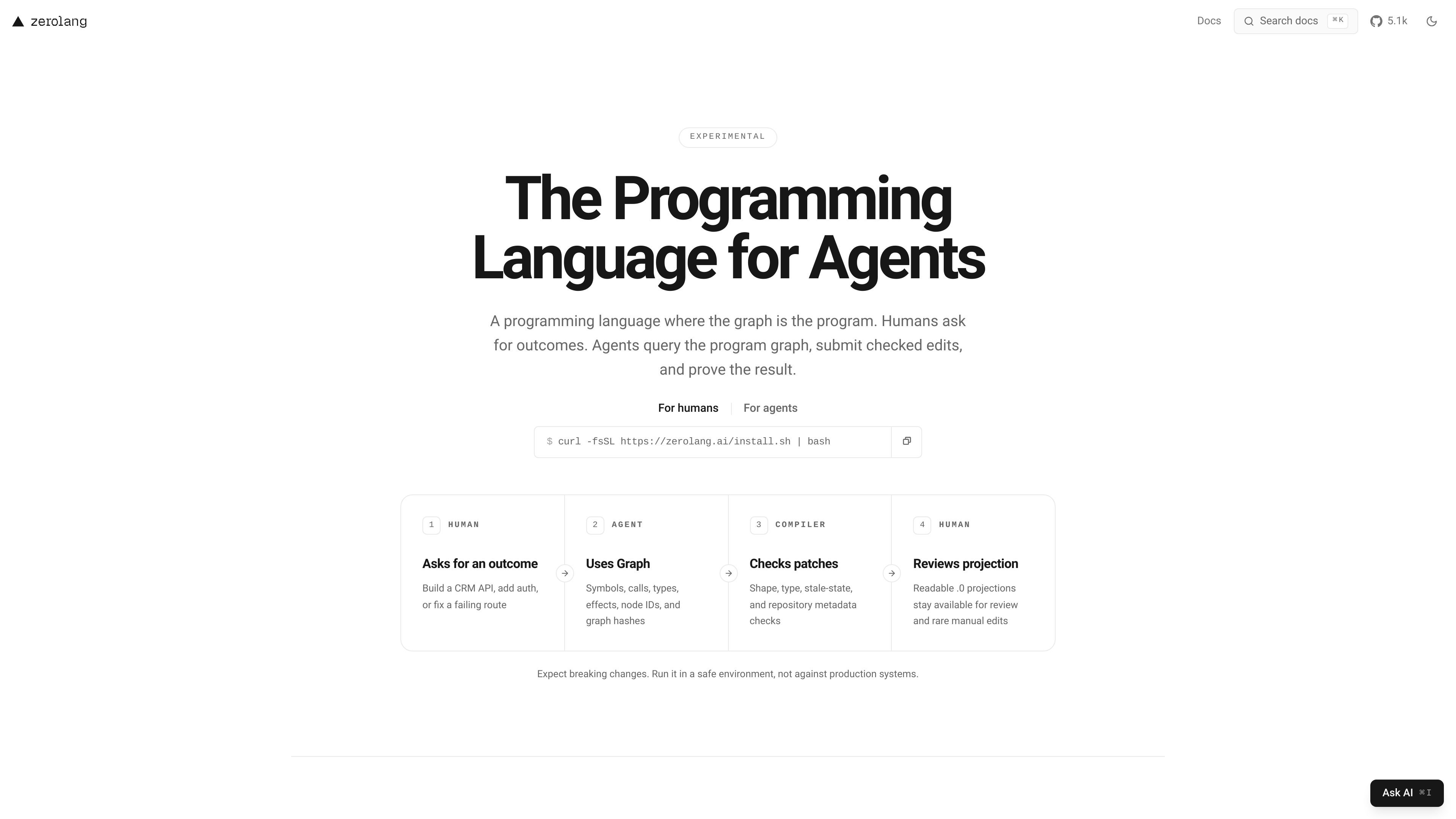
Zero is an experimental graph-first programming language built for agent-assisted development. It treats the graph as the program database, so agents query semantic structure, submit checked edits, and rely on the compiler to validate changes before they become part of the package.
The site positions Zero as a tool for situations where humans ask for outcomes and agents carry out the edit loop. Humans review projections and command output, while the compiler keeps the graph consistent through shape checks, stale-state protection, and repository metadata validation.
Agents work with the semantic graph instead of raw text, so edits target nodes, fields, calls, declarations, and other program facts directly.
Patches are checked against graph hashes, expected values, shape rules, and repository metadata before they are accepted.
The compiler rejects stale or invalid edits before they touch the store, which makes the edit loop more deterministic for agents.
Readable `.0` projections provide a source-like view for review and rare manual edits without making text the primary program database.
The day-to-day workflow includes query, patch, check, test, run, and build commands for agent-assisted development.
The runtime goals emphasize a small, fast, explicit, dependency-free system with low memory use and fast startup/builds.
Use Zero when an agent needs to make a semantic code change, such as adding a function, updating a call, or adjusting typed program facts without rewriting text spans by hand.
Use the projection and review flow when a human wants to inspect a readable representation of the program before accepting or manually adjusting a change.
Use the checked patch workflow when you want stale-state protection and validation to fail invalid edits before they alter the store.
Use the install-and-bootstrap flow to get a local package ready, then run the daily loop of query, patch, check, test, run, and build commands.
Use the build and run commands when you need executable, object, or LLVM IR artifacts from the graph-backed program, especially during early exploration.
Zero is designed for a human working with an agent. The agent authors the program through the graph, while the human reviews the graph summary, command output, and the `.0` projection when needed.
The getting started guide shows `curl -fsSL https://zerolang.ai/install.sh | bash`, then adding `$HOME/.zero/bin` to `PATH` and running `zero --version`. It also mentions installing the agent bootstrap skill with `npx skills add vercel-labs/zerolang`.
The source says to use `zero query`, `zero patch`, `zero check`, `zero test`, `zero run`, and `zero build` for the daily loop. It also notes that `zero export` and `zero verify-projection` are for human review workflows.
The site says Zero is pre-1 and experimental, so breaking changes are expected. It also says to run it in a safe environment, not against production systems.
The product is built around `.0` projections for readable review, while the compiler owns the graph database that agents edit. Humans can occasionally edit projections, but agents are expected to work through `zero query` and `zero patch`.