
Semantic graph queries
Agents use `zero query` to inspect symbols, calls, types, effects, node IDs, and graph hashes, giving them structured program information for subsequent edits.

An experimental programming language for agents to query and edit program graphs.
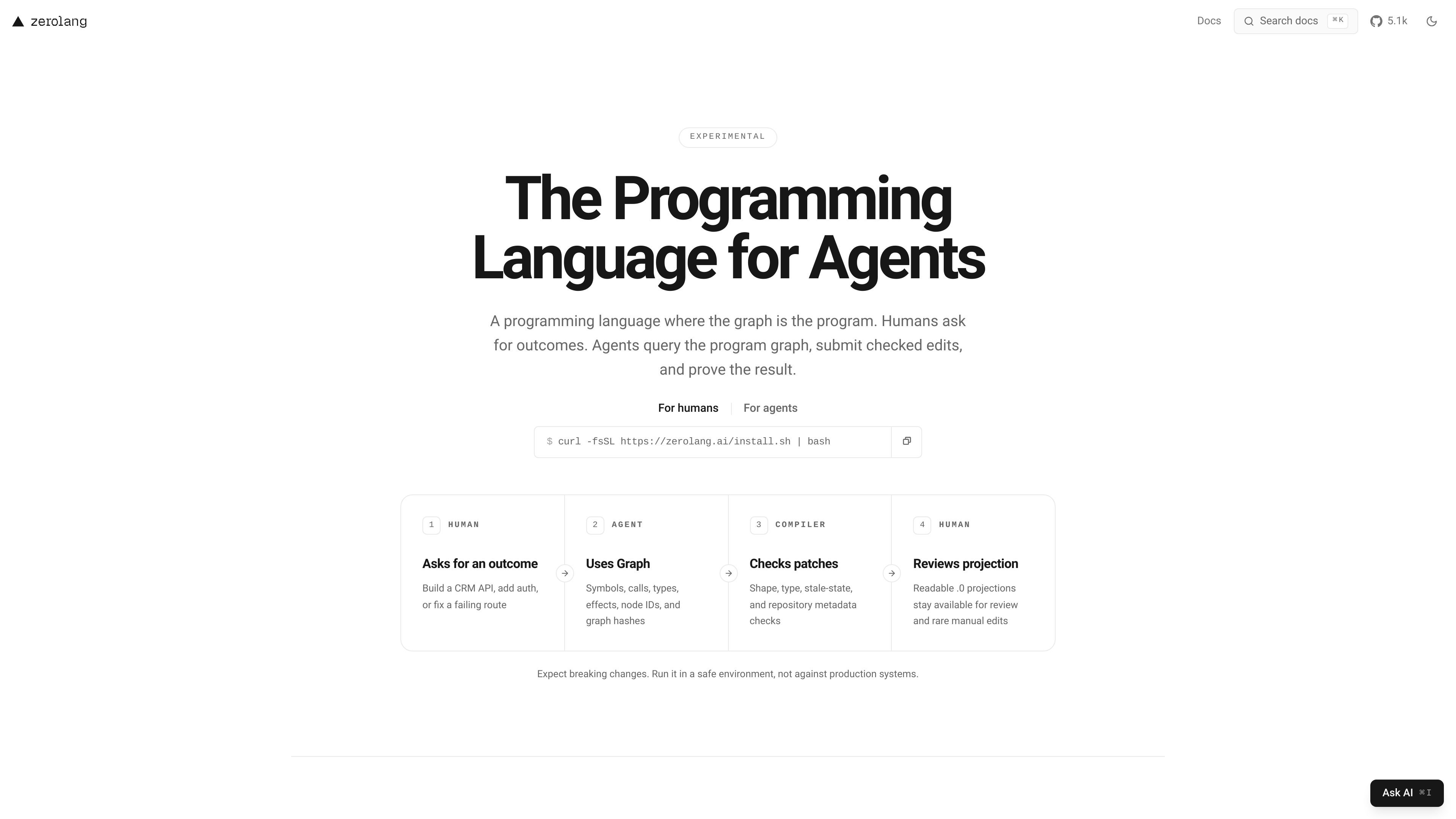
Zero, also called Zerolang, is an experimental programming language designed for humans working with coding agents. Its compiler-owned graph is the program database: agents inspect semantic structure and submit checked edits, while humans describe desired outcomes and review the results.
The workflow puts compiler checks into the editing process. Readable .0 projections remain available for human review and occasional manual changes. Zero is intended for exploration in a safe environment; its documentation warns users to expect breaking changes and avoid production systems.
Agents use `zero query` to inspect symbols, calls, types, effects, node IDs, and graph hashes, giving them structured program information for subsequent edits.
`zero patch` targets semantic nodes and fields. Graph hashes and expected values guard edits, while shape, type, stale-state, and repository metadata checks reject invalid changes before they reach the store.
`zero export` produces readable source projections. Intentional edits to files such as `src/main.0` can be imported back into the graph with `zero import`; `zero verify-projection` checks projection consistency.
The command-line workflow includes `zero check`, `zero test`, and `zero run`. Package commands use the current directory by default, and run commands can pass arguments to the program.
`zero build` supports executable, object, and LLVM IR outputs. The guide demonstrates choosing a target and output path for a Linux musl x64 executable.
Ask an agent to build Hello World, initialize a package, add a main function and output operation, then run it. This provides a small starting point for learning the graph workflow.
Use conversational requests such as building a CRM API, adding authentication, or fixing a failing route to direct an agent's work through graph queries and checked patches.
Export a `.0` projection when a human needs source-like text for review. CI can also use projection verification as a gate for detecting drift.
Install with `curl -fsSL https://zerolang.ai/install.sh | bash`, add `$HOME/.zero/bin` to your PATH, and confirm with `zero --version`. Install the agent bootstrap skill with `npx skills add vercel-labs/zerolang`.
Agents should normally use `zero query` and `zero patch`. Humans can occasionally edit projections, but should run `zero import` before checking or running the program.
Zero is experimental. Its website advises expecting breaking changes and running it in a safe environment, away from production systems.
Traffic data is for reference only.
