
Specialized model training
Trainloop says it trains specialized models for long-horizon tasks rather than general-purpose assistants, with an emphasis on models that match the expertise of the humans guiding them.

Trainloop AI builds specialized post-training models for enterprise workflows, from long-horizon research to custom model training and production deployment.
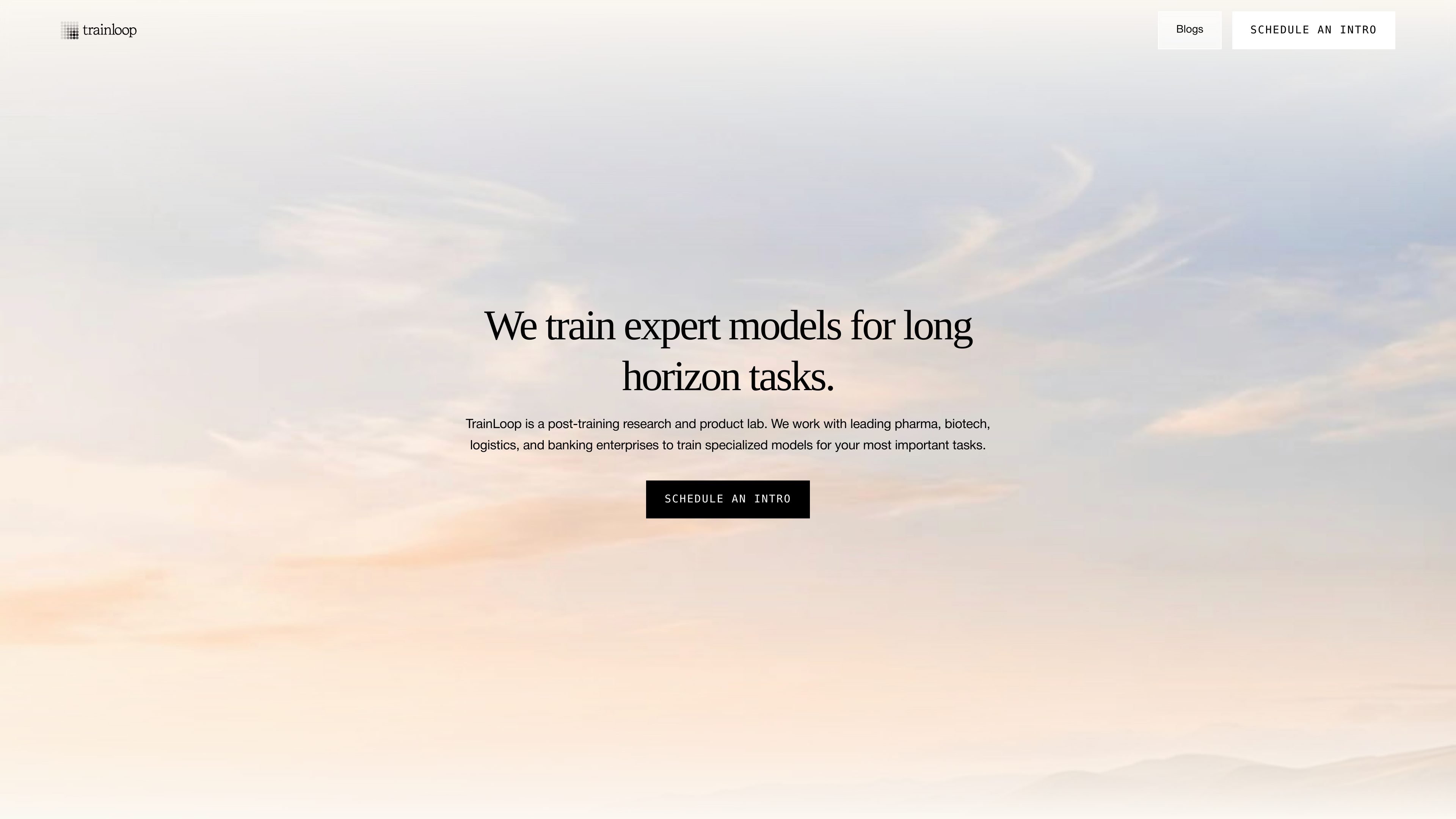
Trainloop AI is a post-training research and product lab focused on training specialized models for long-horizon tasks. The company says it works with enterprises in pharma, biotech, logistics, and banking to turn proprietary data and subject-matter expertise into custom AI systems.
Its site combines product positioning with technical research notes. Those notes describe workflows such as offline reinforcement-learning updates, policy-lagged training, and model specialization for clinical reasoning, knowledge work, and multimodal document understanding. The common thread is post-training models for production use, not a general-purpose AI app.
Trainloop says it trains specialized models for long-horizon tasks rather than general-purpose assistants, with an emphasis on models that match the expertise of the humans guiding them.
The site describes a research team focused on new strategies for long-horizon post-training, including reinforcement-learning approaches and offline training methods such as OAPL.
The homepage highlights a research-to-production workflow that co-defines objectives, advances models, and keeps performance stable after deployment.
Research posts describe using real-world customer traces and offline scoring to train and evaluate models without requiring every update to be tightly coupled to fresh live rollouts.
The model areas section points to biological reasoning, reliability for high-risk industries, and multimodal reasoning for image understanding and document abstraction.
Teams in life sciences can use Trainloop’s approach to build models for biological reasoning, diagnosis support, and treatment-response tasks using proprietary data.
Organizations in banking or logistics can apply the reliability-oriented work to decision-critical agents where accuracy and output consistency matter.
Product teams working with documents or images can use the multimodal reasoning direction for abstraction, interpretation, and structured extraction from complex inputs.
Research teams can use the batch-first or offline training methods discussed in the research posts when they want to learn from collected traces rather than only fresh live rollouts.
Companies with unique data assets can collaborate on co-defining objectives and maintaining model performance in production after the initial training run.
Trainloop AI is positioned as a post-training research and product lab. Its site describes work on specialized model training, long-horizon tasks, and research-to-production deployment for enterprise customers.
The site points to a research-to-production workflow: Trainloop and the customer jointly define objectives, then advance models and sustain performance in production. The research pages discuss training from real-world customer traces, offline scoring, and policy-lagged reinforcement learning setups.
The homepage says Trainloop works with pharmaceutical, biotech, logistics, and banking enterprises. The research pages also discuss clinical reasoning, knowledge-work agents, and logistics workflows as example applications.
The site does not list a public pricing page or plan details; the pricing URL currently returns a page not found error.
The available pages emphasize custom model training and research collaboration. They do not describe a self-serve setup, public integrations list, or packaged product tiers.