
Distributed training coordination
Coordinates large language model training across underutilized, distributed hardware instead of requiring a single centralized cluster.

NOUS RESEARCH builds open source language models and decentralized AI training infrastructure, including Psyche for distributed training on underused hardware.
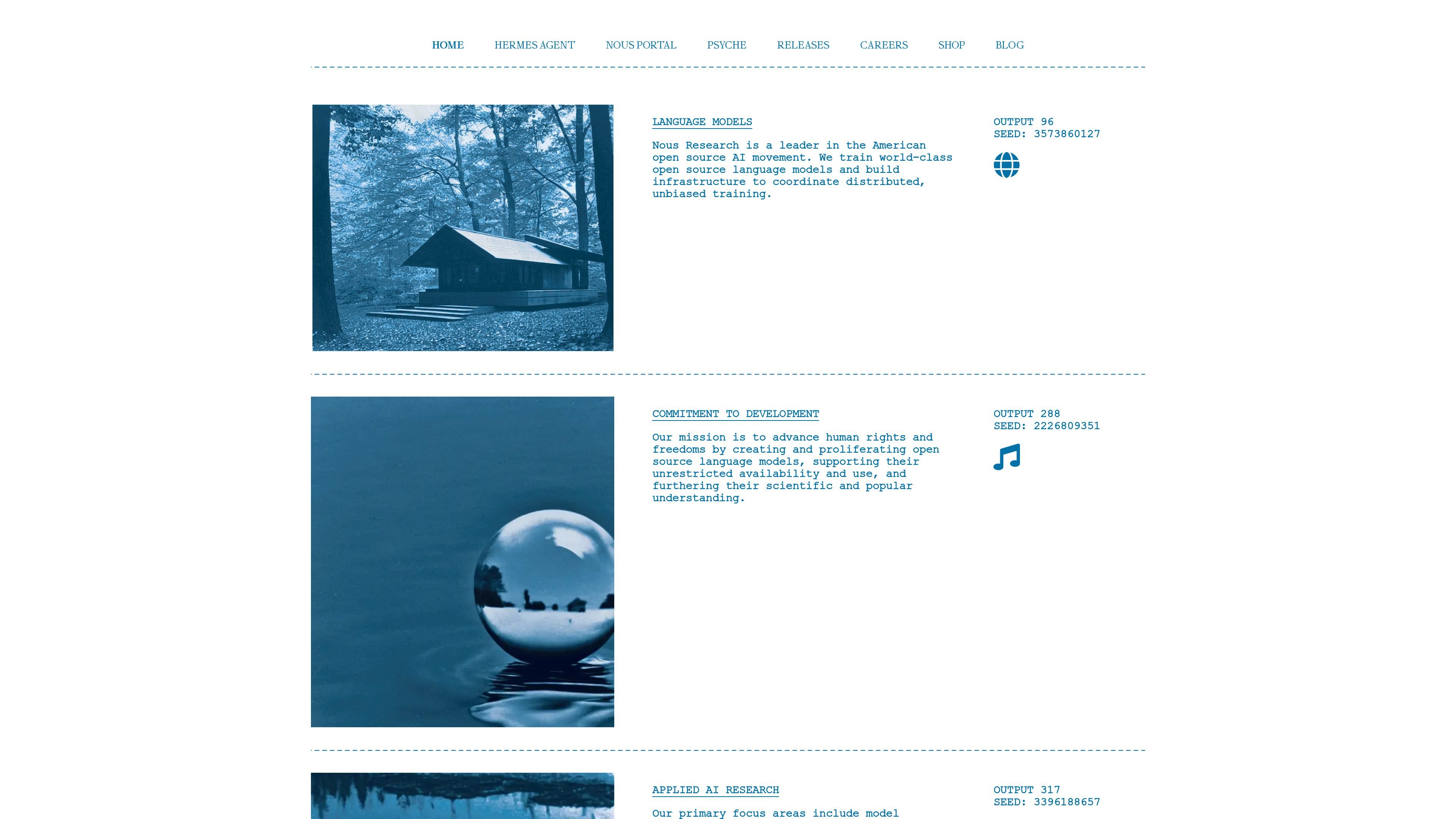
NOUS RESEARCH is an AI research company focused on open source language models and the infrastructure needed to train them. The homepage says the company trains world-class open source models and builds systems for coordinated, distributed, unbiased training.
The Psyche project, documented in detail on the site, is an open infrastructure layer for decentralized AI development. It is designed to spread training across underutilized hardware, reduce data transfer costs through compression-heavy methods such as DeMo and DisTrO, and coordinate the network through the Solana blockchain.
In practical terms, that makes Nous Research relevant to teams and contributors interested in open model training, distributed compute participation, and research into efficient large-scale training systems. The public site also points to related work including Hermes models, Atropos, and releases across models, papers, and simulators.
Coordinates large language model training across underutilized, distributed hardware instead of requiring a single centralized cluster.
Uses Decoupled Momentum Optimization and DisTrO ideas to reduce the amount of data sent between nodes during training.
Relies on the Solana blockchain for coordination, with the source describing that design as fault-tolerant and censorship-resistant.
Provides live training runs and real-time statistics so contributors can inspect training progress and active models.
Supports a staged roadmap that starts with a permissioned testnet and moves toward broader decentralization.
Positions the network for reinforcement learning and reasoning-model capabilities in later stages.
Researchers who want to study or build on decentralized training can use Psyche as a reference for how underutilized hardware, compression-heavy communication, and network coordination fit together.
Organizations with idle or geographically distributed accelerators can contribute compute to a shared training network instead of running only centralized infrastructure.
Model developers interested in open source language models can follow Nous Research releases to track training work, new models, papers, and infrastructure changes.
Teams exploring later-stage capabilities such as reinforcement learning or reasoning models can use the published roadmap to understand where the network is headed.
Nous Research describes Psyche as open infrastructure for decentralized AI development. The page says it coordinates training across distributed, heterogeneous hardware and is intended to make participation in training large language models more accessible.
The page says Psyche began with a permissioned testnet and is moving toward a fully decentralized environment. It also mentions a roadmap that includes accessible inference and advanced capabilities such as reinforcement learning and reasoning models.
The source does not list a hosted pricing model or usage tiers. The pricing page at `/pricing` returns a 404, so no pricing information can be confirmed from the available site content.
The page invites users to view live training runs and contribute compute to the Psyche Network, which indicates a workflow centered on sharing hardware for distributed training.