
Single API for web access
Send one request to a managed API endpoint and receive the page output without running your own browser farm or proxy stack.

Scrappey is a pay-as-you-go web data access API for developers and AI workflows, with direct HTTP, full browser retrieval, residential proxies, and free failed requests.
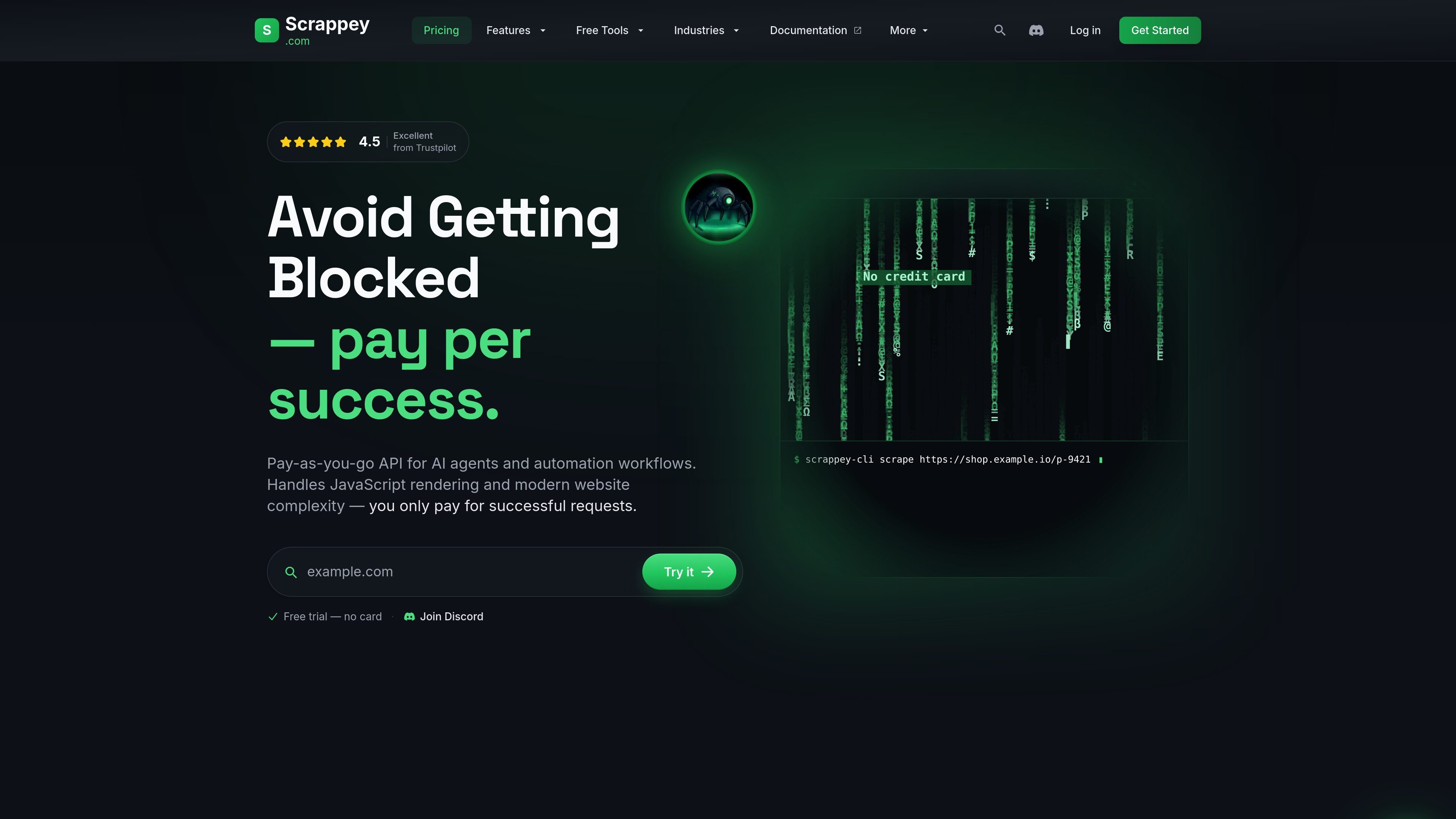
Scrappey is a web data access API for developers and AI workflows. It is designed to retrieve publicly available website data while handling browser rendering, proxy routing, and common access challenges behind a single API.
The product offers pay-as-you-go access with a free demo trial and no subscription. The pricing page presents two usage modes: a lower-cost direct HTTP tier for simpler pages and a full browser tier for JavaScript-heavy sites and verification flows. Both tiers include residential proxies, and failed requests are free when Scrappey cannot return the requested content.
The homepage and supporting pages position Scrappey for automation, scraping, and agent workflows that need structured output such as HTML, JSON, or LLM-ready Markdown. The site also highlights integrations and documentation for tools like Claude, LangChain, n8n, Make, LlamaIndex, Claude Code, and an MCP server.
Send one request to a managed API endpoint and receive the page output without running your own browser farm or proxy stack.
Choose between direct HTTP for simpler targets and a full browser for JavaScript-heavy sites and verification flows.
Residential proxies are included on both pricing tiers, with sticky proxy support and coverage from many countries.
The browser tier supports JavaScript rendering and browser interactions such as clicking, scrolling, typing, and screenshots.
Responses can include HTML, JSON, cookies, and LLM-ready Markdown for downstream parsing or agent workflows.
The platform documents REST API access, webhook support, persistent sessions, and documentation for programmatic use.
Use the API to fetch pages through a managed browser when a site depends on JavaScript, dynamic content, or verification steps before the content appears.
Use the direct HTTP tier for simpler sources such as static pages or JSON endpoints where a full browser is unnecessary.
Feed HTML or Markdown output into an AI agent, coding assistant, or pipeline that needs readable page content rather than raw source alone.
Use the browser actions and session handling to interact with pages that require clicking, scrolling, typing, or maintaining cookies across requests.
Connect Scrappey to tools such as Claude, LangChain, n8n, Make, or LlamaIndex when a project needs web access inside an existing workflow stack.
Scrappey is a web data access API for extracting publicly available data from websites. It handles browser rendering, proxy routing, and verification flows, and returns data such as HTML, JSON, and LLM-ready Markdown.
Yes. The pricing page shows a free demo trial with no credit card required, followed by pay-as-you-go pricing. The site also says balances never expire.
The site describes both a direct HTTP mode and a full browser mode. Direct HTTP is suited to JSON APIs and static pages, while the browser mode is for JavaScript-heavy pages and can perform browser actions such as clicking, scrolling, typing, and screenshots.
The pricing and billing pages state that failed requests are free. Scrappey charges only when it returns a successful response for the requested page.
The integrations page highlights Claude, LangChain, n8n, Make, LlamaIndex, Claude Code, Codex, and an MCP server. The homepage also points to a docs file that can be used by AI coding agents.