
Plain-language agent creation
Build agents from plain-language prompts with Invent, which generates the agents, tools, and evals needed for a workflow.

Relevance AI is an enterprise AI agent platform for sales, marketing, support, and operations, with no-code, plain-language, and programmatic building, plus monitoring and access controls.
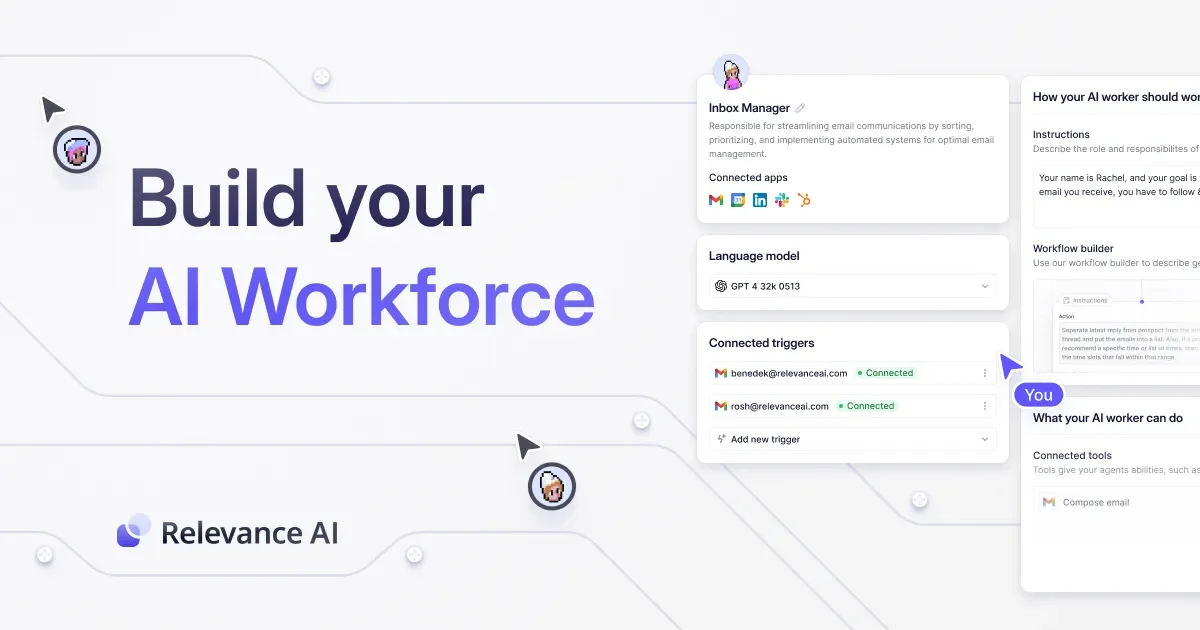
Relevance AI is an enterprise platform for building, managing, and governing AI agents. The site positions it as a way for domain experts to design playbooks and have agents execute them across workflows such as outbound prospecting, inbound qualification, customer success, content marketing, and meeting preparation.
The platform emphasizes a progression from assisted AI to more autonomous operations, with tools for building agents, connecting them to existing systems, evaluating their output, and overseeing what they do. The pricing and enterprise pages show that it is aimed at teams that need shared access, controls, and deployment options rather than a single-purpose chatbot.
Build agents from plain-language prompts with Invent, which generates the agents, tools, and evals needed for a workflow.
Use the no-code builder to refine agents visually or create them from scratch without depending entirely on engineering.
Build programmatically with MCP using Claude Code, Codex, or another copilot for teams that prefer code-first workflows.
Define quality standards and monitor them with evals, including scores and task-level checks that support deployment decisions.
Use monitoring dashboards, audit logs, version history, approval gates, and escalation paths to keep agent activity visible and controlled.
Connect agents to the existing stack through a large integration catalog, plus custom API and MCP connections.
Teams can automate prospect research, lead scoring, outreach drafts, and follow-up sequences while keeping humans in the loop for review or escalation.
Revenue teams can route incoming leads, qualify MQLs, and standardize response handling across HubSpot or similar trigger sources.
Marketing groups can build agents for content repurposing, SEO optimization, and campaign performance analysis with shared playbooks and quality checks.
Support and customer success teams can triage requests, search knowledge bases, prepare renewal work, and escalate low-confidence actions for review.
Operations teams can connect agents to internal tools for enrichment, report building, meeting preparation, and other cross-system workflows.
Relevance AI is positioned as an enterprise platform for building and managing AI agents. The source shows both no-code and programmatic ways to build, plus governance features for oversight and approval.
The site shows three build paths: Invent for building from plain language, a drag-and-drop builder for domain experts, and MCP for building programmatically with tools such as Claude Code, Codex, or another copilot.
The pricing page presents an Enterprise plan that includes custom actions, custom vendor credits, unlimited agents and tools, unlimited users and projects, 2,000+ integrations, calling and meeting agents, agent evaluations, A/B testing and analytics, SSO, RBAC, audit logs, and a dedicated account manager.
The enterprise page lists SOC 2 Type II, SSO and SCIM, role-based access, audit logs, encryption, data residency options, and flexible deployment as part of its security posture.
The site highlights integrations with systems such as Salesforce, HubSpot, Snowflake, Slack, Gong, Gmail, Microsoft, Notion, Jira, Zendesk, Intercom, Databricks, Sheets, Airtable, Salesloft, GitHub, Confluence, and Drive, along with custom API and MCP connections.