
TypeScript backend development
Define schemas, queries, mutations, auth, and APIs in pure TypeScript so backend code lives alongside app code and stays typechecked and autocompleted.

Convex is a code-first backend platform for TypeScript apps with reactive data, built-in backend primitives, and tiered pricing to ship and scale.
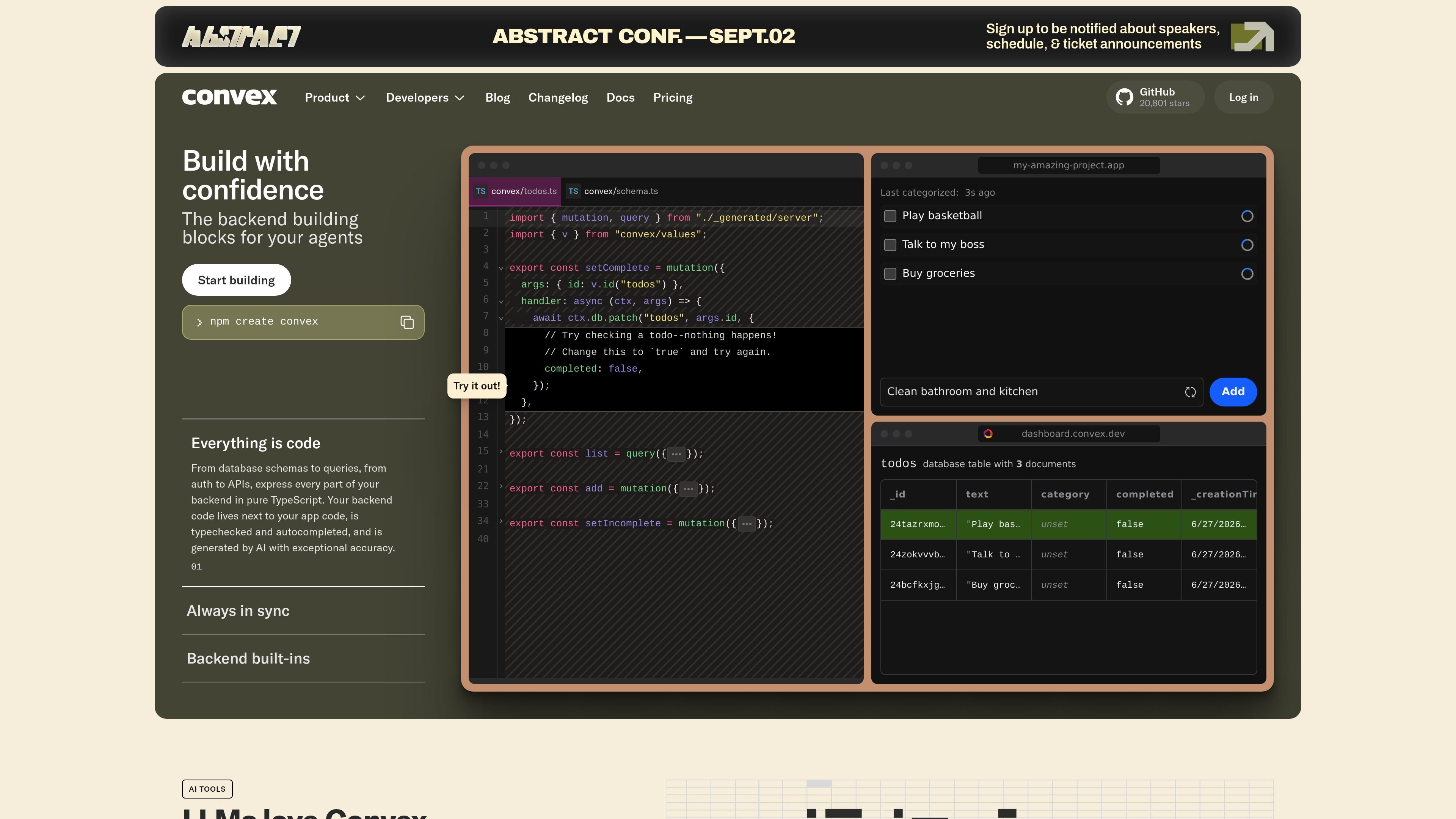
Convex is a backend platform for building full-stack applications and AI-driven products. The site positions it as “the backend building blocks for your agents,” and describes it as a code-first system where database schemas, queries, auth, APIs, and backend workflows are written in TypeScript.
The product emphasizes a reactive database and application model: changes to frontend code, backend code, and database state are reflected in real time, with built-in support for cron jobs, file storage, search, vector search, and other backend primitives. It also provides starter paths such as `npm create convex`, a short tutorial, and pricing plans that range from a free tier to professional and enterprise offerings.
Define schemas, queries, mutations, auth, and APIs in pure TypeScript so backend code lives alongside app code and stays typechecked and autocompleted.
Convex keeps frontend, backend, and database state in sync in real time, reducing the need for separate state managers, cache invalidation logic, or WebSocket plumbing.
Built-in auth, cron jobs, Node.js actions, webhooks, file storage, text search, and vector search cover common backend needs without assembling separate services.
The pricing pages show support for preview deployments, selectable data regions, health and insights dashboards, log streaming, exception reporting, and daily backups on higher tiers.
Convex supports AI coding workflows with guides for Claude Code, Codex, Cursor, Conductor, and GitHub Copilot, and the AI page highlights rules and prompts for better generated code.
Enterprise information includes SAML/SSO, dedicated deployments, service SLAs, custom MSAs, Slack Connect, and audit log options for larger teams.
Use Convex when you want database schemas, queries, auth, and APIs in the same TypeScript codebase as your frontend, so the backend stays close to the app and is easier to iterate on.
Choose Convex for apps that need reactive updates, so changes in backend or database state are reflected in the UI without manual cache management or WebSocket setup.
Use the built-in cron jobs, Node.js actions, and webhooks to run background tasks, scheduled workflows, and server-side logic without stitching together multiple services.
Use the AI-focused components and vector search support when building products that need persistent memory, text streaming, or other intelligent app behavior.
Adopt the enterprise plans when a team needs SAML/SSO, dedicated deployments, service SLAs, or custom contract and support arrangements for production workloads.
Convex is a backend platform for building full-stack applications in TypeScript. The source shows you can start by signing up, using `npm create convex`, or following a short tutorial from the start page.
The source describes Convex as code-first and TypeScript-based, with database schemas, queries, auth, APIs, cron jobs, file storage, vector search, and backend AI workflows available as part of the platform.
Yes. The pricing page shows plans for free and paid use, including a free or $0/month starting option, a Professional plan at $25 per developer per month, and Enterprise pricing that starts at a $2,500 monthly minimum.
Convex is positioned for developers and teams building full-stack apps and AI-driven products. The source also calls out support for agents and AI coding workflows, including Claude Code, Codex, Cursor, Conductor, and GitHub Copilot guides.
The source does not provide a complete integration catalog. It does mention framework integration, auth, and first-class guides for several AI coding agents, but broader ecosystem details are not fully listed on the pages provided.