
AI agent command interception
Registers as a PreToolUse hook so commands proposed by an AI agent are inspected before execution, rather than after something has already been installed.

Agentinel is a local security layer for autonomous coding that intercepts AI-driven package installation requests, scans them against a bundled OSV database and heuristics, and blocks or warns on suspicious dependencies before execution.
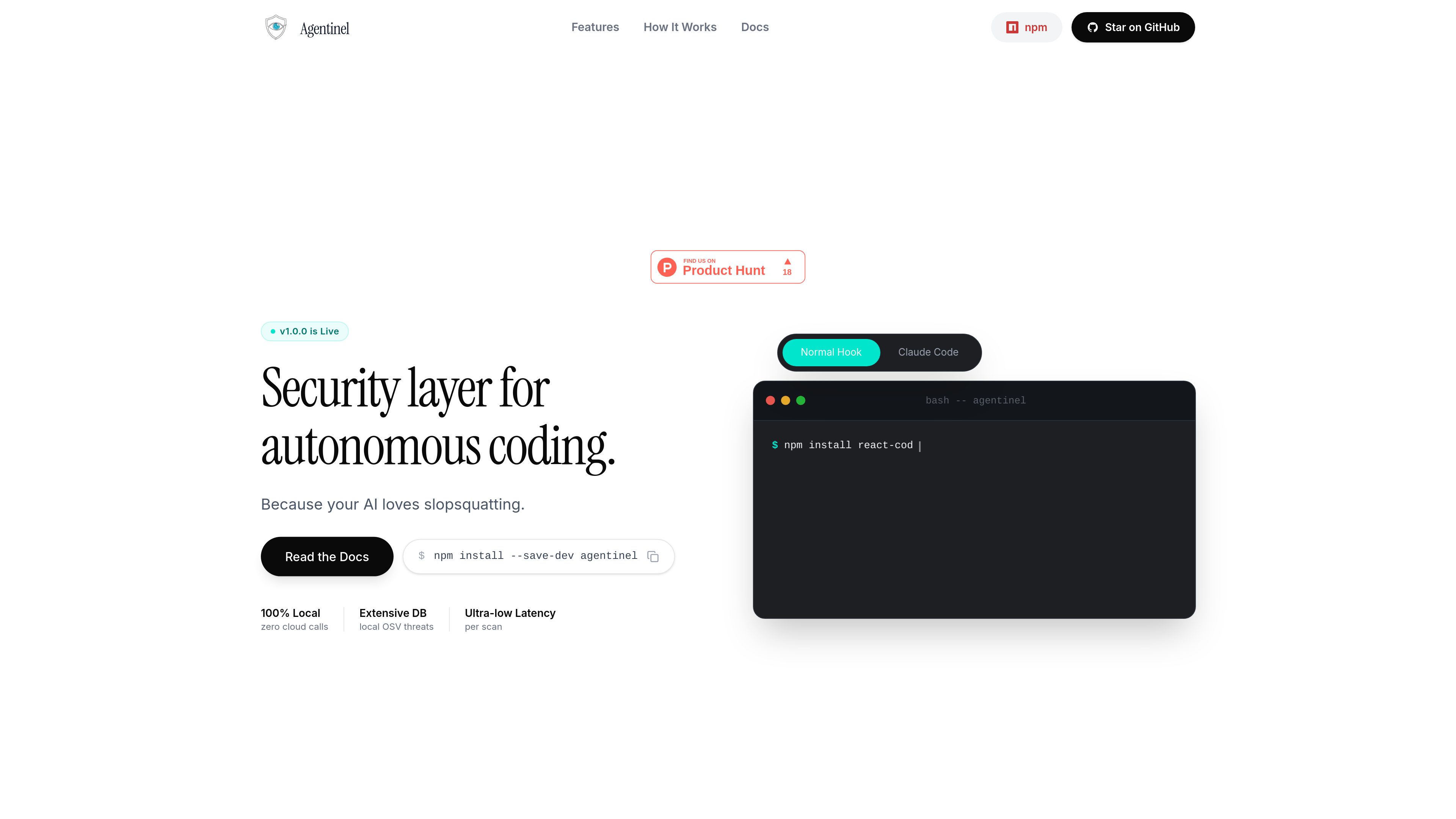
Agentinel is a local security layer for autonomous coding that checks package installation requests before they reach the terminal. It combines a bundled OSV database with heuristic signals such as package age, download counts, maintainer drift, and non-existent package names to identify suspicious dependencies.
The product is built for npm workflows and AI agent runtimes. It can intercept commands through a PreToolUse hook, block or warn on risky installs, and return structured feedback to the agent so it can correct itself without manual intervention.
Registers as a PreToolUse hook so commands proposed by an AI agent are inspected before execution, rather than after something has already been installed.
Uses a bundled snapshot of the OSV npm subset stored locally in the package, avoiding cloud lookups and allowing scans to run without network dependence.
Applies signals such as package age, download count, publisher drift, and ghost-package detection to catch suspicious names that may not yet appear in the vulnerability database.
Supports a strict mode that stops flagged installs and a warn mode that alerts instead of blocking, giving teams some control over enforcement.
Serializes the block decision into JSON and feeds it back to the agent context so the agent can understand why a command was stopped and retry with a corrected action.
Adds Git pre-commit scanning and can check staged lockfiles or full dependency trees, which makes it usable both in local development and in CI/CD pipelines.
Useful when an AI agent suggests a package name that looks plausible but is incorrect or malicious, because Agentinel inspects the request before the shell command runs.
Helps developers assess packages that are very new, have low download counts, or show maintainer drift, which are the kinds of signals the heuristic layer looks for.
Can be used in pipelines to check staged or full lockfile dependencies before merges or deployments, giving teams a pre-execution gate for suspicious packages.
Supports adding internal packages to an allowlist with a required reason, making it easier to document approved exceptions in version control.
The single-package check command is useful when a developer wants to inspect one package name before installing it manually or scripting validation around it.
No. The product materials say it runs locally, uses a bundled OSV database, and makes no cloud calls during scanning.
It scans package names and versions against the local OSV snapshot and heuristic signals, and it can also check staged or full lockfile dependencies.
Yes. Agentinel is designed to register as a PreToolUse hook so it can intercept the agent’s command before execution.
In strict mode it stops the install, while in warn mode it alerts instead. The block context is also returned to the agent as structured JSON so the agent can self-correct.
The source materials describe npm as the supported ecosystem in the current version, and the install and commands shown are npm-based.