
Open-source TypeScript framework
Build agents with TypeScript APIs and compose them with packages such as @voltagent/core, @voltagent/logger, and @voltagent/server-hono.

VoltAgent is an open-source TypeScript AI agent framework paired with VoltOps, a console for observability, automation, deployment, and evals. It helps teams build production-ready agents and operate them from the same ecosystem.
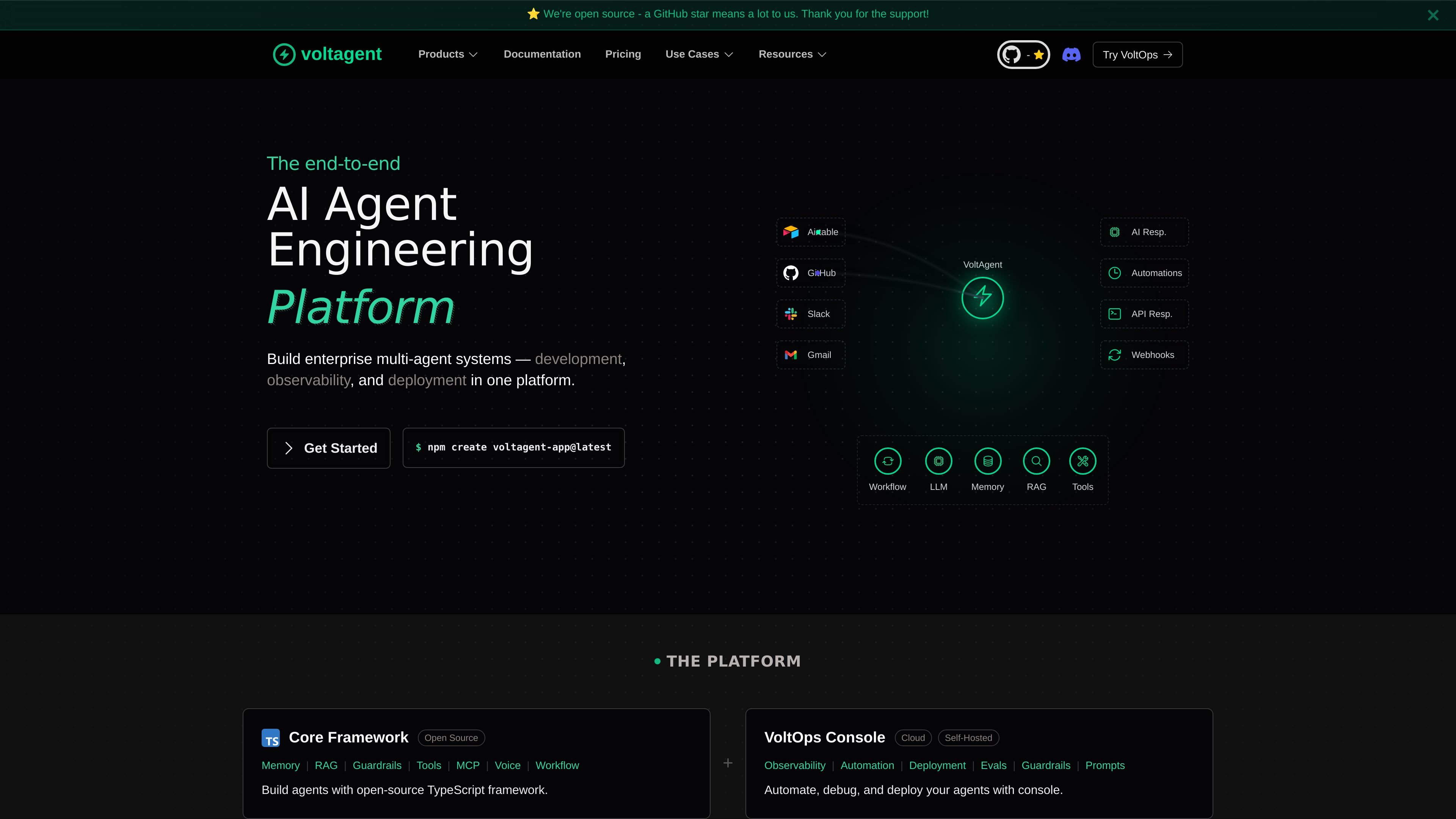
VoltAgent is an open-source TypeScript framework for building AI agents, paired with VoltOps, a console for observability, automation, deployment, guardrails, prompts, and evals. The site positions the platform for teams that want to build production-ready agents in TypeScript and then monitor or operate them from the same ecosystem.
The product combines agent development and runtime operations in one stack. The home page and docs highlight quick-start code with `@voltagent/core`, `@voltagent/server-hono`, and AI SDK integrations, while the pricing page shows that the core framework is free and open source and that VoltOps is offered as a paid cloud or self-hosted platform.
Build agents with TypeScript APIs and compose them with packages such as @voltagent/core, @voltagent/logger, and @voltagent/server-hono.
Create tools with typed parameters and attach them to agents so they can invoke functions and interact with external systems.
Switch between AI providers through a unified API, which the site says lets you update the code rather than redesign the app.
Store and recall interactions to keep context available across sessions and multi-step agent flows.
Build supervisor-led multi-agent systems and route work across specialized agents with shared context.
Create branching workflows with a Chain API and pause or resume long-running processes when needed.
Teams building production-ready agents in TypeScript can start from the core framework, define tools, connect a server, and ship an agent with type-safe APIs.
Developers operating agents in production can use VoltOps to inspect traces, monitor execution, and debug workflows from a console.
Teams coordinating several specialized agents can use supervisor orchestration or workflow chains to assign work, preserve context, and resume long-running processes.
Projects that need retrieval over internal data can connect knowledge bases and vector stores for RAG-style querying and filtering.
Organizations that want to separate product development from operations can use the open-source framework for app code and VoltOps for monitoring, deployment, and evals.
VoltAgent Core Framework is the free and open-source TypeScript framework for building AI agents. VoltOps is the paid observability, automation, deployment, and evals platform available in cloud or self-hosted form.
Yes. The pricing page says both the Core and Pro plans include a 14-day free trial, while the Developer plan is free.
VoltOps data is described as being stored in SOC 2 compliant data centers for the cloud offering, with encryption at rest and in transit. Enterprise customers can use self-hosted deployment so data stays in their own infrastructure.
The pricing page says a trace represents a single execution flow through an AI agent or application, including LLM calls, tool usage, function calls, and nested operations during a request or conversation turn.
The docs and home page show quick-start code using TypeScript packages such as @voltagent/core, @voltagent/logger, @voltagent/server-hono, and the AI SDK OpenAI package.