
Agents and stack together
Run your agents and local services in one workspace, so you can start and stop the stack without opening separate terminals for each process.

Solo is a desktop workspace for running AI coding agents alongside your local development stack. It helps developers watch processes, restart crashes, and coordinate agent workflows without turning the product into a full IDE.
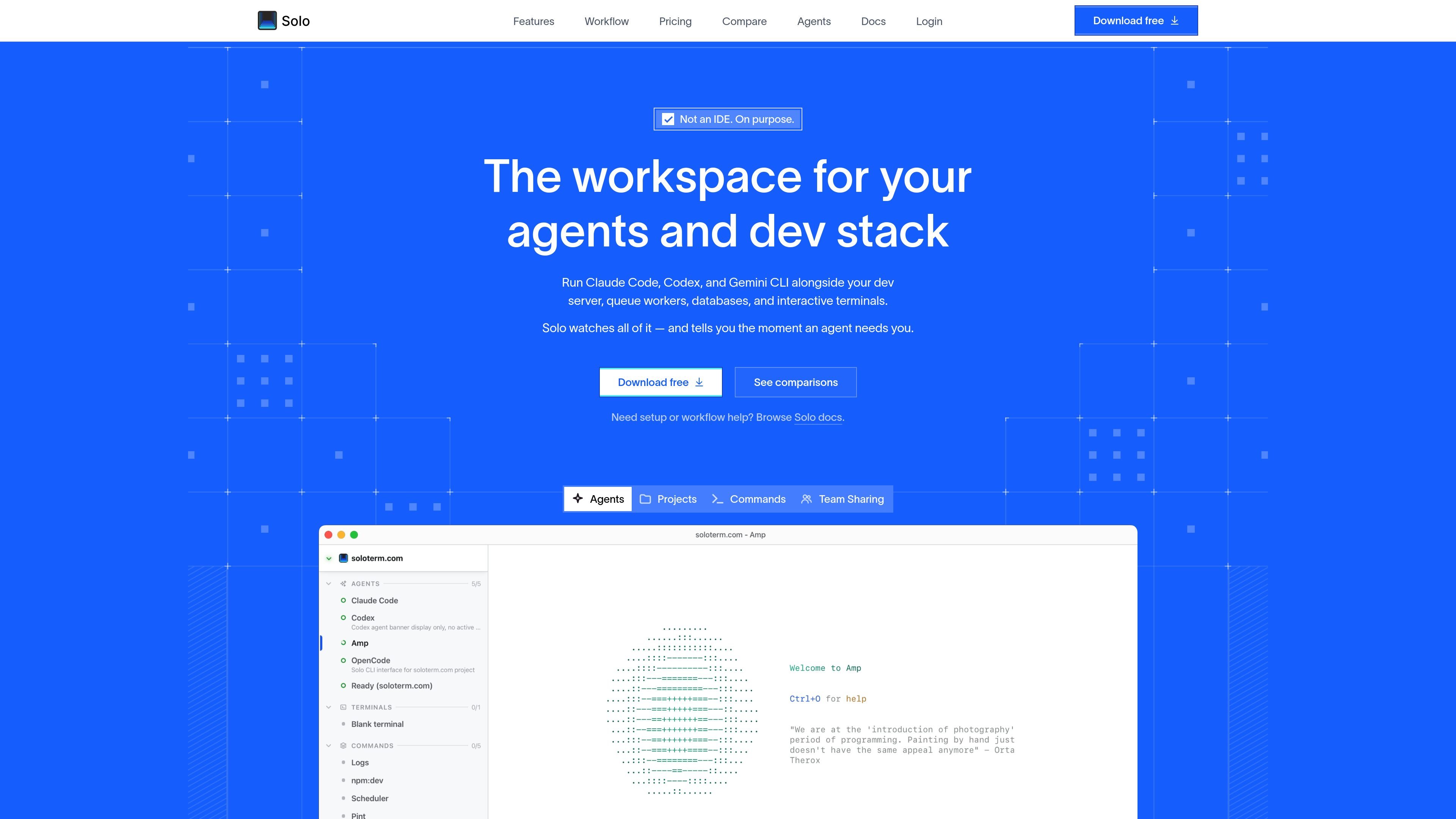
Solo is a desktop workspace for running AI coding agents beside the rest of a local development stack. It is designed for developers who keep multiple terminals open and need a single place to watch agents, dev servers, queue workers, databases, and interactive shells.
The product centers on process visibility and coordination. Solo can auto-start a stack, restart crashed processes, surface logs and status in a dashboard, and expose workspace controls through MCP so agents can read output, coordinate through shared notes and tasks, and ask for help when they need it.
The site positions Solo as a lightweight companion to the editor rather than a new IDE. It supports several CLI-based agents, emphasizes shared team setup through `solo.yml`, and focuses on the terminal workflows around agentic development instead of code editing itself.
Run your agents and local services in one workspace, so you can start and stop the stack without opening separate terminals for each process.
Solo can notice crashed services and restart them automatically, including workflows where file changes should trigger process restarts.
A single dashboard shows whether processes are running or crashed, and whether an agent is working or waiting on input.
Solo speaks MCP, giving agents access to logs, process state, restart actions, shared todos, scratchpads, locks, and timers.
The source describes support for Claude Code, Codex, Gemini CLI, Amp, OpenCode, and Copilot CLI, without locking users into one model or vendor.
Solo is built with Tauri and described as a small native terminal workspace with GPU-accelerated rendering, ANSI support, clickable links, and port handling.
Keep Claude Code, Codex, Gemini CLI, or other terminal agents running next to the services they depend on, so you can see when the stack changes state.
Monitor dev servers and queue workers from one place, with auto-restart and clear crash status when a process drops out unexpectedly.
Standardize a repository’s workflow with `solo.yml` so new teammates can start the same agents and commands without guessing at setup.
Coordinate multiple agents on one codebase using shared todos, scratchpads, locks, and timers to reduce collisions and handoff friction.
Interact directly with running processes and agents from the terminal workspace, including typing into a shell, opening a debugger, or reading output without switching apps.
Solo is a desktop workspace for running CLI agents alongside your dev server, queue workers, databases, and interactive terminals. It adds process visibility, auto-restart, and MCP-based access to logs and workspace controls.
The source says Solo works with Claude Code, Codex, Gemini CLI, Amp, OpenCode, and Copilot CLI — described as anything that runs in a terminal.
Solo can automatically start your stack, restart crashed processes, and expose process state through MCP so agents can inspect output and react to failures.
The source positions Solo as a lightweight native workspace built with Tauri. It is not presented as a full IDE replacement, and your editor remains separate.
The site mentions team usage through a shared `solo.yml`, which lets a team standardize which agents to run and how the project should start.