
Infrastructure across environments
Configure GPU cloud backends, Kubernetes clusters, or SSH-accessible on-premises hosts, and manage compute through a common control plane.

A control plane for provisioning and orchestrating GPU workloads across cloud, Kubernetes, and on-prem infrastructure.
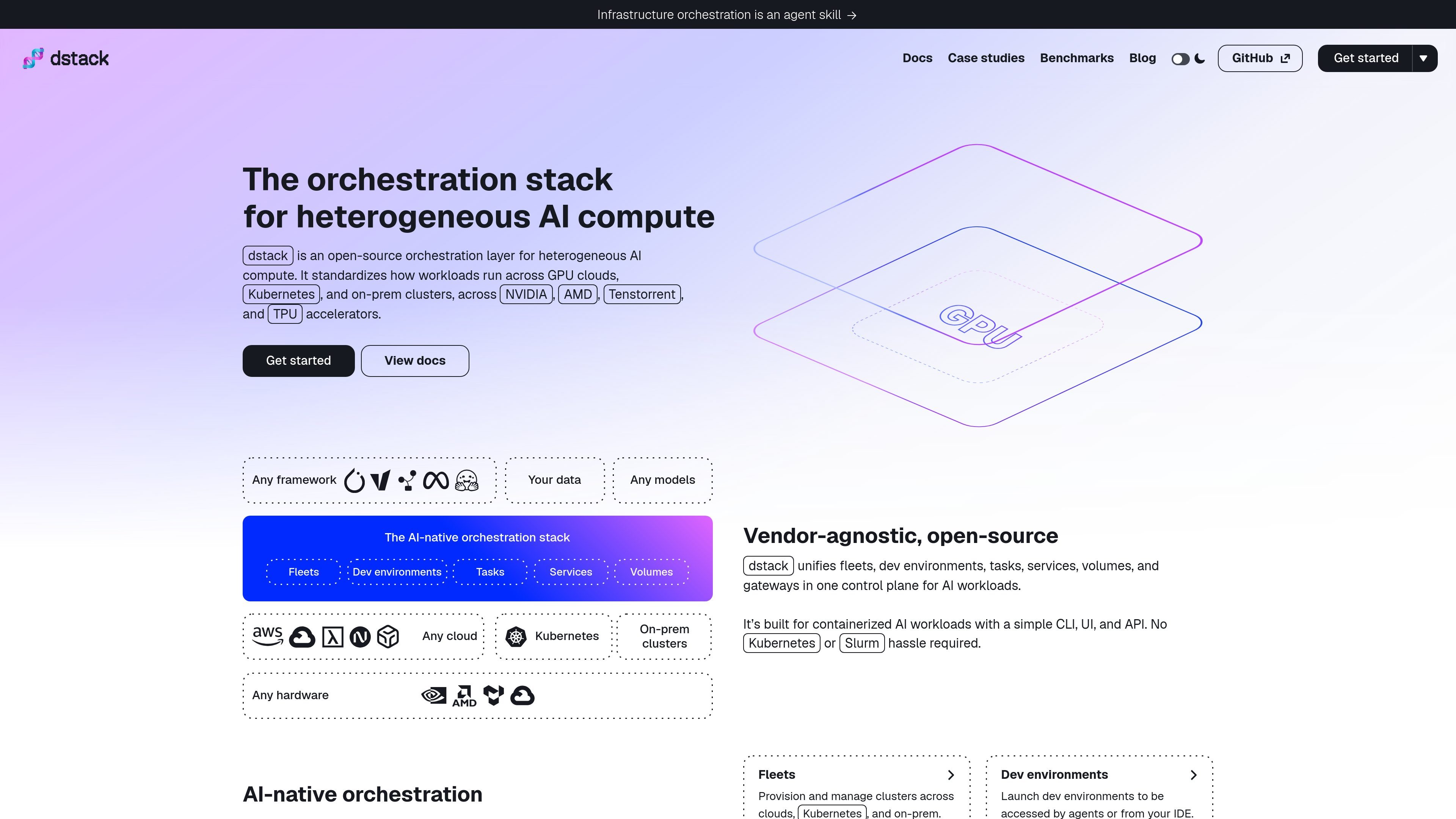
dstack is a unified control plane for provisioning and orchestrating GPU compute across GPU cloud providers, Kubernetes, and on-premises clusters. It coordinates infrastructure with AI development, training, and inference workflows, and supports NVIDIA, AMD, Google Cloud TPU, and Tenstorrent accelerators.
Users describe fleets and workloads in YAML configuration files stored with their project, then apply them through the dstack CLI or programmatic API. dstack handles infrastructure provisioning and job scheduling, with related capabilities including autoscaling, port forwarding, and ingress. The documented workload types include remote development environments, tasks for training or batch processing, and services that expose models or web applications as endpoints.
Configure GPU cloud backends, Kubernetes clusters, or SSH-accessible on-premises hosts, and manage compute through a common control plane.
Define fleets, development environments, tasks, and services in YAML files, then apply them with the CLI or programmatic API.
dstack provisions infrastructure and schedules submitted workloads. Fleets can be configured with node and GPU ranges, including templates that defer instance provisioning until runs are submitted.
Tasks can run across clusters by specifying nodes or node groups; fleet placement can also be configured for cluster use.
Deploy models or web applications as services. Service replicas can be configured behind a single endpoint.
The documentation lists out-of-the-box support for NVIDIA, AMD, Google Cloud TPU, and Tenstorrent accelerators.
Create a development environment on provisioned compute and connect using a desktop IDE such as VS Code or through SSH.
Submit command-based tasks for model training, batch processing, or other jobs, with configurations for single-node or multi-node execution.
Package a service configuration with its command, port, model identifier where applicable, and resource requirements to deploy an endpoint.
Register SSH-accessible servers as a fleet so workloads can use existing hosts that meet dstack's stated host requirements.
The documentation describes GPU cloud providers, Kubernetes, and on-premises clusters. On-prem hosts can be configured through SSH fleets, subject to the documented host requirements.
Define a workload configuration, commonly as a YAML file, and apply it with the `dstack apply` CLI command. The documentation also describes a programmatic API.
The documented configuration types include development environments, tasks, and services. Fleets define and manage pools of compute instances.
Yes. The quickstart says tasks can run on a cluster by specifying `nodes` or defining multiple node groups.
The documentation says users can install the dstack server or sign up for dstack Sky.
流量数据仅供参考。

ubiops.com
Model serving and orchestration for AI teams deploying workloads across cloud and private infrastructure.

cerebrium.ai
Serverless CPU and GPU infrastructure for teams deploying real-time AI workloads.

nebius.com
Nebius AI Cloud 是一个专为开发、训练和部署 AI 工作负载打造的云平台,整合 GPU 与 CPU 计算、托管 Kubernetes、MLOps 工具,以及托管式或无服务器推理服务,助力团队从实验扩展到生产环境。

huddle01.com
Huddle01 Cloud 面向开发者和应用团队,支持部署虚拟机、容器、Kubernetes 集群及 GPU 工作负载,并通过兼容 OpenAI 的接口调用多家供应商支持的模型。