
Coding agents across the SDLC
Factory positions Droids as coding agents that can automate software development work, with claims spanning coding, testing, deployment, and supporting stages in the SDLC.

Factory is an agent-native software development platform that uses AI coding agents called Droids to automate work across coding, testing, deployment, and related SDLC tasks. It supports desktop, web, CLI, and SDK surfaces for individuals, teams, and enterprises.
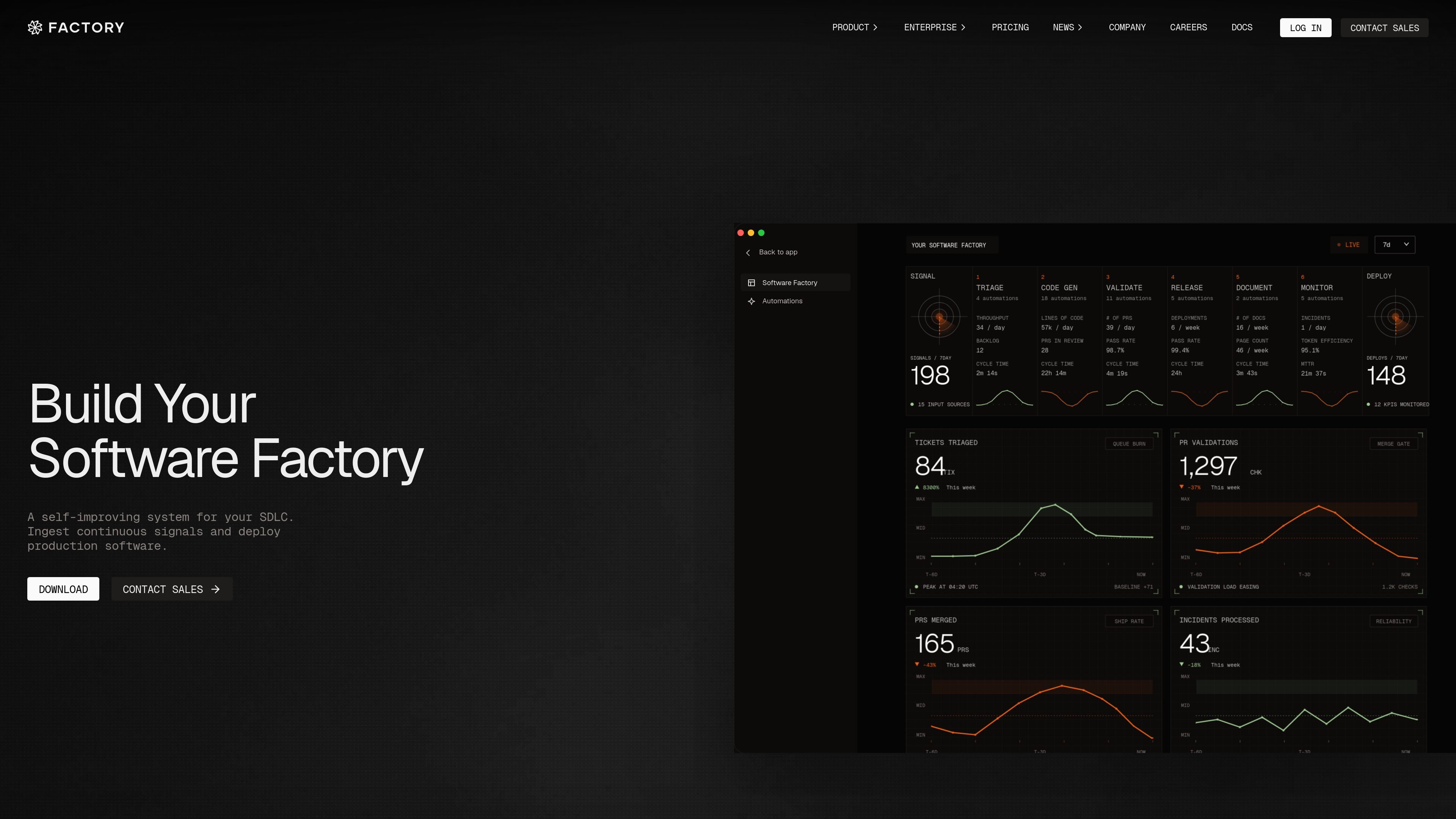
Factory is an agent-native software development platform built around coding agents called Droids. The product is meant to automate work across the software delivery lifecycle, including coding, testing, deployment, documentation, monitoring, and related workflow steps.
The website presents Factory as a way to build faster with AI coding agents while keeping context, state, and control across desktop, web, CLI, and IDE surfaces. It includes a desktop app for managing sessions, a pricing model for individuals, teams, and enterprises, and deployment options that range from managed cloud use to on-premise and air-gapped environments.
Factory positions Droids as coding agents that can automate software development work, with claims spanning coding, testing, deployment, and supporting stages in the SDLC.
The desktop app lets Droids control desktop applications, browsers, terminals, and more, so they can move between tools instead of staying confined to one interface.
Sessions can persist across desktop, web, CLI, and IDE, letting teams keep context while moving between devices and surfaces.
Factory supports Desktop, CLI, and SDK access on the Pro plan, and the desktop app page describes a native app for macOS, Linux, and Windows.
The pricing page describes cloud and local background agents, while the desktop app page adds persistent cloud computers and BYO machine support for Droid runtimes.
Teams and Enterprise plans add admin, identity, and deployment controls such as SSO, SAML/SCIM provisioning, audit logs, and on-premise deployment options.
Teams can delegate coding, testing, and deployment work to Droids while keeping humans in the loop for review and direction.
Developers can launch sessions in the desktop app, move between editor, browser, and terminal, and keep the same agent context while working.
Organizations with security or governance requirements can use the team and enterprise plans for identity controls, audit logs, and deployment options.
Engineers can run Droids with cloud computers, local execution, or their own hardware depending on their setup and environment constraints.
Product and operations teams can use the agent platform to generate documents, track ongoing work, and monitor deployment or incident-related signals across the SDLC.
Factory supports leading frontier and open-weight models, including GPT-5, Claude Opus and Sonnet, Gemini, and more. The pricing page says the full list is available from Factory’s model documentation.
The source pages do not spell out code ownership terms. If that is important for your team, Factory’s contact and enterprise sales flow is the right place to confirm it before adoption.
The source does not state a detailed policy for customer-owned API keys. Factory does show plan tiers and enterprise sales options, so key-management questions are best confirmed directly with the team.
The pricing page says Factory uses rolling rate limits and that plans include usage and billing tracking. If you exceed plan limits, you should expect limits to apply until capacity is increased or a higher plan is chosen.
Factory’s pricing page lists Pro, Plus, Max, Teams, and Enterprise. Pro includes the core agent experience, Plus and Max add higher usage and cloud-computer access, Teams adds admin and identity features, and Enterprise adds deployment and control options.