
Isolated Postgres projects
Each project receives its own Postgres database and compute, alongside Realtime and Storage, rather than sharing a logical database. The database supports SQL and row-level security.

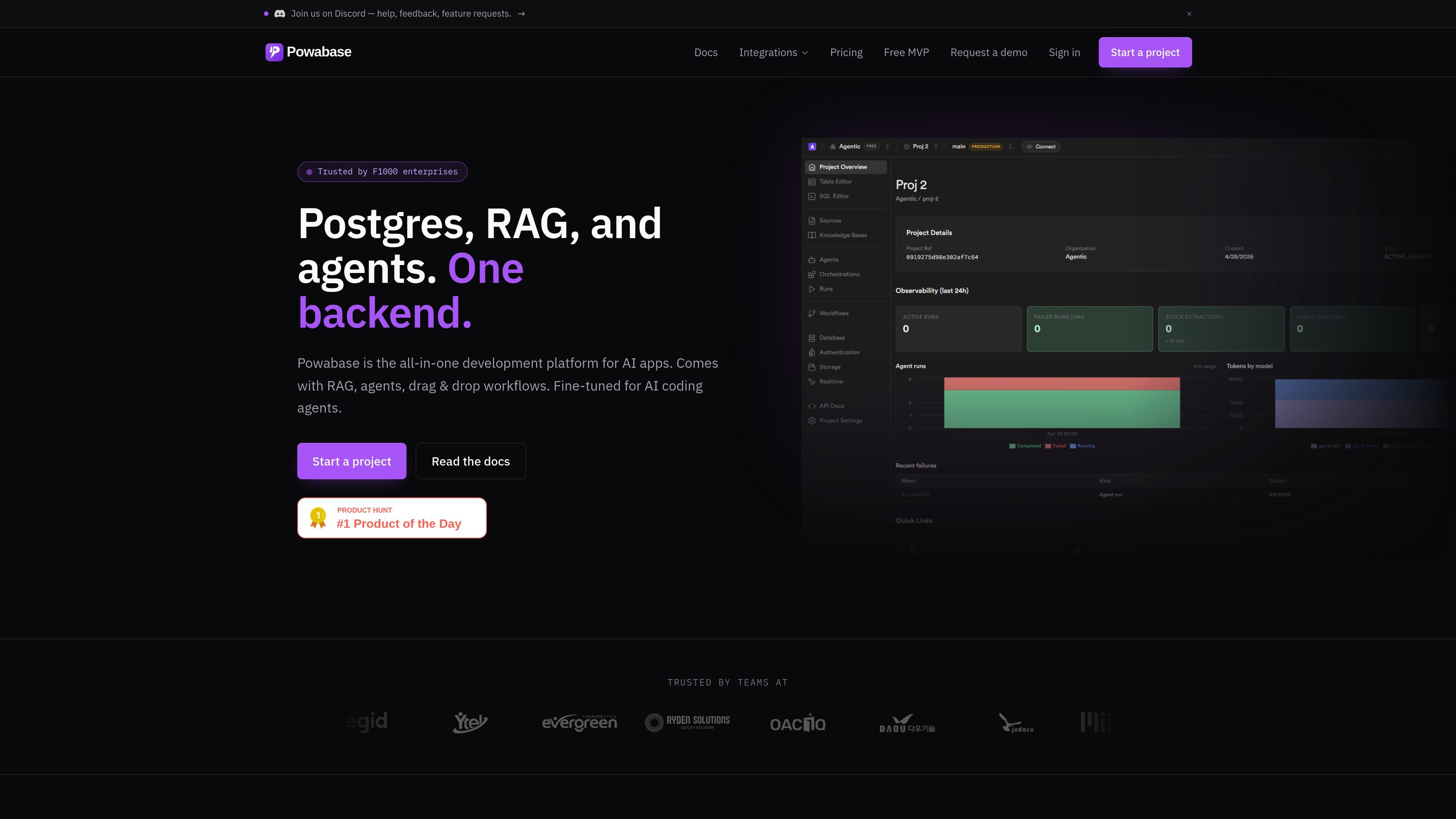
A Postgres backend for AI applications with built-in retrieval, agents, auth, and storage.
Powabase is a backend-as-a-service for AI applications built around a dedicated Postgres stack for each project. It combines database access, authentication, object storage, and realtime services with document ingestion, retrieval, agent execution, and workflows. Applications can use its REST API or connect directly to Postgres. Teams can run the open-source stack on their own infrastructure or use Powabase Cloud for managed provisioning, backups, updates, and scaling.
Each project receives its own Postgres database and compute, alongside Realtime and Storage, rather than sharing a logical database. The database supports SQL and row-level security.
Upload PDFs, images, office files, or URLs for extraction, chunking, embedding, and indexing. Search options include pgvector, BM25, hybrid retrieval, and reranking.
Create agents and multi-agent orchestrations that use knowledge bases and tools over HTTP or MCP. Runs can stream over SSE; sessions are stored in the project's Postgres, with human approval available for sensitive tool calls.
Compose multi-step flows from triggers, conditions, agents, HTTP calls, and code. A natural-language copilot can help design a workflow, which can be deployed as an HTTP endpoint.
Use authentication, object storage, and realtime alongside PostgREST, a REST API, or a direct database connection. Powabase also exposes a GraphQL-style API.
Use managed cloud projects with provisioning, backups, updates, and scaling, or run the Apache-2.0 single-project stack with Docker Compose on your own infrastructure.
Ingest product manuals, policies, or other source files and let an application retrieve relevant passages from its project knowledge base when responding to user questions.
Run a support agent against product documentation, connect it to internal services through HTTP or MCP tools, and stream its responses to a website.
Connect tools such as Claude Code, Codex, Replit, Lovable, or v0 through the agent skill, REST API, or auth guide, then use Powabase for the generated application's backend.
Combine agents, conditions, triggers, HTTP requests, and code in a workflow, then expose the deployed flow through an HTTP endpoint.
Run the open-source stack on local or private infrastructure when a team wants to operate its own Postgres-based backend rather than use managed cloud hosting.
Yes. The Apache-2.0 edition runs as a single-project stack with Docker Compose and does not require a control plane or account. Enterprise options also include private hosting in a VPC or on-premises.
Projects expose a REST API. Server-side calls to the /api/* surface use the Service Role (Secret) Key; client-side calls can use the Anon key and are subject to row-level security. Direct database connections are also supported.
Yes. The pricing page lists keys for OpenAI, Anthropic, Google, and OpenRouter. Keys are stored per project and encrypted at rest. The cloud service also offers inference billed against Powabase credits.
Powabase Cloud provisions projects and handles backups, updates, and scaling. Each project runs on its own isolated stack; paid plans include monthly credits that can be applied to usage.
Powabase is centered on relational data and SQL with Postgres, and includes document ingestion, retrieval, and an agent runtime. Firebase centers on Firestore and has strong mobile SDKs; the source recommends it for mobile-first apps built around Firestore and Google's SDKs.
Traffic data is for reference only.

pages.edgeone.ai
EdgeOne Makers deploys web apps and AI agents on Tencent EdgeOne, combining hosting, functions, storage, runtime, sandbox tools, memory, observability, and built-in models.

www.agentops.ai
AgentOps is a developer platform for building, tracing, debugging, and deploying AI agents and LLM applications. It provides observability for agents built with OpenAI, CrewAI, AutoGen, and more than 400 LLMs and frameworks.

www.cognee.ai
Cognee is an open-source memory platform for AI agents and applications. It connects data across sources, builds connected memory using vector, graph, and relational storage, and makes that context available through SDK, cloud, or self-hosted deployments.

vercel.com
Managed infrastructure to deploy web applications, run AI agents, and deliver content globally.

permit.io
Permit.io controls what users, services, and AI agents can do across applications and systems, with flexible access models and a free Community tier.

relace.ai
Relace is an AI model and infrastructure platform for coding agents, enabling code retrieval, file merging, and source-control workflows with hosted, on-premise, and VPC-isolated deployment.