
Unified model routing
NavtoAI presents itself as a unified gateway that can route requests across many AI models through a single API pattern.

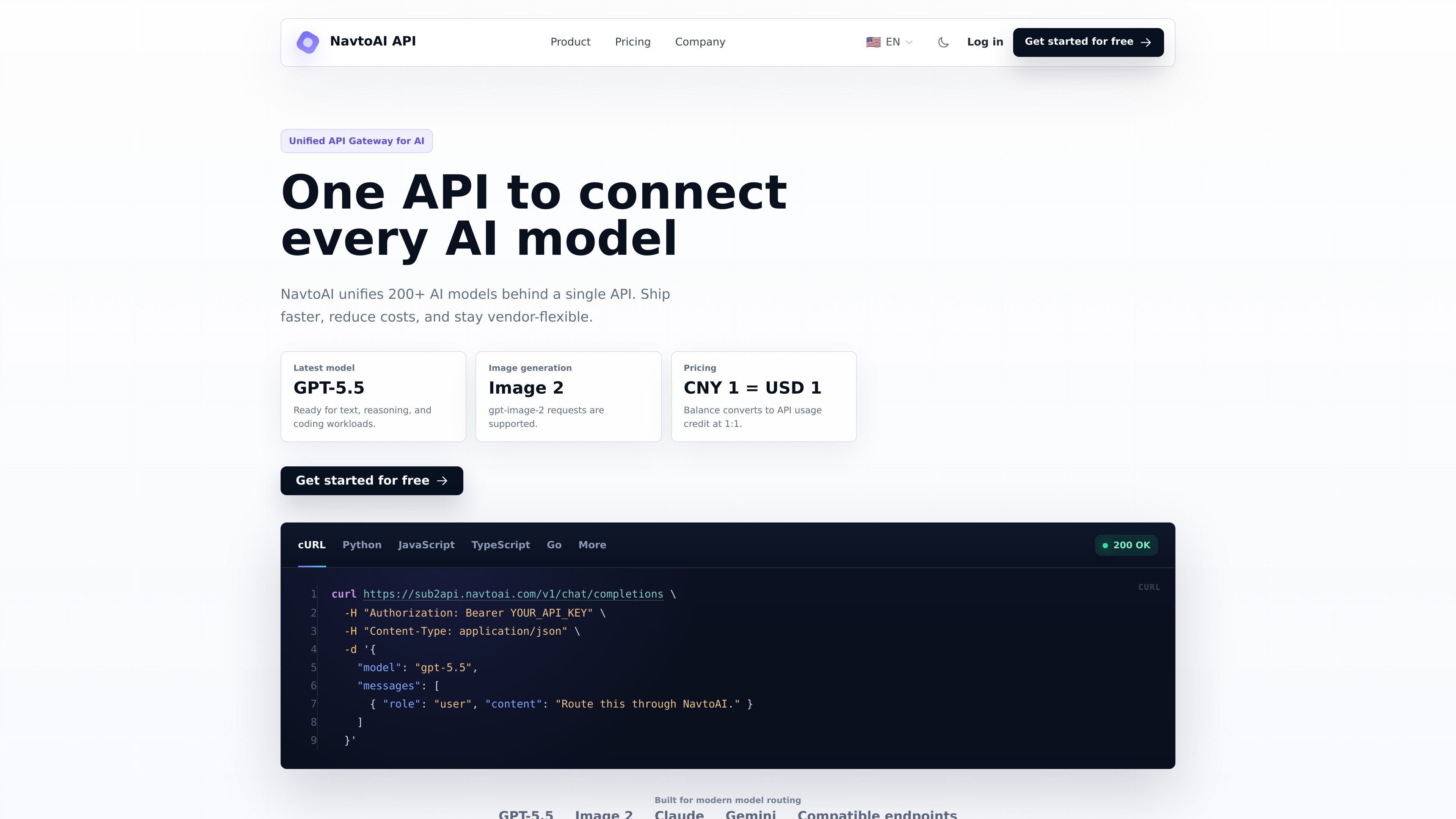
NavtoAI API unifies access to 200+ AI models through one account and API shape, with routing, failover, usage tracking, and centralized team management.
NavtoAI API unifies access to 200+ AI models through one account and API shape, with routing, failover, usage tracking, and centralized team management.
It is aimed at developers and teams that want to route AI traffic without wiring each provider separately. The product emphasizes model routing, key management, quota control, billing, users, and observability from a single console, plus a browser page for checking API key usage.
NavtoAI presents itself as a unified gateway that can route requests across many AI models through a single API pattern.
The home page says the platform supports more than 200 AI models, including examples such as GPT-5.5, Claude, and Gemini.
A chat completions example on the home page shows a familiar API-key workflow for sending requests to `v1/chat/completions`.
The page describes smart routing for failover and traffic balancing without changing every client integration.
The product positions itself as a place to manage keys, quota, billing, users, and observability from one console.
The key usage page exposes a browser-based lookup for real-time spending and usage status tied to an entered API key.
Use one API integration to send requests across multiple model families instead of maintaining separate provider-specific clients.
Route traffic and enable failover when you want a single front door for AI requests but need resilience across models or providers.
Check how much a given API key is spending or using in real time from the key usage page.
Use the console to manage operational settings such as keys, quota, billing, users, and observability for a shared AI API setup.
Run text, reasoning, coding, or image-generation requests through a consistent request pattern such as `v1/chat/completions`.
NavtoAI API is a unified AI API gateway that lets you send requests through one API shape and route them to supported models behind the scenes.
The rendered home page shows a `v1/chat/completions` example using an API key and a model name such as `gpt-5.5`, which suggests a standard API-key-based workflow for chat and routing requests.
The source confirms support for 200+ AI models, including text, reasoning, coding, and image-generation requests such as `gpt-image-2`. It does not provide a full public list of endpoints or providers on the pages collected here.
The pricing page content shows a login form rather than public plan details, so the collected sources do not expose plan names, quotas, or per-model prices.
The key usage page says an API key can be entered to view real-time spending and usage status, and notes that the key is processed locally in the browser and not stored.
Traffic data is for reference only.

openrouter.ai
OpenRouter gives teams one API for hundreds of AI models, with routing, fallback, OpenAI-compatible access, SDKs, prompt caching, and usage controls.

easyrouter.io
EasyRouter is an AI model gateway that unifies access to third-party model APIs through one interface, with standard formats and usage-based billing.

litellm.ai
LiteLLM is an LLM gateway and OpenAI proxy for managing authentication, load balancing, spend tracking, and access across 100+ LLMs through one OpenAI-compatible layer.

grsai.ai
Grsai aggregates image, video, and chat AI models through documented APIs, with credit-based billing examples and onboarding via account and API key setup.

www.experientiallabs.ai
Experiential Labs is an open-source AI gateway that gives teams one endpoint and API key for hosted models, customer-owned keys, and local or custom models. It adds routing, budgets, access control, attribution, and optional intelligence features for agent traffic.

alphaproxy.ai
AlphaProxy is an OpenAI-compatible gateway for routing requests across 450+ models and 100+ providers, with an agent runtime for multi-step work and scheduled workflows—one endpoint for model access, connected tools, and verifiable outputs.