
OpenAI-compatible gateway endpoint
Exposes a single `/v1` endpoint with streaming support so existing clients can connect without changing their basic API shape.

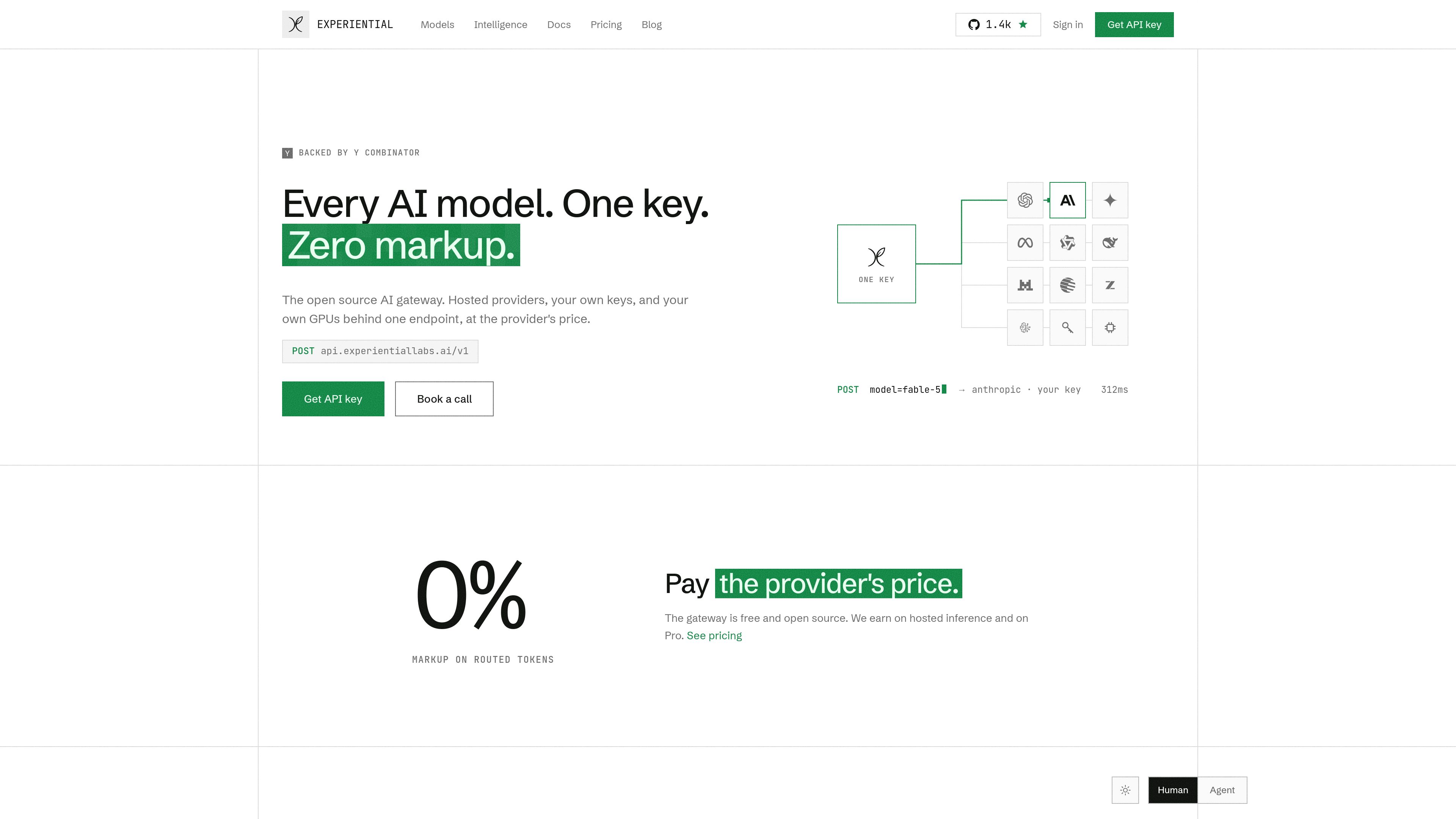
Experiential Labs is an open-source AI gateway that gives teams one endpoint and API key for hosted models, customer-owned keys, and local or custom models. It adds routing, budgets, access control, attribution, and optional intelligence features for agent traffic.
Experiential Labs is an open source AI gateway for routing model traffic through one OpenAI-compatible endpoint. It lets teams point agents and applications at a single API while using hosted providers, their own provider keys, or local and custom models behind the same interface.
The product is designed to centralize key management, usage controls, and attribution across model calls. Its core gateway is free and open source to self-host, while the hosted service adds managed routing, org controls, and an intelligence layer that can suggest cheaper or faster routes, improve cache hit rate, and support a model trained on a team’s traffic.
Exposes a single `/v1` endpoint with streaming support so existing clients can connect without changing their basic API shape.
Routes requests across hosted providers, cloud hosts, pooled accounts, customer keys, and local models, with failover on capacity or provider errors.
Enforces hard caps, model allowlists, and request-level policies at the gateway so limits apply on every call.
Provides logs and dashboards for spend, requests, token counts, TTFT, and usage broken down by agent, person, model, or day.
Supports bringing your own provider keys and, on higher plans, routing to local and custom models through the same endpoint.
Offers per-prompt model optimization, caching suggestions, prompt compression guidance, and an opt-in model trained on the team’s traffic.
Teams that use multiple model providers can give agents and developers one endpoint, one login, and one place to manage keys and policies.
Admins can set caps, route by budget, and inspect usage by key, person, agent, or day to understand where costs are coming from.
Product and engineering teams can use the intelligence layer to route simple prompts to cheaper models and harder prompts to stronger ones.
Organizations that want to run the gateway on their own infrastructure can self-host the open source core and route to local models behind the same API.
Teams that need recordkeeping can review request logs with route, token, fallback, and cost data for individual calls.
Pricing is credit-based. Routed tokens spend credits at the provider’s list price with no markup, and intelligence features also consume credits. The site offers a Free plan, a Pro plan, and Enterprise with custom committed credits.
Yes. The site says BYOK is supported, and routed traffic can use your own provider keys first.
Yes. The core gateway is open source and can be run on your own infrastructure.
Yes. The site mentions budgets, allowlists, RBAC, org-wide policies, and API key management.
It can suggest optimal model routing, identify caching opportunities, and support an opt-in model trained on your traffic.
Traffic data is for reference only.

apipark.com
APIPark is an open-source API portal and AI gateway for managing production APIs and LLMs with multi-model access, traffic control, and observability.

alphaproxy.ai
AlphaProxy is an OpenAI-compatible gateway for routing requests across 450+ models and 100+ providers, with an agent runtime for multi-step work and scheduled workflows—one endpoint for model access, connected tools, and verifiable outputs.

openrouter.ai
OpenRouter gives teams one API for hundreds of AI models, with routing, fallback, OpenAI-compatible access, SDKs, prompt caching, and usage controls.

ai21.com
Access foundation-model APIs and optimize AI-agent traffic with a beta gateway. AI21 also offers dedicated-model work for enterprise workloads.

skillsmp.com
SkillsMP is a free marketplace for discovering open-source agent skills from public GitHub repositories, with search, browsing, REST API, and MCP access for Claude Code, Codex CLI, and ChatGPT.
superqode.dev
SuperQode is an open-source harness layer for coding agents that lets users discover, build, run, evaluate, and optimize agent harnesses from a single terminal. It supports interoperability across A2A, ACP, MCP, and UHP, so teams can keep using their existing coding agents and models.