
Unified OpenAI-compatible endpoint
Applications can use an AlphaProxy base URL and the model value "auto" or a supported model name instead of maintaining separate provider integrations.

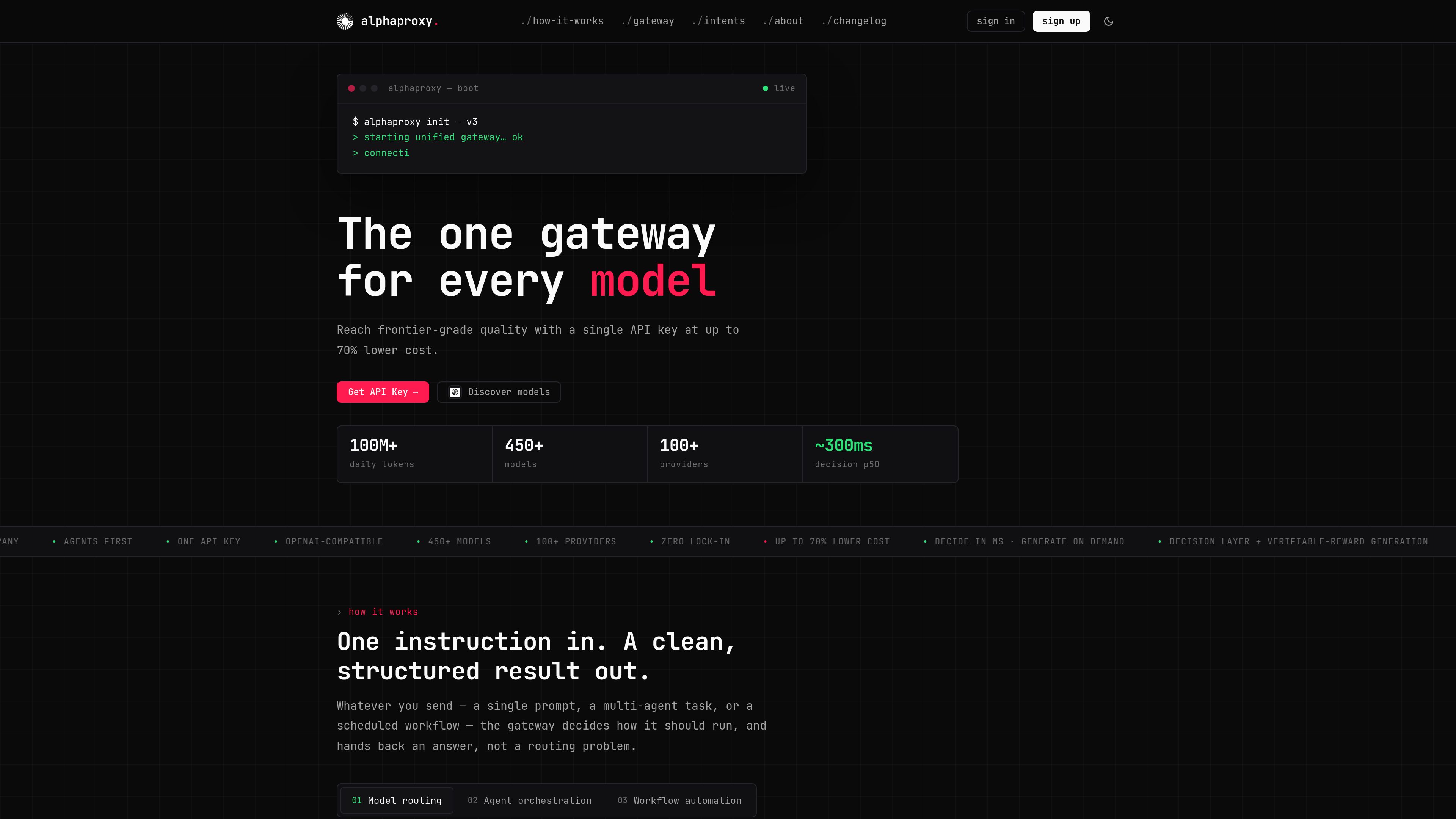
AlphaProxy is an OpenAI-compatible gateway for routing requests across 450+ models and 100+ providers, with an agent runtime for multi-step work and scheduled workflows—one endpoint for model access, connected tools, and verifiable outputs.
AlphaProxy is an OpenAI-compatible gateway that provides one API key and endpoint for access to 450+ models from 100+ providers. It routes requests according to task requirements such as quality, latency, cost, model capability, host health, and fallback availability.
Beyond model access, AlphaProxy runs multi-step agent tasks and scheduled workflows. Its decision layer classifies requests before generation, while the runtime can coordinate tools, sandboxes, files, browsers, connected sources, and verification checks for work that needs more than a single model response.
Applications can use an AlphaProxy base URL and the model value "auto" or a supported model name instead of maintaining separate provider integrations.
The decision layer classifies each request and selects a model, provider host, and fallback chain per call. Routing can account for quality, cost, latency, and provider health.
Requests are evaluated before generation for concerns such as safety, routing, memory, artifact intent, delegation, completion, and sandbox preparation. The site reports typical decision latency of about 300ms and zero generated tokens for this step.
Complex tasks can be divided among ephemeral specialist agents that run in parallel with isolated sandboxes, shared context, and task-appropriate models. A completion gate checks the merged result before delivery.
Users can describe recurring work and attach schedules, connected sources, guardrails, budget caps, retry policies, delivery destinations, and per-run logs.
The platform supports agent-ready work involving browsers, files, sandboxes, and connected tools. Changelog material also documents model discovery, skills preparation, file processing, and generated report, sheet, slide, and app outputs.
Ask the runtime to compare competitors or build a market map. The documented examples describe specialist research, analysis, sourced materials, and deliverables such as reports or spreadsheets.
An agent workflow can inspect a repository, reproduce a regression in a sandbox, propose or create a fix, and use completion checks such as tests or CI status before reporting the result.
Users can describe a larger goal, such as specifying a token model and preparing a testnet, then let the runtime plan sequential steps involving research, coding, browser access, and verification.
A scheduled workflow can combine information from connected documents and spreadsheets, produce a weekly report or presentation, deliver it through email or Slack, and retain a run trace with cost and model status.
Teams can compare many models against an evaluation set and use routing or pinned model controls to select an option that meets their quality and cost requirements.
AlphaProxy presents an OpenAI-compatible endpoint. The site shows replacing a provider base URL with the AlphaProxy API base URL and using "auto" or a model name, so existing OpenAI-compatible integrations can be adapted without changing the core application flow.
No. Every request first passes through a non-generative decision layer that classifies, scores, and routes it. Generation is used when a produced artifact or response is required; the site reports about 300ms typical decision latency and zero generated tokens for that decision step.
Yes. The documented runtime can create ephemeral specialist agents, run independent work in parallel, provide isolated sandboxes and shared context, and check the merged result before delivery.
Yes. The site describes durable scheduled jobs with connected sources, model policies, guardrails, budget caps, retry policies, delivery destinations, and per-run logs. A weekly report assembled from documents and spreadsheets is given as an example.
No pricing tiers, rates, usage limits, or billing terms are provided in the supplied product pages. The pricing URL returned a not-found page, so prospective users would need current product information from AlphaProxy.
Traffic data is for reference only.

weaveos.com
Weave Router is an intelligent model router for coding agents. It evaluates coding tasks and routes requests across open and closed models, helping developers keep existing agent workflows while managing speed, quality, and model spend.

www.experientiallabs.ai
Experiential Labs is an open-source AI gateway that gives teams one endpoint and API key for hosted models, customer-owned keys, and local or custom models. It adds routing, budgets, access control, attribution, and optional intelligence features for agent traffic.

twigg.ai
Twigg is a stateful API for building LLM applications, with hosted conversation storage, context assembly, compaction, and model routing. Send only the next event, preserve chats across requests, and switch models or providers without moving conversations into vendor-specific threads.

openrouter.ai
OpenRouter gives teams one API for hundreds of AI models, with routing, fallback, OpenAI-compatible access, SDKs, prompt caching, and usage controls.

litellm.ai
LiteLLM is an LLM gateway and OpenAI proxy for managing authentication, load balancing, spend tracking, and access across 100+ LLMs through one OpenAI-compatible layer.

omlx.ai
oMLX is a native macOS LLM inference server built on MLX for running compatible language, vision-language, embedding, and reranker models locally on Apple Silicon. Designed for coding-agent workflows, it works with Claude Code, OpenClaw, Cursor, and OpenAI-compatible clients.